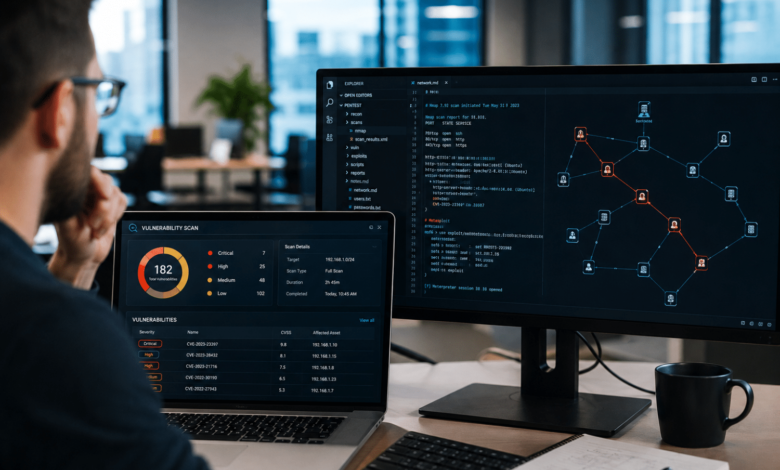
Companies today face the challenge of continually protecting their IT systems against cyber attacks. The question often arises:
Is a vulnerability scan sufficient or is a pentest required?
The short answer: Both procedures have their place – but they pursue different goals. If you want to sustainably improve your IT security, you should know the differences and make targeted use of the respective strengths.

What is a vulnerability scan?
A vulnerability scan is an automated security check. Special tools scan systems, applications or networks for known vulnerabilities, misconfigurations and outdated software versions.
The advantages:
- Automated execution
- Fast results
- Regular repetition possible
- High coverage of large IT environments
- Early detection of known vulnerabilities
A vulnerability scan is particularly suitable for continuous monitoring of the IT landscape and provides a good overview of potential security problems.
However, a scan only shows that a vulnerability exists – not whether it is actually exploitable or what impact it would have on the company.

What is a pen test?
A penetration test (pentest) goes one step further.
Here, experienced security experts manually check how a real attacker would proceed.
The aim is to actively exploit vulnerabilities and recreate possible attack routes.
This makes it possible to answer questions such as:
- Which vulnerabilities are actually critical?
- How far into the environment could an attacker penetrate?
- Which systems or data would be affected?
- What combinations of vulnerabilities make an attack possible?
A pen test not only provides technical insights, but also assesses the actual risk for the company.
Why a scan alone is often not enough
In practice, successful attacks rarely arise from a single vulnerability.
There are often several factors that combine to make an attack possible:
- Outdated user accounts
- Permissions too broad
- Lack of network segmentation
- Insecure external interfaces
A vulnerability scan detects individual technical vulnerabilities. However, it is often only a pen test that shows whether this results in a real attack path.
The best solution: combine both approaches
From a safety and economic perspective, the combination of both processes makes particular sense. Vulnerability scans and pentests pursue different goals and that is precisely why they complement each other.
While vulnerability scans help to continuously identify known vulnerabilities, a pentest looks at the IT environment from the perspective of an attacker and assesses what risks can actually arise.
This not only gives companies an overview of potential vulnerabilities, but also an assessment of their actual relevance. This creates a much more complete picture of the security situation than using a single procedure.

Conclusion
IT security cannot be reduced to a single measure. Anyone who relies exclusively on automated checks will get a good overview of known vulnerabilities. However, if you really want to understand and prioritize risks, you also need the perspective of an attacker.
The question is therefore not whether a vulnerability scan or a pentest is the better choice. What is crucial is how both procedures can be used sensibly in order to identify risks at an early stage and make well-founded decisions for your own security strategy.