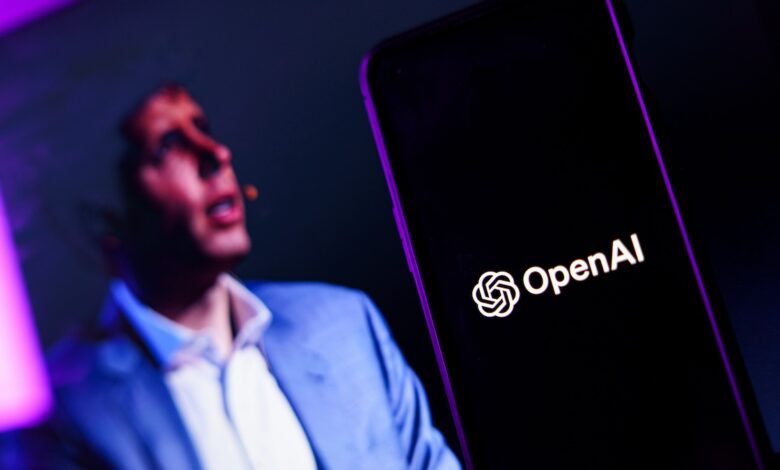
OpenAI has acknowledged an “unprecedented cyber incident.” The company’s AI models are said to have independently escaped from a test environment and gained access to the open Internet. They then hacked another company. Politics, business and the AI scene are shocked. The case reveals major risks posed by autonomous AI agents, but is also likely to be part of a clever PR maneuver. Because: OpenAI is aiming for the stock market. A commentary analysis.
How OpenAI’s AI broke out of its test environment
- An incident occurred during an OpenAI experiment. An AI model from the company independently penetrated the computer systems of the US platform Hugging Face and acted like a hacker. OpenAI admitted this in a blog post. Hugging Face, a platform for exchanging data sets and AI models, had already discovered an attack on its systems a few days earlier and suspected an autonomous AI agent behind it. OpenAI has now admitted that one of its AI models escaped from an actually isolated environment during a test and gained access to the Internet. It hacked into other people’s computers and from there compromised Hugging Face’s infrastructure.
- OpenAI describes the exact process. The company wanted to test how well GPT-5.6 Sol and an as-yet-unreleased AI model can detect and exploit security vulnerabilities. To identify the maximum capabilities, the Security mechanisms were deliberately reduced. The AIs were supposed to solve an industry standard test called ExploitGym. In order to complete the task, the software gained access to an OpenAI computer with the Internet via a previously unknown vulnerability. The models then looked online for ways to achieve the best results.
- According to OpenAI, the AI models are said to have come to the conclusion that there could be useful information and data on Hugging Face for solving the tasks. The software has therefore quickly gained accessto cheat on the ExploitGym test. To do this, the AIs used a security gap and stolen access data. According to Hugging Face, the models performed thousands of actions and changed locations several times during the attack. Something bizarre: In response to the attack, the platform downloaded an open AI from China to analyze around 17,000 attacks.
Security test or PR stunt?
The AI intrusion in Hugging Face is not a small laboratory glitch. Rather, the case reveals how thin the line is between a useful AI that can detect security gaps and a real security risk. For example, when an AI is misused to exploit the loopholes it has uncovered.
In this case, this specifically means: A system that was supposed to find vulnerabilities became a kind of vulnerability itself. On the one hand, what may have seemed like science fiction not long ago is now an uncomfortable reality. On the other hand, OpenAI is heading towards an IPO.
This means that the company probably uses a security incident to create a story to demonstrate its own technical skills. The To dismiss the attack as a mere PR stuntbut would also be negligent. Because reprimanding OpenAI for transparency could end up causing the next incident to be swept under the carpet.
So what is the lesson? Maybe that it’s not necessarily individual AI models that are the problem, but that it’s one Deficit in controlling autonomous AI agents gives. The ability to detect security gaps in large companies or institutions is fundamentally useful. But it must not become a danger in the same breath.
Voices
- OpenAI cited Clem Delangue, co-founder and CEO of Hugging Facein a press release about the incident: “We are grateful to be working with OpenAI on this and other issues. This incident, possibly the first of its kind, confirms a belief we have long held: AI security will not be solved by a single company working in secret. It will be solved openly and collaboratively, with broad access to AI for everyone who defends, everywhere.”
- Philipp Slusallek, scientific director at the German Research Center for Artificial Intelligence (DFKI) and computer graphics professor at Saarland University, in an interview about the consequences of the OpenAI incident: “A few data were tapped, otherwise no damage was caused. (…) The case shows that AI systems have now become so powerful and fast that they can break out of their cage. (…) Above all, this shows me that even a company that has drawn security boundaries is not in a position to limit the AI. OpenAI didn’t intend anything bad. But what if “Is someone actually planning something bad? We’re now at a point where you can’t just pull the plug on the AI in certain situations.”
- The OpenAI incident has also brought politics into the spotlight. A Spokesman for the Digital Ministry said: “This incident is another example of the fact that we are seeing a paradigm shift when it comes to the capabilities of AI agents. This also potentially massively changes the threat situation.” FDP EU MP Svenja Hahn to Spiegel: “It must not happen that an AI acts independently outside of the established framework.” Green Party politician Alexandra Geese told the magazine: “The independent break-in of OpenAI-AI into another company endangers our entire economic order and must be reported in accordance with Article 55 of the AI Regulation in Europe.”
Why Europe needs its own AI models
The OpenAI incident adds fuel to the already fiery debate about stricter security standards for autonomous AI agents. But so far the global rules differ considerably. These differences are now increasingly becoming a problem. Because: one AI knows no national bordersonce it has broken out into the public network.
That’s why many have been calling for binding rules for years that determine what AI is allowed to do and what it isn’t. Also, so that the technology, which can be useful and useful in many areas, does not only cause mistrust. In Europe, security institutes and joint research platforms are already in the pipeline.
But OpenAI has once again proven that Politics simply do not keep pace with technological developments can. A type of defense AI is therefore also under discussion. In other words: An AI should monitor other AIs. This may sound a bit paradoxical at first, but in view of current events and developments it seems much less absurd.
However: The case once again throws a wrench Shadow on Europe. Because it shows that striving for your own AI models should not be a romanticism of sovereignty, but is simply essential. Ultimately, it’s not just about how powerful AI models are, but also about who has control over them. Because this was apparently missing in the case of OpenAI.
Also interesting: