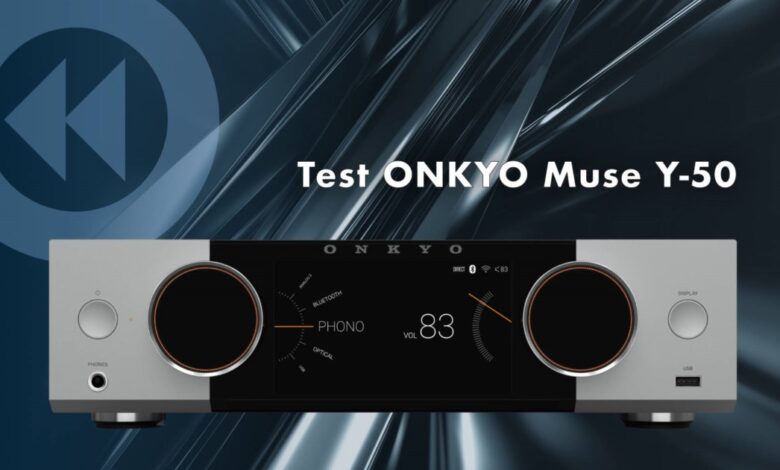


In the best Japanese electronics tradition, Onkyo has brought the Y-50 onto the market, a versatile streaming integrated amplifier that represents an all-round happy solution at a really fair price. The REWIND test.
I still remember my first attempts at network audio streaming in the early 2000s. As someone who, in retrospect, perhaps gave up or gave away his analogue record collection a little too quickly in order to concentrate fully on digital music playback, this gave me an important wealth of experience. But at the cost of numerous frustrating experiences.
| Art | Streaming integrated amplifier |
Short history
A notice: If you want to go directly to the description of the device, please jump to the next page. But a little backstory doesn’t hurt.
Every beginning is difficult. This one too. Initially, in the early days of music streaming and music playback on computers and network devices, the question of data format and compression was still very much in the foreground. The all-dominant MP3 format from the iPod era (and even before that for burning CDs) was important in order to be able to squeeze a lot of music – mostly from silver discs, but sometimes also from rather dubious download sources – onto ridiculously small data storage devices. My first iPod had a 1.8″ mini hard drive with a whopping 5GB, which was pretty decent at the time.
 1st generation iPod with 5 GB hard drive (2001)
I didn’t like the lossy data squeezing at the expense of sound quality back then and I decided around the mid-2000s to create new music, if at all, only in lossless compression. This was a challenge not only because of the expensive storage space, but also because most playback devices could only handle MP3 or – if at all – only completely uncompressed formats such as WAV, which required a particularly large amount of storage space. Lossless compression using FLAC or ALAC only gradually became established, and the storage space problem eventually resolved itself as capacities continued to increase. Just like the bandwidth problem with online activities with music data, which ultimately makes today’s uncomplicated streaming of video and music possible. At least in most regions. As is well known, there are still black spots in the Internet supply.
In the end, despite all my efforts, my music collection was very “mixed” in terms of the quality of the files. From lousy 128 kbit/s MP-3 files that I couldn’t get back in higher quality (or because it wasn’t worth it), to files in Ogg Vorbis, AAC, WMA, RealAudio and what else I didn’t try, everything could be found on the hard drive (now SSD). Later also ALAC as a lossless codec, which could not prevail against FLAC. Most of these formats can still be played by today’s players, but fortunately the need for this has decreased significantly.
 The Roku SoundBridge from 2003 was one of the first audio streamers.
The incomplete metadata of even ripped or downloaded music was also a constant annoyance. I remember with horror how many hours I spent manually adding little JPG images of the covers and title information. However, many albums were very “fragmented” in terms of metadata and thus recognition as a coherent album. Any small typographical error or variation in spelling in the track information resulted in an album not being recognized as a whole.
Dealing with the first network-capable players was also adventurous. In addition to metadata, we also had to deal with network problems. A stable connection over the home network and uninterrupted playback was often a gamble. Not to mention online streaming.
Fortunately, development progressed quickly and unstoppably. Today we have truly paradisiacal conditions. Not only that, thanks to online streaming, everyone has access to a gigantic range of music at a comparatively very affordable price and in (usually) very high quality. Today we no longer have to worry about “tagging” music with manual metadata editing. Today, every album, every title – no matter what genre of music – comes to the house with extensive information. Especially when platforms like Roon are used.
 The era of modern and quite mature streamers began around 2015 with streaming bridges like the Auralic Aries.
A large part of the initial effort to create my own music library became obsolete at some point when I was able to digitize my entire CD collection again under optimal conditions with a high-quality CD drive in lossless quality and automatically add the correct metadata via the Internet. Plus a number of LowRes and a few HiRes downloads that have been accumulated over time, this still only amounts to a collection of a comparatively ridiculous 35,000 titles. Practically every well-known streaming service now has more than 100 million tracks on offer.
And then there is the hardware. Network or streaming-capable audio components have undergone an equally radical evolution in terms of usability. Today you no longer need an IT degree to get music from a streamer. Simply plug in the network cable or connect via WLAN using a comparatively simple procedure and off you go. There are still pretty clear differences when it comes to operation. – And so, after a long preamble, I now come to my test candidate today, because the Onkyo Y-50 streaming integrated amplifier is a prime example of how user-friendly and clear a network amplifier can be today if you don’t want to be a jack of all trades.
 Today’s streaming amps like the Onkyo Muse Y-50 are true all-rounders and easy to use.