Smartphones, AI systems and smart devices are consuming more and more energy – especially for data storage. A team of researchers from Japan has now developed a memory that is only 25 nanometers wide and is intended to save data for ten years without electricity. This means devices could last for months on a single charge.
Global energy demand is expected to continue to rise due to artificial intelligence and neuromorphic computing. Researchers from Japan have now developed a new type of memory component that is intended to permanently save data without a constant power supply. These are so-called ferroelectric tunnel contacts that are very energy-saving.
In the future, such components could form an important basis for significantly longer battery life in mobile devices and allow them to run for months on a single charge. The scientists used the material hafnium oxide for their development.
This material is already used in common chip production, which should make later mass production easier. The addition of a little yttrium gives the material special electrical properties. This means that the stored information is retained in its entirety even when the system is switched off.
How memory works with just 25 nanometers width
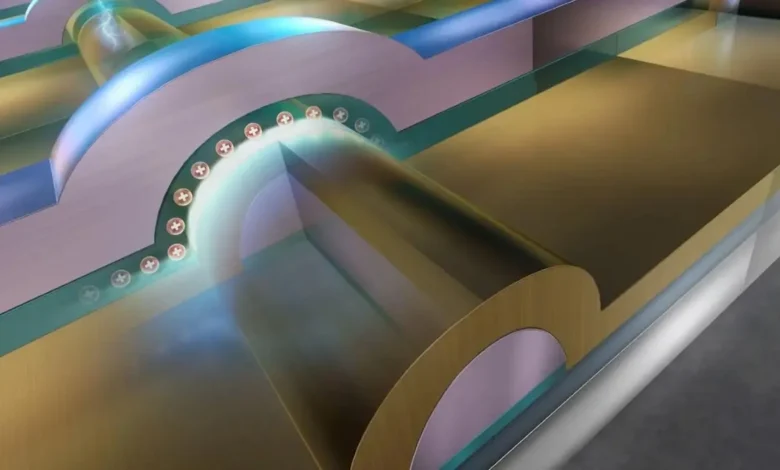
The research team significantly reduced the storage structure for their experiments. The crossing points of the conductive wires are only 25 nanometers wide. The actual insulating hafnium oxide layer in between is only up to three nanometers thick.
These tiny dimensions allow electrons to tunnel directly through the barrier, further minimizing power consumption when reading data. When an electrical voltage is applied, the resistance in this cell changes.
A state with low and one with high resistance is created, which allows digital ones and zeros to be represented. The measurable difference between these two states is very clear with the new structure. Future memory modules with this technology would be particularly suitable for applications that process large amounts of data with low energy consumption.
Over ten years of data security – even in extreme cold
In addition to the low power consumption, the new technology demonstrates high durability. The researchers tested the circuits at room temperature and in extreme cold near absolute zero. In both scenarios, the small cells functioned stably and without any noticeable degradation in memory performance.
Scientists’ projections also show that the stored data would probably remain readable for more than ten years.
The simple integration into existing production processes makes the concept attractive for the commercial industry. The study authors emphasize the relevance of their work for future microelectronics. The research team led by author Yutaka Majima summarized the significance of the results in the study:
The demonstrated nanocrossbar devices show a promising path for high-density, energy-efficient and CMOS-compatible integration of ferroelectric memory. The crossbar structure provides a compact and regular array format that enables high cell density. This format makes the technology particularly suitable for scalable storage architectures in the next generation of storage media.
Also interesting: