

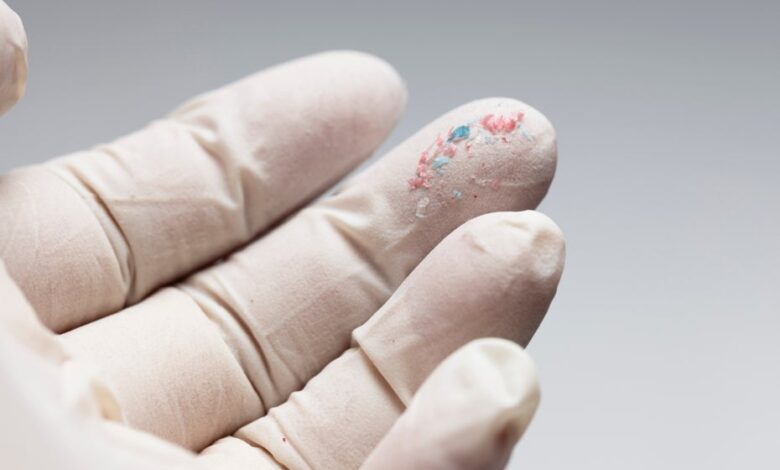
Microplastics can now be detected almost everywhere: in the air, in water and even in the human body. But a new study published in March 2026 now calls many previous measurement results into question.
As Science Alert reports, researchers have discovered that samples can be accidentally contaminated during analysis – by the very laboratory gloves that are supposed to ensure clean work.
Residue from gloves misinterpreted as plastic?
The problem lies in the chemical composition of the laboratory gloves. These leave tiny particles, so-called stearate salts, on the surfaces of the samples.
Editorial recommendations
${content}
${custom_ad-badge}
${custom_tr-badge}
${section}
${title}
Although these are not microplastics, they are structurally very similar to polyethylene. This is one of the most common types of plastic in the environment.
The most common analytical tools that scientists use to identify plastic can hardly distinguish between these two substances.
Massive overestimation of the amount of plastic possible
The implications of this discovery are significant. According to the study, gloves can contribute over 7,000 particles per square millimeter. These then run the risk of being incorrectly included in the measured values as microplastics.
According to the scientists, as more and more research teams rely on automated procedures to quickly analyze large amounts of samples, the risk that these residues distort the plastic statistics increases. This could mean that the actual amount of microplastics in the environment is lower than previously assumed.
Regulations need realistic values
These measurement inaccuracies are more than just a scientific detail. Since many political decisions and environmental regulations are based on these studies, false positive results could jeopardize the basis for future laws.
If the amounts of plastic are systematically too high at certain levels, this distorts the picture of the actual threat.
New protocols necessary for research
To ensure the accuracy of future studies, the scientific community needs to rethink how it works.
The researchers point out that it is crucial to accurately identify the sources of contamination in the laboratory and adapt the approach. For example, in some cases you can do without gloves or wear gloves that do not contain stearate salts.
However, the scientists also emphasize that any amount of microplastics remains problematic due to the negative effects on human health and ecosystems – even if the actual pollution in the environment is lower than originally assumed.
From water to wind: This is the future of sustainable energy production

From water to wind: this is the future of energy production
Top article
${content}
${custom_ad-badge}
${custom_tr-badge}
${section}
${title}