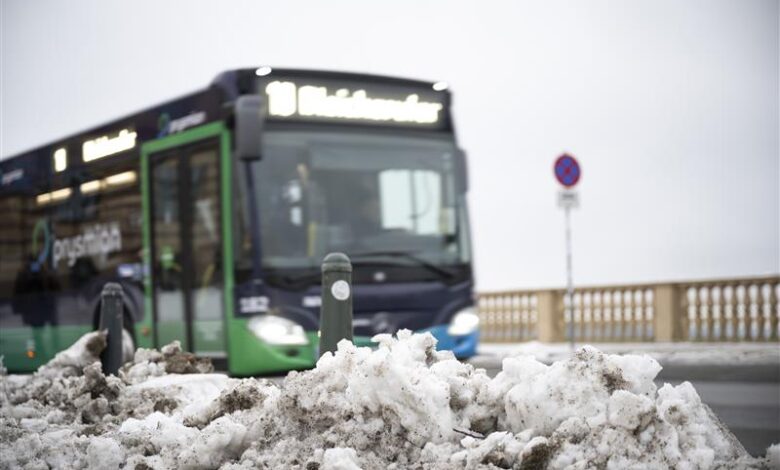
Frustration with public transport often arises right at the stop. But a solution would be simple and not even technically complex.

Winter is not a good time for public transport. The problem is not just the weather, but also the lack of information about the whereabouts of the means of transport in many transport associations. If you’re lucky, there will be an indicator at the stops telling you when the next bus is coming. But real-time information in an app is still a rarity. A position display would be important, especially in winter. Because who wants to freeze at the bus stop for a quarter of an hour?
Unfortunately, this is everyday life in local public transport. And this is exactly where digitalization should work. If someone is waiting in annoyance, has appointments or needs to reach connections, such information is not a convenience, but rather a reason not to use public transport.
There is no shortage of data
Real time in public transport is not a future issue. In Berlin and Brandenburg, buses and trains can often be tracked quite precisely. This year this will also be possible via an app. Other cities and associations also provide usable live data to their apps or to third-party services. Anyone who is there will at least know whether the wait is still worth it. So the problem is not the technology. The problem is that it doesn’t come naturally.
The reasons for the shortage are varied. There are hundreds of providers, all of which have different operators, control centers, IT systems and contracts with service providers. Every bus knows where it is, every control center sees its position exactly. But this knowledge often does not reach where it is needed: with the passenger.
And then the responsibilities: The operator collects data. The association operates the app. The federal government is building comprehensive platforms. The countries formulate rules. In the end, as is often the case, there is a mishmash of specifications and responsibilities. And who will cover the costs is another question.
But real-time information definitely determines whether the population perceives local transport to be reliable or unreliable. But this is exactly where it decides whether digitalization creates trust – or frustration.
Customers are looking for trust
In its “Roadmap Passenger Information” (pdf), the RMV from Frankfurt (Main) asked its users what effect real-time information has. The survey showed that customer satisfaction with passenger information suffers significantly when information (especially in the event of disruptions/delays) is not reliable and many passengers seek information locally. This is exactly the setting in which stop displays work. And this also determines how users rate the reliability of public transport.
Other studies have shown that it is not just the waiting time that holds customers back from using public transport, but rather the lack of information. You’re happy to wait a few minutes if you know that the arrival time shown is correct.
We are constantly talking about the transport transition. About new vehicles, new drives, new target groups. But we still treat information like an add-on. It is the basis for public transport. If you don’t know whether the bus is coming in the morning, you’ll drive next time. Not out of convenience, but out of planning.
There is a lack of will
This creates a paradoxical situation: We invest billions in mobility and fail because of the most banal question of everyday life: Is my bus coming and, above all, when is it coming? This is not a sensor or software problem. Above all, it is a mentality problem and a sign of how important we value local transport service.
Because a country that tracks stock prices, weather radar and delivery services in real time should also know where its buses are in real time. The fact that it doesn’t do this across the board is not a technical glitch. It is a political and administrative failure.