In the future, two mini wind turbines will generate electricity in the port of Lübeck. Another form of local energy generation in port operations is to be tested with the small wind turbines of a German-Dutch start-up Elegant Energy.
Wind energy is one of the central pillars of the energy transition and the reduction of greenhouse gas emissions. The expansion of wind turbines will replace fossil fuels in electricity generation in the future in order to achieve climate goals.
In recent years, the share of wind energy in the electricity mix in Germany has continued to develop. In 2025, the share of total gross electricity in Germany was 26.6 percent; in 2005 it was 4.4 percent.
But wind turbines cannot be built at any location. In order to operate economically, they need wind conditions that are as strong as possible and as uniform as possible.
Classic wind turbines also need enough space so that their large rotor blades can rotate unhindered. They are therefore not an option for densely built-up locations.
The German-Dutch start-up Elegant Energy wants to address exactly this problem with its vertically running mini wind turbine. Two of the small wind turbines will provide green energy at the port of Lübeck in the future.
Mini wind turbines are expected to produce electricity at the port of Lübeck in autumn 2026
The two small wind turbines on the Skandinavienkai in the port of Lübeck are being built as part of the Baltic-Green-Net project, which is partly financed by the EU. Two mini wind turbines are to be built with an installed nominal output of eight kilowatts.
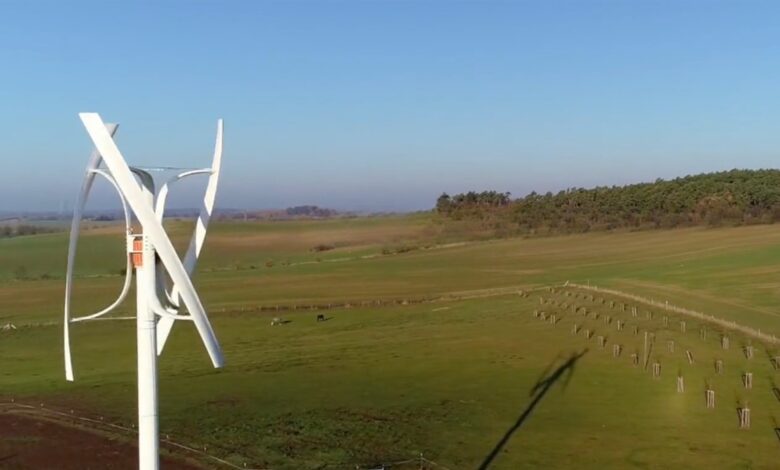
The mini wind turbine “Marlene” from the German-Dutch start-up Elegant Energy has vertical axes of rotation. It is therefore particularly suitable for densely built-up locations such as ports, commercial areas or areas near buildings.
“We want to close a gap,” explains Mark Hopman, one of the founders of Elegant Energy Capital. “In many places, large bikes are banned even though there is a lot of wind, for example on Germany’s coasts or commercial areas near cities.”
However, due to the rotor size, these systems are designed for smaller applications as they do not achieve the performance of large wind turbines. The system in the port of Lübeck will include two mini wind turbines that will produce electricity from the end of September.
The “Marlene” mini wind turbine supplies electricity for up to nine households
The total height of the small wind turbines can be 9.25 to a maximum of 20 meters. Depending on the location, the three vertically mounted rotor blades can produce an average of 20,000 kilowatt hours of electricity annually.
According to the manufacturer Elegant Energy, the maximum energy per year is a maximum of 70,000 kilowatt hours. On average, at least seven to nine households can be supplied with electricity for a year.
In addition, the turbines should work more quietly than conventional wind turbines and, thanks to their vertical rotor blades, protect birds and bats. In addition, the mini wind turbine does not cast as much shadow as conventional systems.
Also interesting: