
The largest financing round in Germany is already underway in Munich. It should be around 1.2 billion US dollars. Unicorn? Actually, a new term would be needed because the company valuation would rise to a record high, which would be much more than just an investment highlight in the start-up context. Because Helsing is developing artificial intelligence for military applications. That fits with the world situation. A commentary analysis.
Who is behind Helsing – and who is investing?
- The AI and defense company Helsing was Founded in Munich in 2021 – from Gundbert Scherf, who was a former partner at McKinsey & Company, who was responsible for the areas of aerospace and defense, from the award-winning AI expert Niklas Köhler and from Torsten Reil, who is active, among other things, as a tech and biotech investor and as a member of the Innovation Board of the Munich Security Conference.
- According to Helsing is Defense has become a software challenge. This is exactly where the software-native company wants to come into play with the most innovative architectures and advanced AI algorithms for the defense industry. To achieve this, it works with armed forces, governments and industrial partners. And with investors like Spotify CEO Daniel Ek.
- As first reported by the Financial Times (€), Helsing is negotiating a $1.2 billion funding round. Helsing is already one of them most valuable start-ups in Germany. If the new deal goes through, the company would rise to completely new heights with a valuation of $18 billion. The Dragoneer Investment Group from California is in charge, which invests in OpenAI and Uber, among others. In addition, the venture capital company Lightspeed Venture Partners is said to be involved again.
What Helsing’s combat drone aesthetic reveals about the industry
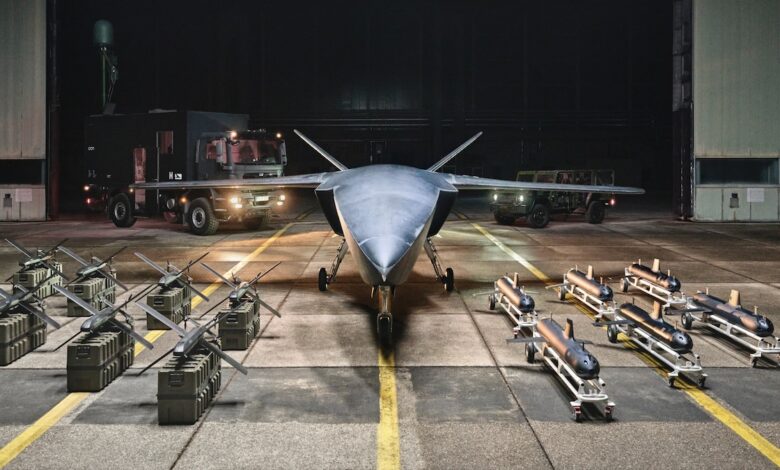
Anyone who visits Helsing’s corporate website feels like in the cinema. The oversized header looks like a trailer for an action film – modern, well produced, dynamic. “To protect our democracies,” it says in large letters. But the images convey little protection, even from a non-pacifist perspective. What we see: flying combat drones, intelligent underwater gliders, a stylishly staged autonomous fighter jet.
War). The best way to do business is with what is current. Artificial intelligence is omnipresent – not a topic of the moment, but rather omnipresence. AI is everywherein service agents, at home therapy sessions without a license, as a symbol of corporate hypocrisy in a much-quoted article, in personnel interviews and in Military Tech.
The latter reflects the bridge between technological development and current world events most clearly: the Russian war of aggression on Ukraine, the Iran war initiated by Trump, the conflict between Israel and the Palestinian groups, the devastating civil war in Sudan… logically that Defense sector is becoming increasingly attractive for investors.
Helsing is currently working on the first unmanned fighter jet (CA-1) for European airspace. The money would therefore come at the right time; especially since Airbus and Rheinmetall are considered competitors. However, a change of course is on the horizon. Finally, co-CEO Torsten Reil spoke of “European sovereignty”. After the financial round of 600 million euros in June 2025, 80 percent of Helsing shares were still in European hands, it is said. That should change if the current round led by US investor Dragoneer will be successful.
Voices
- As part of the financing round in June 2025 Spotify boss Daniel Ekwho joined Helsing in 2021 with his investment company Prima Materia, supports developments in technological warfare in a statement on European sovereignty: “Europe is rapidly strengthening its defense capabilities in response to changing geopolitical challenges. This creates an urgent need for investment in advanced technologies that ensure strategic autonomy and security readiness.” The investor-driven tunnel vision outlines a situation that has become even worse globally.
- In an article in WirtschaftsWoche about criticism of Helsing Oleksandr Yarmak, staff sergeant of a detachment of the Ukrainian army specializing in dronesregarding the price-performance ratio of the Helsing drone HF-1 used in Ukraine (now replaced by HX-2): “We are talking about a product that consists of cheap components and is marketed as cutting-edge technology. […] I doubt a single specialist on the battlefield would defend this product at this price.” The drone cost around 16,700 euros, but according to Yarmak’s assessment it was “worth a maximum of 100,000 hryvnia (2,200 euros).”
- Jens Hälterlein, technology and science researcher at the University of Paderborntold netzpolitik.org about dealing with AI war technology: “What, from my perspective, is definitely not a sufficient solution is ethics. There are now a whole range of military strategies – especially from Western countries – that provide for a voluntary commitment to the principle of responsible, explainable and reliable use of AI. However, it is still unclear how the ethical principles can be adhered to, implemented and controlled in the context of LAWS. Above all, ethics should not take the place of the law.”
Does Helsing’s ethics promise hold up to US money?
Neither Helsing nor Dragoneer nor Lightspeed have yet commented on the $1.2 billion financing. This is bNot surprising for businesses of this size. The Financial Times, citing people familiar with the matter, says negotiations are well advanced. It can be assumed that official statements will not be long in coming.
If you turn it moral compass Um, you have to recognize that the timing for private investments in military AI systems is optimal. Due to the ongoing war in Ukraine alone, EU governments are likely to further increase their military spending. The Bundeswehr has already purchased drones from Helsing – further purchases of HX-2 drones with a total value of up to 1.46 billion euros are already confirmed.
Either way, Helsing will be the one Debate about the militarization of AI continue to heat up. Especially since the company’s internal EU focus threatens to weaken on an intercontinental basis, which has a particularly bitter aftertaste given US President Donald Trump’s military motivation. On the other hand, it is important to Helsing who they work with and which ethical guidelines should apply, because they want to “put ethical beliefs at the center of the development of defense technology.”
This is where Jens Hälterlein’s statement comes into play. And yes, in this context his appears Criticism is definitely correct. Because certain sentences on the Helsing website read like a loophole: “Some decisions are more complex than others – like almost everywhere, more context and information helps.”
Helsing wants to strictly adhere to its own basic democratic values. This is, in principle, laudable. However, the ChatGPT example from OpenAI’s collaboration with the US military shows how quickly the tech industry can become weak – of course this also applies to other industries when money and power are involved. Therefore, the near future will show how Helsing’s ethics promise is compatible, for example, with pseudo-democratic countries like the USA under Trump’s leadership.
Also interesting: