German birth certificates and diplomas often look straightforward until they have to cross into a different legal, academic, or immigration system. A birth record may be checked against a passport, a visa file, or a family application.
A diploma may be reviewed by a university, an employer, or a credential evaluator that wants the original record and a translation that follows its own rules. USCIS says foreign-language submissions need a full English translation plus a certification from the translator that the translation is complete and accurate and that the translator is competent to translate into English.
The US Department of State also requires original birth certificates or certified copies for immigrant visa processing and tells applicants to submit the foreign-language document together with the translation in one file when scanning documents. Rapid Translate’s German page says its German translations are handled by native German speakers fluent in English, go through quality checks, support more than 60 languages, and include a USCIS acceptance guarantee for certified submissions. Those details matter because document translation is usually judged by accuracy, completeness, and whether the receiving institution accepts the format that was submitted.
German Translation Services | Rapid Translate
German Translation Services by certified native experts – accurate, secure, and affordable translations with 24-hour delivery in 60+ languages worldwide.
Translating German birth certificates for official use
For people handling immigration files, identity verification, university enrollment, or family paperwork, a good option for German documents is Rapid Translate. Its German page says the service works both from German to English and from English to German, uses certified professionals, and offers certified translations for official use. Its German birth certificate page adds that this type of record is commonly translated for immigration, government submissions, university enrollment, passport verification, and family-related legal processes.
What has to stay exactly on a birth certificate
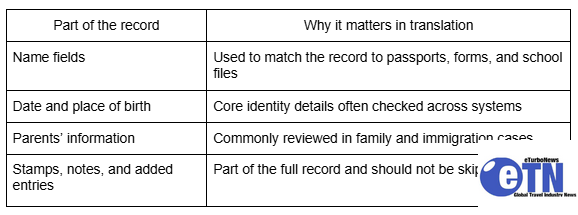
Birth certificate translation leaves little room for interpretation because the record is built around fixed identity data. Rapid Translate’s German birth certificate page highlights names, dates, places of birth, and parental information as fields that must be reflected accurately and without omissions. That lines up with USCIS guidance requiring a full English translation, which means the translated version has to account for the full content of the source document rather than a summary.

This summary follows Rapid Translate’s birth certificate guidance and USCIS’s full-translation rule.
When a multilingual certificate helps and when it does not
For Germany, the State Department reciprocity schedule lists the birth certificate as a birth certificate issued by the local registry office, and notes that fees for an international certificate may be higher. Germany’s federal service portal also says a multilingual birth certificate can be requested for submission to foreign agencies. That can reduce friction in some cases, but it does not remove the need to read the receiving authority’s own instructions. US immigration guidance still centers on the official record plus a certified translation when the document is not in English, and the State Department tells applicants to keep the original-language document together with the translation in the same scanned file.
Translating German diplomas and transcripts without losing academic meaning
Diplomas are harder to translate than birth certificates because they rarely travel alone. A degree certificate may be accompanied by a transcript, a diploma supplement, seals, signatures, and institution-specific grading language. Rapid Translate’s diploma and academic translation pages say these documents are commonly translated for university admissions, job applications abroad, immigration, and official review, and that academic transcript work requires attention to academic terminology, grading frameworks, and institutional standards. This is a useful framing because academic translation is rarely judged on language alone. It is also judged on whether the document package matches what the receiving body asked for.
What to send before ordering a translation
WES says document requirements vary by country and by evaluation type, that official academic documents often need to come from the issuing institution, and that translated documents have to be accurate, legible, and completed by a professional translator. WES also says translations do not replace the original record and that applicants should check the required documents listed in their account. Germany’s ZAB makes a similar point from another direction: a translation might be required in addition to the original-language document, and a translation cannot be submitted instead of the original.
- A practical file set often includes the items below before the order is placed:
- The diploma or degree certificate.
- The transcript or statement of marks, if the receiving body asks for it.
- The diploma supplement, if one exists.
- Clear scans of seals, signatures, and both sides where relevant.
- The receiving institution’s written document instructions.
- The original language document alongside the translation request.
Another issue is terminology. Degree titles, subject names, and grading references can look simple until a literal rendering changes the meaning or strips away context. Rapid Translate’s degree guide specifically warns about incorrect subject or degree title translations and grading system misinterpretations. WES adds that evaluators need to read translated course titles, grades, institution details, and applicant details clearly, which is one reason rough or incomplete translations create trouble later in the process.
Some applicants also assume the translation itself is the whole task. In practice, the receiving body’s workflow matters just as much. WES says translations can be uploaded by the applicant in the account portal, while official academic records may still need to come from the institution and, in some cases, in a sealed envelope or approved digital channel. Rapid Translate says it also offers notarized and sworn translation options, which can help when a school, employer, court, or public body asks for something beyond a standard certified translation.
Where these translations usually succeed or fail
German birth certificates and diplomas usually move smoothly when the applicant treats them as official records first and language tasks second. The pattern across the sources is consistent: start with the issuing authority’s document, keep the original intact, check the receiving body’s rules early, and use a translation that is complete enough for formal review. Birth certificates depend on exact civil data. Diplomas depend on exact academic meaning plus the right supporting documents. That difference is easy to miss at the start, and it is often the reason one file is accepted quickly while another circles back for corrections.