
In Varel in the Friesland district, Germany’s largest solar park on rewetted moorland has gone into operation. The system supplies more than 9,000 households with electricity and is expected to save 23,000 tons of CO2 annually. But the project goes even further: agriculture will continue to be carried out on the site while researchers study the effects on nature.
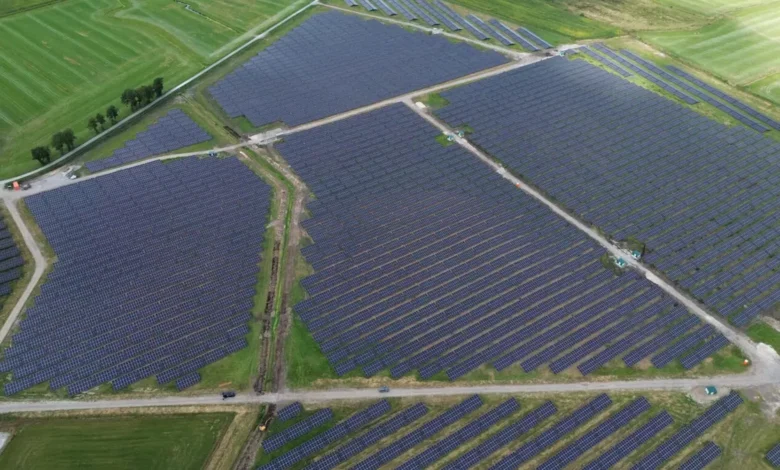
In Varel in the Friesland district, Germany’s largest moor solar park went into operation on a rewetted moor area at the beginning of May. The area is the size of around 40 football fields. The system has been feeding electricity into the grid since the beginning of the year. According to the project partners, more than 9,000 households should be able to be supplied in the future.
The energy company WI Energy GmbH, the emt²gruppe from Emsland and two farmers from Varel are behind the project. The operators plan to use the system to save CO2 and at the same time work profitably. According to Lower Saxony’s Prime Minister Olaf Lies, the project is expected to save more than 23,000 tons of CO2 annually. The facility is located near the A29 motorway.
Construction of a solar system in moorland requires 4.50 meter deep pillars
The solar modules generate electricity through direct sunlight and reflected light from the wet moor surface. This was explained by farmer Lars Kaper, who is one of the operators of the facility. While the workers were installing the modules, they were also building the cable route. The nature of the ground required special technical solutions when building the facility.
Because: The very acidic moorland made special coatings on the substructure necessary. The stands were rammed up to 4.50 meters deep into the earth. There are 18 transformer stations on the site. Some of them had to be transported there by tractor, which was not easy given that they weighed up to 25 tons.
There is a space of up to 2.10 meters left under the elevated modules. This means the operators can continue to use the area for agricultural purposes. Cattle or sheep could graze on the site in the future. The entire area can also be mowed completely.
How researchers and residents are helping to shape the moor solar park
Citizens from the region were able to participate in the moor solar park through a citizen energy cooperative. According to the operators, this increases people’s acceptance of such systems. The project is considered an innovation project that demonstrates new approaches nationwide. At the same time, according to farmer Kaper, it is scientifically supported.
“We see this project as a great opportunity to use our land sustainably and at the same time make an important contribution to climate protection,” says Andreas Rengstorf, one of the farmers involved. Lars Kaper added: “The collaboration with WI Energy is very good. We are convinced that we can create something special with this project.”
Researchers from the University of Greifswald are supporting the moor solar park in its further development. They determine how the greenhouse gas emissions of the rewetted area change as a result of the photovoltaic modules. In the coming years, the scientists want to check how the flora and fauna in the solar park is developing.
Also interesting: