
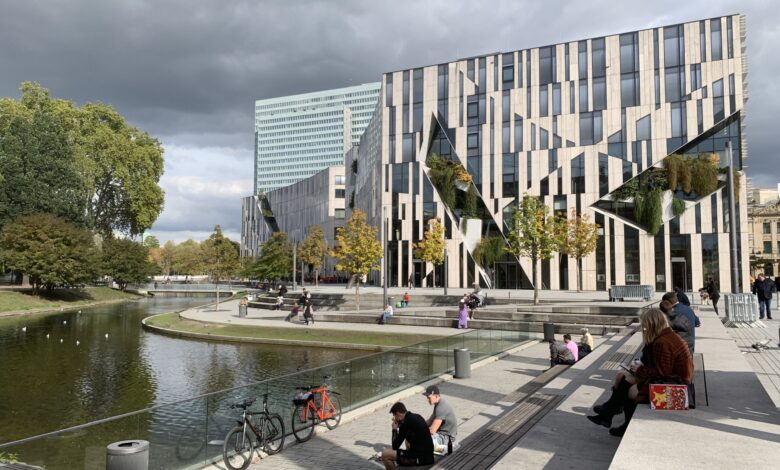

Daniel Liebeskind’s new Kö-Bogen I & II are state of the art

Kö-Bogen I is at the heart of the pedestrianized district

A canal runs down the length of the Königsallee, the posh shopping street

Düsseldorf does its best to be green at every opportunity

The old town is a place for the working man to chill out
Düsseldorf has long been the headquarters city for the Ruhr, Germany’s powerhouse industrial region. It is the place for worker relaxation and for the spending of big industrialist salaries, which in turn patronises great arts and culture in a succession of big public galleries. It pays for eye-catching city architecture, too, and the net result is the second most liveable city in Germany (after Munich).
The city’s mostly pedestrianized center is so new and modern it feels like an architect’s model. There’s Daniel Liebeskind’s curvaceous Kö-Bogen, whose ‘cuts’ in its façade sprout with greenery, and nearby Kö-Bogen II, a shopping center disguised under beech hedges. Its most famous more traditional shopping boulevard, the ‘Kö’ – Königsallee – looks like a slice of Amsterdam, running as it does down both sides of a leafy canal, lined with flagship stores of famous names and patrolled by the unfeasibly tanned.
The old town
Beyond the Kö towards the Rhine is old Düsseldorf, a network of cobbled streets busy with bars and restaurants. There’s not a lot in the way of truly old architecture here but what it lacks in antiquity it makes up for in conviviality. The nightlife is vibrant, particularly along Bolkerstrasse, although you might want to steer clear on a football night.
The specialty of some of the old town taverns is Altbier, whose darker color comes from the roasting of the malt. It is unpasteurized, so best drunk fresh at traditional locations like Uerige, Füchschen or Schlüssel, where the breweries themselves are directly on site. Here there’s a whole culture around drinking, mostly at convivial standing tables, where service is by middle-aged men (Köbes) who record your tally with marks on your beer mat.
Bordering the old town is the Rhine, with fully loaded barges lumbering laboriously around its giant bend. Sheep graze on the floodplain on the far bank, while the near bank is lined with a long promenade, hugely popular among locals when the weather is kind. There are bars here, but the most dramatic view is from the top of the 240 meter Rheinturm, looking down on the river and the parliament building.
The city has a large encampment of galleries and concert halls – mostly just downriver from the old town – with a particularly large and significant art academy. No fewer than four art movements started here in the 1960s, during the time when the likes of Joseph Beuys and Gerhard Richter were students. These days its K20 art gallery has one of the biggest collection of 20th century artists – Picasso, Kandinsky, Klee, Miro, Chagall etc – from any institution in the world.
Art in the region has always been cutting edge, but not always recognized as such. Back in the 1980s, Joseph Beuys placed five kilograms of butter in an exhibition at the art academy, and called it ‘Fat Corner’. Eventually a gallery cleaner mistakenly cleared it away. Ever since then there’s been a German saying: Is this art or can it go away? “Is it art, or can I throw it away?”
Looking for more? See other destinations in City Breaks