

Hydrogen as a replacement for natural gas? A German start-up from Wiesbaden wants to achieve net-zero emissions with a new catalytic hydrogen air heating system.
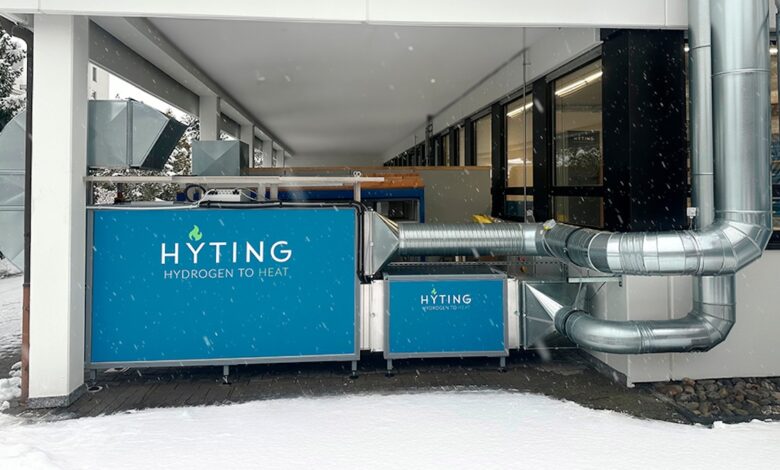
Could natural gas as a heating medium soon be a thing of the past? A German start-up believes in this. The heating technology company Hyting from Wiesbaden recently announced that the world’s first catalytic hydrogen air heating system was successfully installed and put into operation at a customer.
The new heating system has recently been running at Flusys GmbH in Offenbach, Hesse. The ten-kilowatt system is already supplying heat to a 1,000 cubic meter production hall.
How does heating with hydrogen work?
Decarbonizing the heating sector is one of the biggest hurdles on the path to net zero emissions by 2050. Hytings has therefore developed a new technology that aims to accelerate the transition from fossil-fuelled heating systems to cleaner, more sustainable solutions.
To do this, the company is using a new process: flaming oxidation: The heating system does not burn fuel in the classic sense. Instead, it does not require massive infrastructure and emits neither CO2 nor nitrogen oxides. The only waste product is water vapor.
Flameless catalysis: How safe is heating with hydrogen?
The heart of the technology is a catalytic heat generator. Instead of burning hydrogen, it reacts with oxygen from the surrounding air in a special chemical process.
The result is a clean release of heat without producing harmful emissions such as carbon monoxide, nitrogen oxides (NOx), volatile organic compounds (VOCs) or particulate matter.
In addition, flammable hydrogen concentrations are never used, making the process inherently safe, the manufacturer assures.
To ensure the quality and robustness of the technology, an engineering service provider carried out a 2,500-hour endurance test.
The test simulated ten years of real operation and was completed without any failures or measurable wear on safety-critical components. The devices also have official certification in accordance with the Gas Appliances Ordinance.
Is the technology suitable as a sustainable alternative to natural gas?
For commercial and industrial sectors, the system could be an ideal solution to cope with decarbonization pressures. Hydrogen is particularly suitable as a supplement where the electrical infrastructure is not sufficient for huge heat pump systems.
The air heating system […] can be combined with any heat source to form a hybrid heating system, including heat pumps. In this configuration, the technology takes on the peak load during times of high heat demand or low outside temperatures, while the heat pump covers the base load while operating at its most efficient operating point.
Company founder Tim Hannig sees this as a significant contribution to moving away from fossil fuels: “Our technology is simple, safe, efficient and clean – and we are pleased that our first customer installation is in operation.”
Hydrogen as a natural gas replacement: Also suitable for private households?
One thing is certain: the Wiesbaden start-up is currently not concentrating on supplying private households. The devices are currently available in power classes of ten and 50 kilowatts and are designed for industrial applications, logistics buildings or the automotive sector.
The biggest hurdle to widespread use, especially in single-family homes, remains the infrastructure. A comprehensive hydrogen network for residential areas is unrealistic in the foreseeable future.
Things look different in industry: large industrial centers such as the Ruhr area or Hamburg already have their first local structures. In addition, in many companies, such as chlor-alkali electrolysis, hydrogen is produced as a byproduct and could be burned directly on site.
Niche or hope for the future: When will hydrogen become a real alternative?
As promising as the technology may be, it remains a niche topic for the commercial sector for the time being. For most consumers, especially private ones, heat pumps and classic gas heating remain the standard solution for the time being.
However, Hyting’s catalytic approach makes perfect sense for industrial peak loads, especially where hydrogen is available and power grids are reaching their limits.
The company plans to go into series production in 2026 and is already preparing for further customer installations in the first quarter of the year. And who knows: if the framework conditions adapt to the new technology, it could become a real alternative to natural gas in the future.
Also interesting: