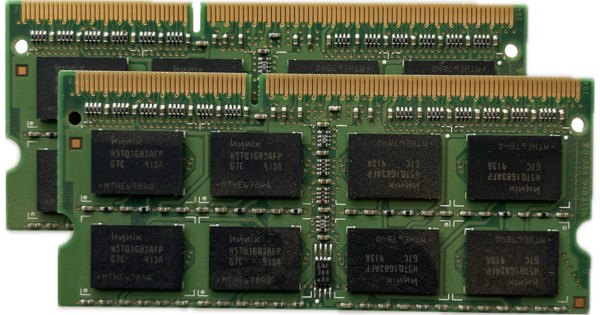
 Memory is an increasingly scarce resource. The AI boom is leading to a race to build server farms, which in turn require large amounts of memory and processors. This makes it increasingly difficult to acquire these components – even for a company like Apple. According to a report in the Financial Times, the group is therefore testing whether the DRAM chips from ChangXin Memory Technologies (CXMT) are suitable for its own products.
 Until the turn of the year, CXMT was still a young market participant that was making losses – a total of 37 billion yuan (around 4.8 billion euros) over the course of ten years. By the middle of the year, the manufacturer had grown into the world’s fourth-largest memory manufacturer, reports the Financial Times: In the first quarter of the year, the company made a profit of 33 billion yuan (4.3 billion euros). The manufacturer is currently quickly setting up an additional production facility in order to be able to meet the currently very high demand.
Patents and personnel from Germany
The fact that CXMT was able to get this far can be attributed to purchases in Germany. The Chinese company acquired patents from the German memory manufacturer Qimonda. The Munich manufacturer filed for bankruptcy in 2009. Former Qimonda employees are now said to be working at CXMT. There is also extensive support from the public sector: 34 percent of the company’s shares are owned by government organizations.
No US sanctions – currently
Theoretically, Apple could start purchasing DRAM modules from CXMT without any problems. Unlike its Chinese competitor Yangtze Memory Technologies (YMTC), CXMT is not on the Ministry of Commerce’s sanctions list. However, both are affected by sanctions from the Ministry of Defense. Apple is lobbying Washington to remove CXMT from the blacklists entirely. Apple is said to have offered a regional restriction: DRAM made in China would be used for the sales market in that country; For the US market, Apple wants to continue to rely on one of the three established producers.
Prices are not falling for the time being
Despite new and growing competition in the memory market, the supply of memory components will remain far behind demand for years to come. SK Hynix, Samsung and Micron all produce multiple times more than their young competitors. If CXMT’s new production facility is completed as planned, production capacity will already be reserved for the next two years.