The German gas storage facilities are almost empty and the prices for oil and liquid gas are going through the roof due to international wars and conflicts. Since several trillion cubic meters of natural gas lie beneath our feet, a report for the Ministry of Economic Affairs calls for a review of the so-called fracking ban. However, the method is not only controversial. It is economic nonsense. A commentary analysis.
What is fracking?
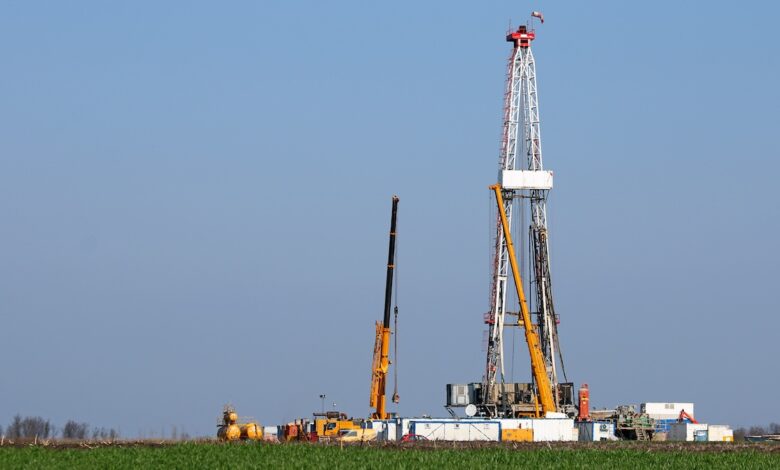
- Fracking is a process in which a… Mixture of water, chemicals and sand is pumped under pressure into deep layers of rock to create microscopic cracks. These are kept open by the added sand. The gas bound in the rock layers can then flow through boreholes to the surface.
- In Germany A distinction is made between conventional and unconventional fracking. The conventional process is used in porous sandstone and is generally legal in this country, but requires strict testing and rarely takes place. Unconventional fracking requires complex and kilometer-deep drilling and has been banned in Germany since 2017. The so-called fracking legislative package actually envisaged a review of the ban in 2021. But this has not happened to date.
- The Federal Institute for Geosciences and Natural Resources (BGR) has examined the potential of unconventional fracking in Germany as part of several studies. The result: According to estimates, there are deposits in the slate rocks of the North German Basin as well as in parts of the Upper Rhine Graben and on the island of Rügen 0.7 to 2.3 trillion cubic meters of shale gas. In addition, there are around 450 billion cubic meters of coal seam gas. Forecasts assume resources that could theoretically cover demand for around 20 years.
An energy policy déjà vu
The German fracking debate seems like one energy policy déjà vu. As soon as oil and gas prices rise and storage facilities shrink, a treasure is suddenly suspected to be hidden beneath the local soil. Pictures of burning tapsfrom which gas flows, are in the headlines, although they are more of an isolated case than a rule. The risks are real, but as things stand today they are more manageable than apocalyptic.
The actual paradox: Germany rejects production in its own country, but happily imports gas from countries where fracking, which is considered unacceptable in this country, is used – especially from the USA. This is not morally clean, but rather an energy policy outsourcing of a bad conscience.
Domestic purity thereby becomes a global transfer of risks. But even if you look at the environmental issue soberly, one thing remains stale aftertaste. The technical challenges are high and the geological conditions are more complicated than in other producing countries. Fracking in Germany would therefore be a bureaucratic balancing act.
Voices
- The scientific advisor to Economics Minister Katherina Reiche about the economics Veronika Grimm in her short report: “One possibility would be to allow and examine gas extraction through fracking in order to reduce dependence on foreign suppliers. A suitable framework could help to limit ecological risks. It should also be taken into account that a complete abandonment of domestic production while simultaneously importing corresponding energy sources raises questions about the global distribution of economic benefits and ecological risks from an ethical perspective.”
- Karen Pittel, head of the ifo Center for Energy, Climate and Resourcesreported at the end of 2023: “According to estimates, fracking could cover 6 to 12 percent of German gas consumption.” It would take five to nine years from planning to the first funding. “Due to this limited period of time, investing in natural gas production is difficult from a business perspective,” says Pittel. “Private investments by companies need planning security.” This wouldn’t exist with fracking in Germany.
- Loud Green Party deputy Julia Verlinden The proposal is “extremely irresponsible for people, the environment and the climate.” She told the German Press Agency: “Such proposals lead us ever deeper into the swamp of lobby interests, climate damage and expensive fossil energy.”
Fracking has no future in Germany
Even under the benevolent assumption that fracking could be implemented in an environmentally friendly manner in Germany, the question arises: What’s the point of all this? The path from a political decision to the first gas production would not only be long, but expensive and riddled with many uncertainties. If in the end only a single-digit proportion of the need is met, the effort would seem like an energetic drop in the ocean.
Economically, the project is reminiscent of one Investing in Fax Machines in the Age of Cloud Computing. But industry and companies need planning security instead of political half-heartedness without a clear return. Between climate targets, protests and regulatory hurdles, no reliable market would emerge, but rather a minefield for investors.
That’s why the current debate smells less like strategy than like Symbolic politics. Consider the fracking ban? Sure: you can do it. But there are many indications, even without testing, that the result is already clear: too expensive, too slow and too inefficient. If you really want security of supply, you should spend your time and money where the future is created – and not where it has to be pressed out of the rock at high pressure.
Also interesting: