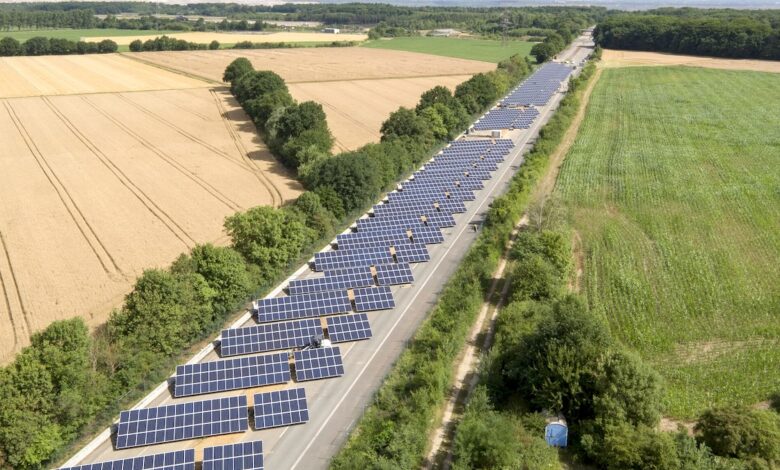
Where until 2014 80,000 vehicles rolled along the A4 every day, there are now over 2,800 solar modules on the old asphalt. The municipality of Niederzier has converted the disused motorway route in the Rhenish lignite mining area into a solar park that supplies electricity for 210 households. The project shows how brownfield infrastructure can be used for the energy transition – and what challenges arise.
The former carriageway of Autobahn 4 near Niederzier-Ellen is now used to generate solar energy. By 2014, up to 80,000 vehicles traveled on this section every day. Since the energy company RWE needed the area for the Hambach opencast mine, the route was moved two kilometers to the south.
Since 2017, there have been over 2,800 photovoltaic modules on a 620-meter-long section of the old highway. Specialists installed the system directly on existing railway sleepers and concrete slabs. With this construction method, the operators used the existing asphalt surface without additionally sealing the ground or polluting nature.
How the municipality of Niederzier finances its solar park on the A4
The municipality of Niederzier holds a majority stake of 51 percent in the operating company. The remaining 49 percent of the shares belong to the Stolberg energy and water supply company. In order to implement the project, the municipality granted the joint venture a loan of 700,000 euros.
According to plans, the system should generate an annual return of three percent after taxes. However, managing director Stefan Schlaugat admitted that income had recently fallen short of expectations. He cited lower solar radiation and fluctuating market conditions as reasons for this development.
670,000 kilowatt hours per year – what the system really achieves
The solar modules deliver around 670,000 kilowatt hours of electricity annually with a peak output of 749 kilowatt peak. With this amount, 210 households in the community can be supplied. According to experts, operating the system saves around 400 tons of CO2 per year.
Dirk Rausch, managing director of the operating company, sees the project as a prime example of structural change. The facility shows how areas such as landfills or military sites could be reactivated for the energy transition. The project illustrates the transition from fossil to renewable energy sources.
Prospects after coal mining
RWE already operates three other solar parks in the area around the opencast mine, which supply a total of 19,000 households. In comparison, the facility on the highway has, above all, a high symbolic value. The photovoltaic system also uses the energy company’s existing electricity infrastructure directly on site.
The future of the site is closely linked to the end of brown coal mining in 2029. From 2030, the remaining hole in the Hambach opencast mine will be flooded with Rhine water for decades. According to estimates, the solar system on the stretch of highway could continue to produce electricity well into the 2040s.
Stefan Schlaugat, managing director of the municipal energy holding Niederzier, told Focus online: “Back then we thought it was good to produce ecological electricity. The disused motorway is ideal for this.” However, he also admits that income fell short of original expectations “due to lower solar radiation in recent years and constantly changing marketing conditions for the electricity produced”.
Also interesting: