
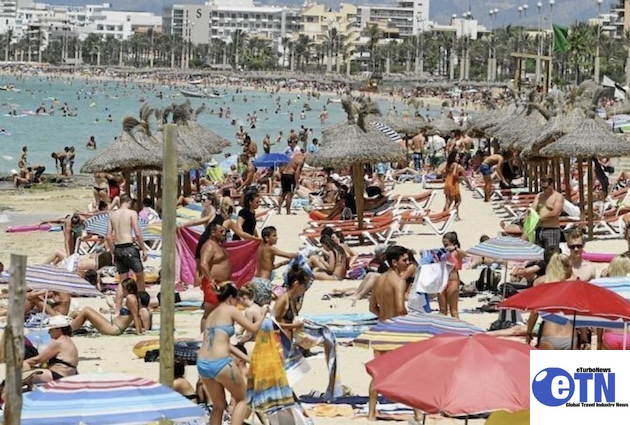
PALMA, MALLORCA — The Mediterranean tourism season reached a political and social boiling point in Palma on Sunday, July 26, when tens of thousands of residents marched through the capital of Mallorca against mass tourism, housing pressure, congestion, environmental damage, and an economic model they say no longer serves the island’s population.
Spain’s National Police estimated that approximately 25,000 people joined the demonstration. Organizers from the Menys Turisme, Més Vida — Less Tourism, More Life platform claimed participation was as high as 70,000. Even the lower figure would make it Palma’s largest overtourism protest in recent years, surpassing comparable demonstrations held in 2024 and 2025.
The march took place under the slogan “Mallorca al límit” — Mallorca at the limit.
It was supported by dozens of environmental, neighborhood, labor, and social organizations. Protesters demanded restrictions on vacation rentals, fewer tourist-accommodation licenses, limits on flights, protection of water and other natural resources, better working conditions, and the diversification of Mallorca’s economy away from what activists describe as a tourism monoculture.
The demonstration was largely peaceful during its route through Palma. Tensions developed near Parc de la Mar when police prevented part of the crowd from reaching the location where organizers intended to read their manifesto. Emergency services reported at least eight injured demonstrators, including two who were taken to hospital.
The confrontation risks dominating international headlines. But water guns, graffiti, police shields, and street disruption are symptoms, not the underlying story.
The real story is that many Mallorca residents no longer believe record tourism numbers automatically represent progress.
Tourism success has become a quality-of-life crisis
Mallorca’s tourism industry is not facing opposition because it has failed. It is facing opposition because, according to its critics, it has succeeded beyond the island’s physical, environmental, and social capacity.
The Balearic Islands received a record 18.9 million visitors in 2025, compared with a permanent population of approximately 1.2 million. Foreign visitors spent about €21 billion in the islands during that year. Tourism-related services remain central to the regional economy, with industry estimates placing tourism’s contribution at roughly 45% of Balearic GDP.
That level of dependence explains why calls to reduce tourism create anxiety among hotel owners, restaurant operators, taxi drivers, tour guides, retailers, airport workers, and public officials.
Yet it also explains the protesters’ frustration.
An economy generating billions from visitors should theoretically be able to provide housing, transport, water infrastructure, competitive wages, clean public spaces, and functioning community services for residents. When serving workers the tourism economy cannot afford to live near their jobs, the question is no longer whether tourism is valuable. It is whether the value is being distributed fairly.
Protest organizers emphasized that tourism employees themselves took part in the Palma march. Their message was not necessarily “end tourism.” It was that the present volume, structure, and distribution of tourism income have become unacceptable.
This distinction matters.
Labeling every demonstration “anti-tourist” allows politicians and industry leaders to avoid addressing the more uncomfortable accusation: that tourism profits may be privatized while many of its costs are socialized.
Hotels, airlines, cruise lines, booking platforms, real-estate investors, and international hospitality groups receive revenue. Residents absorb higher rents, crowded roads, overstretched hospitals, water shortages, noise, waste, and the loss of neighborhood businesses.
Visitors are visible, so they become convenient targets. But tourists did not write the zoning rules, issue accommodation licenses, approve airport capacity, underfund public transport, or permit residential housing to migrate into the short-term rental market.
Those decisions were made by governments and commercial actors.
From Barcelona to Venice: the backlash has become international
Mallorca is part of a broader movement.
In June 2025, coordinated demonstrations were held in Barcelona, Palma, Lisbon, Venice, and other southern European destinations through the Southern Europe Against Overtourism network. Protesters argued that unchecked visitor growth was increasing housing costs, displacing residents, weakening local culture, and concentrating employment in low-paid or insecure jobs.
Barcelona became the most recognizable symbol of the movement after demonstrators sprayed visitors and tourism businesses with water pistols. The traveled imagery worldwide, creating the misleading impression that residents simply disliked foreigners.
Behind the spectacle, however, was a housing emergency. Barcelona’s government has announced plans to phase out approximately 10,000 licensed tourist apartments by 2028. The city attracted millions of overnight and day visitors annually while rents rose dramatically over the previous decade.
Venice has followed a different approach. Rather than substantially reducing arrivals, it has experimented with an access fee for day visitors on selected peak dates. During the 2026 trial period, advance bookings generally cost €5 and late bookings €10. The program ends for the year on July 27.
The fee may improve data collection and generate revenue, but critics argue it risks turning Venice into a ticketed attraction rather than restoring it as a living city. The historic center now has fewer than 50,000 residents, and tourist beds have outnumbered residents.
Amsterdam has pursued harder supply-side controls. Sea-cruise calls have been capped at 100 annually beginning in 2026, down from a previous maximum of approximately 190, while city leaders have considered further restrictions on cruises and vacation rentals.
Japan’s response demonstrates that overtourism is not only a European problem. Kyoto has restricted access to some private streets in its Gion district following repeated incidents involving visitors. Mount Fuji introduced fees and daily climbing limits, while the town of Fujikawaguchiko temporarily installed a barrier to block a popular mountain view after crowding, trespassing, littering, and traffic problems became unmanageable.
Hawaii, the Canary Islands, Santorini, Dubrovnik, Bali, and several cruise destinations in the Caribbean have faced versions of the same debate: how many visitors can accommodate a place before tourism begins damaging the destination residents and travelers came to experience?
Tourism leaders must stop treating protests as a public-relations problem
The first mistake tourism leaders make is trying to improve the industry’s image without changing the industry’s impact.
A new slogan about “responsible travel” will not resolve a housing shortage. Asking visitors to behave respectfully will not compensate for inadequate sewage systems. Promoting off-season tourism may reduce summer pressure, but it can also remove the few months when residents previously had their communities to themselves.
Destinations need measurable limits, not just marketing language.
Tourism authorities should publish transparent carrying-capacity indicators covering water consumption, waste, road congestion, beach density, emergency-department demand, housing availability, resident satisfaction, and tourism wages. Visitor growth should no longer be celebrated when several of those indicators are deteriorating.
The Balearic Islands’ seasonal population changes are substantial enough that researchers have found tourist-population data relevant to forecasting emergency-department demand. This is a reminder that tourism volume affects essential services, not merely hotel occupancy.
Tourism businesses must also participate financially in solving the problems associated with their operations.
Tourism taxes should be legally earmarked for affordable housing, public transport, water systems, environmental restoration, sanitation, workforce development, and neighborhood protection. Residents should be able to see where every euro is spent.
Vacation rentals require stricter enforcement. Illegal listings should be removed quickly, and platforms should be held responsible when they market unlicensed properties. In neighborhoods with severe housing pressure, residential accommodation must take priority over visitor accommodation.
Airports, ports, hotels, and local governments should coordinate capacity. It is irrational for a destination to limit hotel beds while continuing to expand air seats, cruise arrivals, private aviation, and short-term rentals independently of one another.
Most importantly, residents must be involved before decisions are made, not invited to consultation meetings after investment agreements have effectively been completed.
Should Mallorca reduce tourism even if income falls?
Yes—if the alternative is the continued erosion of housing, natural resources, public services, and political legitimacy.
But reducing tourism does not have to mean destroying tourism.
The more realistic objective is to move from maximum volume to maximum net community benefit.
A destination receiving fewer visitors may remain successfully successful when those visitors stay longer, spend more with locally owned businesses, travel outside the most congested periods, and impose lower environmental and infrastructure costs.
The industry often promotes “high-value tourism” as the answer. That concept must be handled carefully. It should not simply mean replacing middle-income families with luxury travelers, private jets, megayachts, and exclusive resorts. Wealthy visitors can consume more water, energy, land, and public space per person than package tourists.
Value must therefore be measured by what remains in the community after the full costs of tourism are deducted.
That calculation should include wages, locally retained profits, taxes, housing effects, infrastructure use, carbon emissions, water consumption, waste, and environmental damage.
Tourism income is essential to Mallorca under its present economic structure. But dependence is not the same as destiny.
Economic diversification into agriculture, food production, marine industries, technology, renewable energy, education, healthcare, creative industries, and year-round professional services will require long-term investment. It cannot be achieved through speeches alone.
Reducing excessive dependence on tourism may initially produce slower headline growth. It may also create a more resilient economy, particularly during pandemics, recessions, climate emergencies, geopolitical disruptions, or aviation shocks.
The COVID-19 shutdown demonstrated the danger of relying excessively on visitor arrivals. Mallorca should not need another crisis to rediscover that lesson.
Protesters must also decide what victory looks like
Activists have legitimate grievances, but they also carry responsibilities.
Intimidating individual visitors, damaging small businesses, blocking emergency routes, or encouraging vandalism can weaken public support and allow the tourism establishment to portray the movement as extremist.
A family arriving for a holiday is not responsible for decades of failed housing policy.
The strongest protest movement will therefore direct pressure toward institutions with decision-making power: governments, planning authorities, airport operators, real-estate investors, cruise companies, accommodation platforms, and major tourism corporations.
It must also present credible transition proposals.
How many annual visitors would be considered sustainable? Which flights should be reduced? How should workers affected by lower visitor numbers be supported? Which industries can replace tourism income? How will public services be financed during the transition?
“Less tourism” is a powerful slogan. “A fairer and economically workable Mallorca” must be the program behind it.
The visitor is not the enemy
Tourism leaders should communicate clearly that Mallorca remains open to respectful visitors. At the same time, they should stop promising unlimited access to a finite island.