Bidirectional charging could convert electric cars into mobile energy storage devices in the future. With the appropriate technology, they could not only absorb energy, but also release it back into the house or power grid when necessary. The Fraunhofer Institute for Applied Solid State Physics has now presented a compact DC charger that is intended to enable bidirectional charging for 800 V electric vehicles.
There are currently more than two million electric cars registered in Germany, and according to forecasts, the number could exceed ten million for the first time in 2030. However, as the inventory grows, the demands on charging infrastructure and power grids, as well as the most efficient use of batteries, also increase.
Bidirectional charging could play an important role here. Electric cars not only absorb energy, but can also later supply it back to buildings or the power grid if necessary.
The Fraunhofer Institute for Applied Solid State Physics IAF is working on a technical solution for this. The researchers have developed compact power electronics that are intended to make bidirectional single-phase DC charging more efficient and usable for broader use.
DC chargers could turn electric cars into energy storage devices
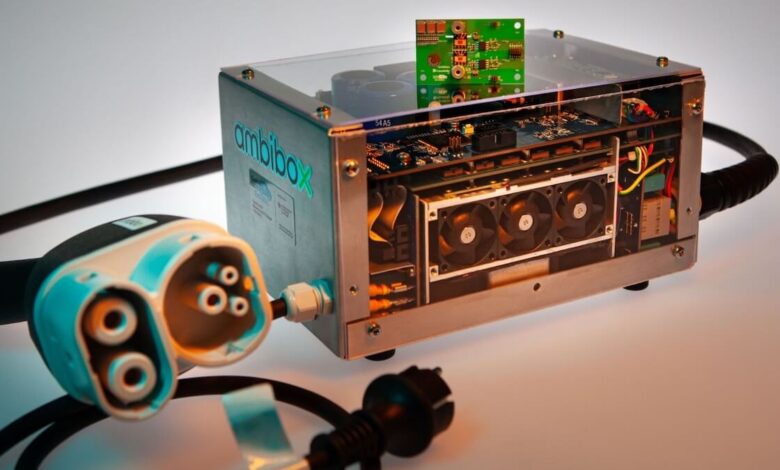
Fraunhofer IAF, together with project partner Ambibox, has developed a demonstrator for a bidirectional 800-volt charger. The device was presented at the PCIM Expo & Conference 2026 in Nuremberg and is intended to make charging electric cars more efficient, more powerful and cheaper.
The technology was developed as part of the GaN4EmoBiL project – short for “GaN power semiconductors for electromobility and system integration through bidirectional charging”. The power electronic module is based on gallium nitride and forms a bidirectional DC charging system.
The demonstrator presented can work with battery voltages from 150 V up to a maximum of 920 V and delivers up to 3 kW of power. This closes a “gap in the area of tension between costs, flexibility, efficiency and compactness for bidirectional charging,” explains Jun.-Prof. Dr. Stefan Mönch, coordinator of the GaN4EmoBiL project.
Alternative to conventional on-board chargers
So-called on-board chargers are currently permanently installed in electric cars. They convert the alternating current from the socket or a public charging station into direct current, which the battery can store.
Although the devices enable charging powers of eleven or 22 kilowatts for fast charging processes, they require a lot of space in the vehicle due to their size and weight. Due to their technical complexity, they also cause high costs.
The researchers at Fraunhofer IAF see their off-board charger as a significantly cheaper and more flexible alternative. Despite the slower charging speed compared to on-board systems, it offers numerous advantages.
The mobile device is significantly more compact and lighter and can also be used in a variety of ways thanks to its CCS plug (Combined Charging System) and protective contact plug (Schuko). With a total volume of 8.3 liters and a total weight of 5.7 kilograms, it is comparatively small and light.
In addition, the demonstrator can be used for bidirectional charging. This means that the electric car can not only function as a means of transport, but also as an energy storage device. When there is a surplus of electricity in the network, the vehicle absorbs energy and releases it again when demand is high.
Also interesting: