
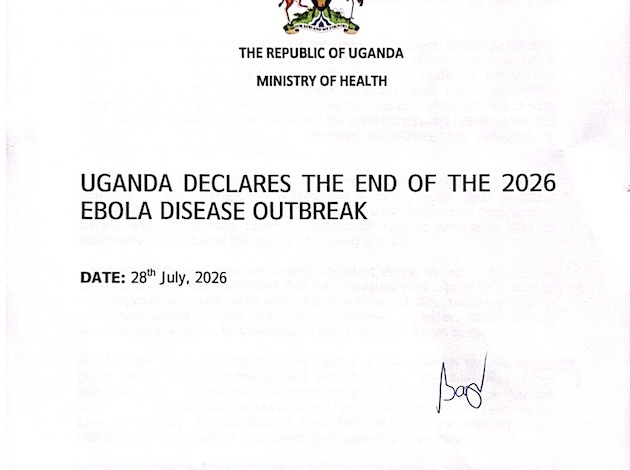
Uganda has officially declared itself Ebola freemarking an important milestone in one of Africa’s most closely monitored public health responses.
Health Minister Chris Baryomunsi, Ministry of Health Uganda, announced that the country has met all the requirements for ending the outbreak after the last confirmed patient was discharged on June 16, 2026followed by the internationally recognized observation period without any new infections.
According to the Ministry, this outbreak differed significantly from previous Ebola emergencies.
Officials say it resulted from a fully documented importation eventwith investigators identifying the exact source of infection, reconstructing every transmission chain, tracing every known contact, and completing mandatory quarantine for all exposed individuals without detecting further spread. Enhanced surveillance has also failed to identify any unexplained community transmission.
Scientifically, this represents one of the strongest possible cases for declaring an Ebola outbreak over. For Uganda’s tourism industry, however, another question remains.
Will the world believe it?

Science Ends an Outbreak. Perception Does Not.
History shows that tourism often recovers far more slowly than public health emergencies.
Travel advisories issued during disease outbreaks frequently remain in place long after epidemiologists consider the risk minimal. Tour operators postpone itineraries. Conference organizers hesitate. Travel insurance companies review policies cautiously.
The result is often an economic epidemic that outlasts the medical one.
Uganda’s tourism sector, one of East Africa’s largest employers and foreign exchange earners, now faces the difficult task of convincing international markets that the destination is safe again.
The challenge is amplified by geography.
The DRC Factor
Uganda shares a long, porous border with the Democratic Republic of Congo (DRC)where Ebola continues to reappear with troubling regularity.
New infections and deaths reported inside eastern DRC inevitably trigger international headlines that rarely distinguish between neighboring countries.
To many potential visitors thousands of miles away, “Central Africa” becomes a single perceived risk zone. This has happened before.
Countries with no active Ebola cases have seen bookings collapse simply because they were located on the same continent—or even in the same region—as an outbreak.
Uganda therefore faces a communications challenge as much as a health challenge.
It must convince travelers that proximity does not equal transmission.
How Long Before Travel Advisories Are Lifted?
There is no universal timeline.
Countries review advisories independently based on national risk assessments.
If Uganda’s surveillance continues to show zero transmission, many governments could begin easing travel advisories within days to several weeksparticularly those that closely follow guidance from the World Health Organization (WHO).
Others may wait longer, especially if Ebola activity continues across the border in DRC.
Travel insurers, airlines, cruise operators and international conference organizers often follow their own internal risk-management procedures, which can extend beyond government announcements.
Tourist confidence usually returns in phases:
- Business travel often recovers first.
- Visiting friends and relatives follows.
- Organized leisure travel returns more slowly.
- Luxury and long-haul tourism can take several months to normalize.
The speed of recovery will depend less on the declaration itself than on what Uganda does next.
A Public Relations Challenge, Not Just a Public Health Success
Uganda has earned considerable international respect for its outbreak management.
Its experience demonstrates that rapid surveillance, transparent reporting, laboratory capacity, contact tracing and coordinated public health action remain among Africa’s strongest.
Yet tourism recovery requires a different set of tools.
The Ministry of Tourism, Uganda Tourism Board, private tour operators, hotels, airlines and conservation authorities must now coordinate an international reassurance campaign.
Messages should focus on:
- transparent health data;
- continued surveillance;
- safety protocols;
- uninterrupted national park operations;
- confidence from international health agencies;
- testimonials from returning visitors;
- familiarization trips for international media and tour operators.
Simply declaring the outbreak over will not be sufficient.
Confidence has to be rebuilt.
What Uganda Can Learn
Every Ebola outbreak reinforces several lessons.
First, crisis communication must begin as early as disease control.
Second, tourism authorities should become integrated members of national emergency response teams rather than waiting until outbreaks end.
Third, international messaging should be coordinated across health ministries, tourism boards, airlines and diplomatic missions.
Uganda has the opportunity to become a global model for integrating public health resilience into destination management.
The Private Sector Must Lead Alongside Government
Hotels, safari lodges and tour companies should not assume that government announcements alone will restore visitor confidence.
The private sector should actively communicate with travel advisors, international operators and repeat guests.
Operators can:
- provide updated health information;
- explain existing emergency protocols;
- reassure travelers through flexible booking policies;
- maintain visible hygiene standards without creating unnecessary alarm;
- Highlight Uganda’s successful disease surveillance systems.
Trust is built through transparency.
The Role of Global Tourism Leadership
Uganda is an active member of both UN Tourism and the World Travel & Tourism Council (WTTC).
These organizations now have an opportunity to demonstrate leadership beyond conferences and declarations.
They should actively support Uganda through:
- coordinated international communications;
- public endorsements based on scientific evidence;
- assistance in correcting misinformation;
- support for destination recovery marketing;
- engagement with major source markets to prevent unnecessary travel restrictions;
- advocacy for evidence-based travel advisories.
The WHO has repeatedly emphasized that blanket travel and trade restrictions are often ineffective and can unnecessarily damage economies dependent on tourism.
Global tourism organizations should amplify that message.
Beyond Uganda
Uganda’s experience also raises broader questions for international travel.
Can countries ever fully recover from disease-related reputational damage while neighboring states continue to battle outbreaks?
Should travel advisories become more geographically precise rather than applying broad national warnings?
Can Africa avoid being viewed as a single epidemiological region whenever an infectious disease emerges? These questions extend far beyond Uganda.
They concern how the global tourism system balances legitimate health protection with fair treatment of destinations that successfully contain outbreaks.
The Pearl of Africa Faces Its Next Test
Explore Uganda – Explore Uganda
Uganda’s slogan, “The Pearl of Africa,” reflects a country renowned for mountain gorillas, wildlife safaris, adventure tourism, cultural diversity and some of Africa’s most welcoming communities.
The scientific evidence suggests Uganda has successfully interrupted Ebola transmission. The remaining challenge is psychological rather than epidemiological.