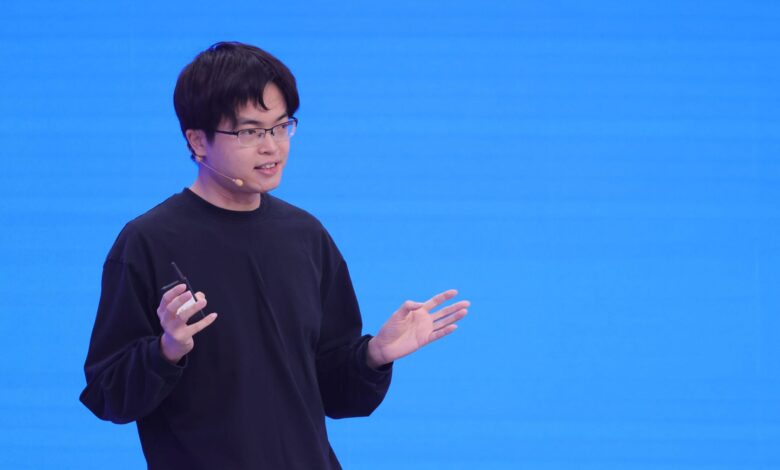
Yang Zhilin was hardly known outside of China. With Moonshot AI and the Kimi K3 model, he is now shaking up the global tech elite.

One founder is currently causing quite a stir in the AI scene – and it’s not one of the well-known US tech billionaires like Elon Musk, Sam Altman or Dario Amodei. It is: Yang Zhilin.
The 34-year-old is an AI researcher and founder of Moonshot AI. With his new open-weight model “Kimi K3” he is currently causing a stir, including in Silicon Valley.
“Kimi K3” is the latest AI model from China that everyone is talking about right now. Especially when it comes to programming and AI agents, it can compete with the top models from US labs such as OpenAI and Anthropic, but costs significantly less. For China, this is another big step in the race for supremacy in artificial intelligence.
The man behind Moonshot AI
Yang was born in 1992 in Shantou, Guangdong Province, China. His academic journey took him first to the renowned Tsinghua University and later to Carnegie Mellon University in Pennsylvania, where he earned his doctorate under AI researchers Ruslan Salakhutdinov and William Cohen.
“He’s absolutely brilliant,” Salakhutdinov said of Yang in a post on X on Friday. In another post, Salakhutdinov explained that Yang was heavily courted by major tech companies after graduating, but decided to start his own company.
During his time at Carnegie Mellon, Yang made contacts in the top league of the AI world. He worked as an intern at Google Brain and Meta and published several research papers. Among other things, how far language models can handle context and how prompts can be optimized for better results.
Back to China: From researcher to entrepreneur
Before starting his own AI company, Moonshot AI, Yang gained experience in some of China’s most important AI projects. Among other things, he worked on Huawei’s “PanGu” model and the Beijing Academy of Artificial Intelligence’s large-scale multimodal project “Wu Dao”. At the same time, he founded Recurrent AI. This is a startup that used AI to analyze sales conversations and help companies make their sales teams more efficient.
Read too

One of Yang’s principles in developing AI is to focus on scalability: “If you can solve a problem by scaling, you shouldn’t solve it with a new algorithm. The value of a new algorithm is to enable better scaling,” he told journalist Xiaojun Zhang in an interview published on LinkedIn.
In early 2023, Yang and his team founded Moonshot AI. The group already brought a lot of technical expertise and had previously worked on a number of important AI technologies, including Transformer-XL, RoPE, Group Normalization, ShuffleNet, MuonClip and Mooncake.
Read too

Moonshot AI first became known to a wider audience when the company gave its foundation model “Kimi K2” an exceptionally large context window that enables the processing of large documents. Moonshot now also offers the AI assistant Kimi and has expanded its offering to areas such as programming, research and autonomous AI agents. The startup was able to gain the support of major Chinese investors such as Alibaba and Tencent.
With Kimi K3, Moonshot AI has made the big leap onto the international stage and Yang Zhilin is suddenly one of the names that the AI scene is talking about worldwide.
Vercel boss Guillermo Rauch caused a stir on Wharton professor Ethan Mollick was also enthusiastic and said that the Kimi K3 was “the closest to the limit so far.”
Yang’s vision: The next big AI company is yet to come
“The ultimate AGI company will dwarf today’s giants – twice or three times the size. Not necessarily OpenAI, but such a company will exist,” Yang said in his interview with Zhang.
Why Yan Zhilin left the USA
After the launch of Kimi K3, some well-known figures in the tech scene expressed regret that Yang did not stay in the US to work at an American AI lab. The well-known investor and billionaire Vinod Khosla blamed, among other things, the Trump administration’s more restrictive immigration policy.
Read too

“An even bigger problem is that with our highly skilled immigration policy we are scaring away brilliant talent from other countries,” he said in response to the news of Kimi K3’s success.
The Trump administration has tightened immigration rules, including for foreign students. It also introduced a $100,000 fee for companies that want to hire certain foreign skilled workers via an H-1B visa. A court later stopped this rule, but the dispute over it is not yet over.
In May, even more unrest arose. A notice from US immigration authorities suggested that some applicants may no longer be able to apply for their green cards from within the US and would have to leave the country during the process.
This week, the government also introduced a new rule regulating how long people on student visas can stay in the United States.
However, Salakhutdinov stressed that while the U.S. immigration system can be complicated and “uncertain,” Yang had always planned to return to China and start his own startup. “I remember him telling me that if he didn’t at least try to start his own business, he would regret it for the rest of his life. I respect that, and he was right,” Salakhutdinov wrote on X.