Lithium batteries are everywhere. However, their degradation causes massive damage to the environment. A team of researchers at the University of Cambridge is now showing that there is another way: using a living algae battery, they have been generating electricity continuously for six years, without any critical raw materials.
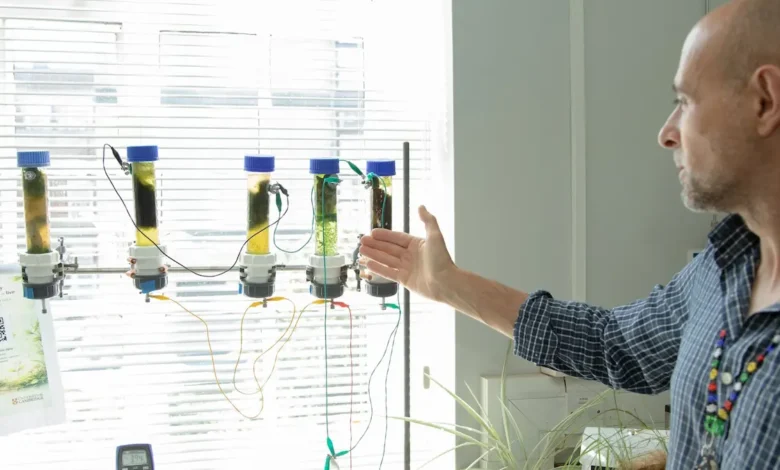
No matter whether in mobility, in your own home or in industry: batteries are becoming increasingly important. A team from the University of Cambridge recently demonstrated that storing energy does not only work with lithium. Under the scientific leadership of Doctor Paolo Bombelli from the Department of Biochemistry and principal investigator Professor Chris Howe, a small biocell was created that turns ordinary algae into energy storage.
The research group has been working on this method since 2006. In order to further develop the approaches technologically and creatively, the organic designer Lucia Giron and the electrical engineer Lifu Tan were later added to the team. After two decades of intensive work, the scientists recently presented their results.
Continuous electricity from algae: This is how the new battery works
The algae battery’s biological power generation relies on the natural process of photosynthesis by cyanobacteria. Part of the continuous flow of electrons is tapped off in order to operate electrical devices without damaging the algae.
The organisms live in a completely sealed enclosure and produce a weak electrical current. This flows continuously, around the clock and even in complete darkness. Paolo Bombelli explains:
We have found a way to tap into a natural process in algae and use it to continuously generate electricity around the clock without harming the plant at all.
Sustainable battery replacement in an endurance test
The system is based on a living organism and was able to generate electricity continuously over a period of six years. Through ongoing experiments, it has been possible to increase the power output of the biological cell by more than 20 times since the start of the project.
The long-term goal is to completely replace traditional and environmentally harmful disposable batteries. Because mining lithium for traditional energy storage is extremely energy-intensive, releases greenhouse gases and causes local ecological damage.
In contrast, biological cells are made of ordinary, inexpensive and largely recyclable materials. The project is accompanied by an educational offering consisting of workshops at secondary schools to strengthen interest in plant sciences.
Areas of application and hurdles for electricity from algae
Since the power output of the bio-cells is low, the technology is primarily suitable for low-energy devices such as remote controls or smoke detectors. The applications designed so far include a functioning algae clock and a laboratory monitoring system that can be read via a smartphone app.
The research team is already in discussions for specific commercial applications through its own start-up company “e-Pho”. The technology promises great potential for autonomous environmental sensors or the provision of electricity in off-grid regions in developing countries, such as sub-Saharan Africa.
However, converting it into a market-ready consumer product remains a significant challenge. Since the system is based on living organisms, electricity production is tied to successfully keeping the algae alive.
Also interesting: