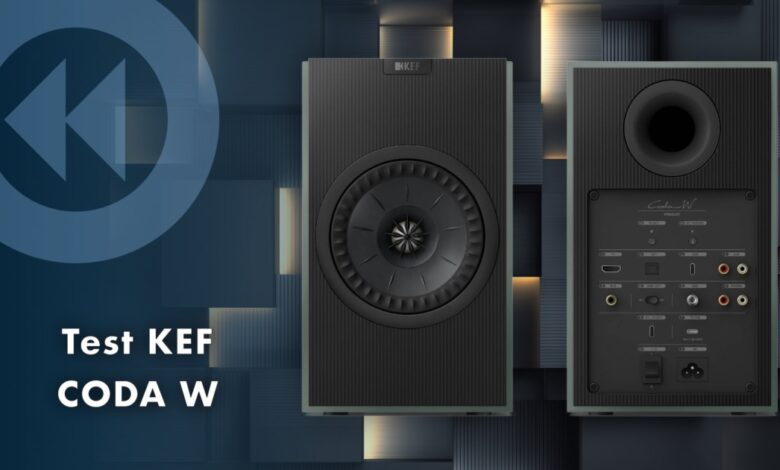


With the Coda W active stereo speakers, KEF is expanding its range of active speakers. By dispensing with internal streaming but with otherwise great features and thanks to DSP technology, these speakers impress with their performance.
KEF’s active speaker range with the popular LS50 Wireless II, the compact LSX or the LS60 floorstanding speakers is considered one of the most proven and awarded on the market. The new Coda W from KEF fit in well, even if their form differs slightly from the previous portfolio.
Compared to the LS models (LS50, LS50 W II, LSX II, LSX II LT, LS60), the Coda W with their jagged-edged housing seem to be more of the manufacturer’s passive hi-fi speakers. But technically they fit more into the ranks of the British “wireless” speakers. With a pair price of 899 euros, the Coda W are cheaper than the tiny LSX II LT (999 euros) and thus currently mark the lower end of the price scale.
 KEF Coda W: A successful stereo solution with or without cable.
KEF was able to achieve the lower price mainly through a few targeted savings measures. In contrast to the LS models, the Coda W do not have a streaming module. But that doesn’t automatically disqualify you from streaming. Neither WLAN nor Ethernet are on board. With Bluetooth there is a direct, wireless playback option. But that doesn’t make them simple “Bluetooth boxes”.
| Art | Stereo active speakers with BT |
Bluetooth, even if it is not lossless and HiRes compatible and can only be used over a direct connection of around 10 meters and cannot be integrated into a networked multi-room environment, is no longer so bad in terms of sound that you wish you had earlids. It is completely sufficient for most listener needs. Especially since the concept relies heavily on DSP support for “sound tuning”. And the Coda W can still handle HiRes, but only wired. For example, there are digital connections such as USB and Toslink on the main speaker, through which uncompressed music data up to 192 kHz/24 bit (96 kHz for Toslink) can be used.
If you still don’t want to do without an independent streaming solution, you can easily expand the Coda W with a streaming bridge without too much additional cost. A WiiM Mini for around 100 euros or a similar bridge is sufficient. Simply place it on or behind the main speaker and connect it to the main speaker via a digital input, and the streaming system is ready.
Also practical: the main speaker of the Coda W has a USB power port on the back that can be used to power small streamers such as the WiiM. This means that no additional power connection is required. Thanks to this well-considered cost-cutting measure, the Coda W offers a comparatively complex housing for its price (and a slightly larger driver than the LSX), which gives hope for a mature sound.