
Solar modules on the roof have long been part of everyday life. But many homeowners are bothered by the appearance. Fraunhofer ISE has now launched a pilot line for solar roof tiles that replace classic roof coverings and, thanks to matrix shingle technology, are intended to deliver twice as much power as conventional modules in partial shade.
Solar energy is one of the central pillars of the energy transition and is becoming increasingly important in both the public and private sectors. Since 2008, the number of photovoltaic units in Germany has continued to develop.
While around two million photovoltaic units were installed in Germany in 2020, in 2025 – just five years later – there were already more than 5.68 million units. More and more homeowners are relying on solar systems or plug-in balcony power plants.
Solar modules on roofs are no longer a rarity, but are now an integral part of the cityscape in many places. At the same time, however, there is a growing desire for solutions that fit more harmoniously into the existing architecture and appear less technical.
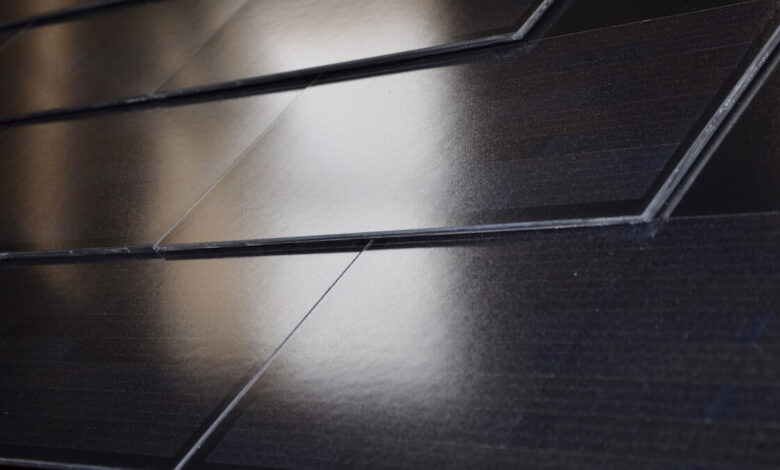
This is exactly where solar roof tiles come in, replacing classic roof coverings and integrating solar modules in such a way that they fit into the overall picture in a much less noticeable way. The Fraunhofer Institute for Solar Energy Systems ISE is also working on a corresponding solution and has now set up a pilot line for PV roof tiles.
Solar Roof Tiles: What is Matrix Shingle Technology?
The solar roof tiles are created in the “SPHINX” (Sustainable Photovoltaics Integration in buildings and Infrastructure for multiple applications) research project, in which several European PV manufacturers and research institutions are involved. The researchers’ goal is to develop cost-effective and quickly deployable building-integrated photovoltaic elements using innovative matrix shingle technology.
These prefabricated modules will be available in different sizes and designs, for example as lightweight components, semi-transparent versions or as solar roof tiles. Fraunhofer ISE has now put a pilot production line into operation for the latter. The first small series are manufactured here on an industrial scale.
The bricks are particularly thin and intelligently connected to each other using matrix technology. This means they have a higher tolerance for partial shading.
“Matrix shingle modules are predestined for integrated applications, especially in building facades and, as here, as PV roof tiles on roofs,” explains Torsten Rößler, project manager at Fraunhofer ISE. “It is precisely there that maximum utilization of space, shading tolerance and attractive aesthetics are important.”
The matrix arrangement allows the current to flow around the shaded areas. According to Fraunhofer ISE, depending on the partial shading, twice the output can be achieved compared to conventionally connected PV modules.
Why solar roof tiles are still too expensive
Since March 2025, 800 shingle modules have already been completed on the industry-related production line. A total of 4,000 roof tiles are to be produced using matrix shingle technology.
Despite the industry-oriented production line, the production of solar roof tiles is currently still very complex. Since elements also have to be attached by hand, the production method is still too expensive for mass production.
In the long term, the researchers not only want to bring their technology to roofs, but also use it for car roofs, hoods, house facades and noise barriers.
The solar roof tiles are currently being tested on five roofs in Switzerland. The roof installation is carried out by the project partner Freesuns, a Swiss solar roof manufacturer. “Our focus in this product development is on applications for existing buildings and especially listed buildings,” explains John Morello, founder and CTO of Freesuns.
Also interesting: