How far can an electric car really go? The Norwegian Automobile Club NAF tested 22 current models under real conditions. The results sometimes differ significantly from the manufacturer’s information. A BMW is surprisingly clear at the top, while a Chinese model remains almost twelve percent below its promise. An overview.
The range of electric cars on paper is one thing, the actual mileage is another. In order to get to the bottom of the discrepancy between the manufacturer’s information and reality, the Norwegian automobile club NAF carries out its large-scale El Prix range test twice a year. For the 2026 summer edition, 22 popular electric cars with fully charged batteries were sent onto the track to test how far they can go.
22 electric cars in comparison: This is how the range test went
To ensure that the conditions are fair and comparable for all vehicles, at the El Prix all electric cars tested drive the same route through Norway on the same day at the same speed. The temperatures on the day of the test were between a mild 12 and 18 degrees, and the roads were dry throughout. The route consisted of a balanced mix of city traffic, country roads and motorways.
However, it should be noted that speeds of more than 110 km/h are rarely permitted in Norway. This relatively low speed for German drivers suits electric cars because it reduces consumption. On the other hand, the route was mostly uphill, which at least partially offset this factor.
The distance traveled up to the point at which a vehicle reduces its performance was measured. Unlike a combustion engine, an electric car does not stop abruptly when the battery is almost empty, but instead switches to a kind of emergency mode in which, among other things, the top speed is limited. As soon as this moment occurred, the NAF testers evaluated the distance covered up to that point.
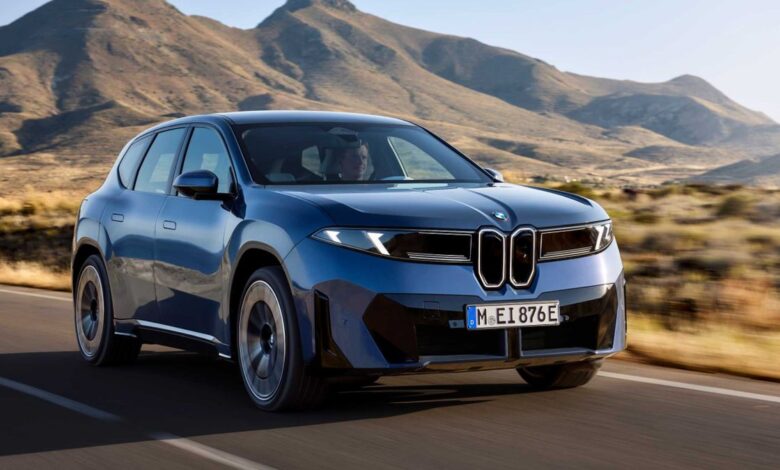
From a German perspective, the results of the study are encouraging. The victory goes to a premium model from Bavaria: the BMW iX3. The electric SUV left all 21 competitors behind and covered by far the longest distance of 781 kilometers. To put it into perspective: This roughly corresponds to the distance from Berlin to Brussels. The second-placed Lucid Gravity only covered 720 kilometers and therefore stopped a full 61 kilometers earlier than the iX3.
Manufacturers often provide optimistic information
In addition to the pure range, another value is particularly interesting: the deviation of the manufacturer’s information from the actual performance. However, the result is not entirely negative, as around half of the electric cars in the test actually drove further than promised. The clear winner in this discipline is the Chinese electric car Xpeng X9, which went 11.4 percent further than stated (646 instead of 580 kilometers). Such a value cannot be taken for granted in a heavy seven-seater.
The bottom performer in this category also comes from a Chinese brand. With a negative deviation of 11.7 percent, the MG IM6 fell well short of expectations and only traveled 446 kilometers instead of the promised 505. This is surprising, especially since the sister model MG S6 achieved an increase of 3.4 percent.
One rule with batteries is to never fully charge or empty them in order to increase their durability. Accordingly, you should never drive an electric car completely empty in everyday life, because in the worst case scenario this can damage the battery. That’s why the NAF also recorded how far each car would have gotten if the test had been stopped with a remaining charge of 20 or 10 percent.
An example that illustrates the relevance of these values is the Toyota bZ4X. In the test, this was able to achieve exactly its specified WLTP range of 506 kilometers. However, with 10 percent remaining battery, he had only covered 429 kilometers. And you really shouldn’t drive any further. So realistically in everyday life it’s more like 429 kilometers instead of 506 kilometers – a difference of 77 kilometers.
And here is the complete table, with all the values of the 22 tested electric cars in direct comparison, sorted according to the full range up to the drop in performance:
| Place | Model | Range to standstill | with 10% remaining battery | with 20% remaining battery | WLTP information | WLTP deviation |
|---|---|---|---|---|---|---|
| 1 | BMW iX3 | 781km | 665.6km | 587.2km | 770km | +1.5% |
| 2 | Lucid Gravity | 720km | 598km | 518km | 748km | −3.7% |
| 3 | Mercedes Benz CLA | 675km | 585km | 514km | 708km | −4.7% |
| 4 | Mercedes Benz GLC | 665km | 578km | 509km | 643km | +3.4% |
| 5 | Xpeng X9 | 646.3km | 560km | 494.6km | 580km | +11.4% |
| 6 | Polestar 3 | 601.1km | 542.3km | 479.3km | 625km | −3.8% |
| 7 | Mercedes Benz GLB | 593km | 520km | 453km | 563km | +5.3% |
| 8 | Toyota C-HR+ | 586.5km | 507km | 457km | 607km | −3.4% |
| 9 | Kia EV4 | 574.5km | 505.3km | 453.1km | 594km | −3.3% |
| 10 | Hyundai Ioniq 9 | 565.8km | 504.4km | 455.5km | 600km | −5.7% |
| 11 | Smart #5 | 556km | 490.1 km | 440km | 540km | +3.0% |
| 12 | Toyota bZ4X | 505.9km | 429km | 400km | 506km | 0% |
| 13 | MG S6 | 501.6km | 447.5km | 401.4km | 485km | +3.4% |
| 14 | Citroën Ë-C5 Aircross | 500km | 430km | 372km | 513km | −2.5% |
| 15 | Mazda 6e | 484km | 428km | 387km | 479km | +1.2% |
| 16 | BYD Atto EVO | 460km | 407km | 359km | 470km | −2.1% |
| 17 | MG IM6 | 446.1 km | 404km | 353.1km | 505km | −11.7% |
| 18 | Changan Deepal S05 | 431.6km | 385km | 350km | 445km | −3.1% |
| 19 | Hyundai Inster | 372.5 km | 342km | 311.9km | 360km | +3.5% |
| 20 | KGM Musso | 369km | 339km | 317km | 379km | −2.6% |
| 21 | Dongfeng Vigo | 347.8km | 321km | 300km | 340km | +2.3% |
| 22 | Kia EV2 | 324.7km | 280km | 250km | 308km | +5.4% |
A look at the models from Germany
In addition to the winner from BMW, three models from Mercedes-Benz and the Smart #5, which also belongs to Mercedes, were also at the start. The two electric SUVs GLB and GLC were each able to exceed their manufacturer specifications by 5.3 and 3.4 percent respectively. They come in seventh and fourth.
For the CLA, the range information had to be reduced by 4.7 percent. This is the third largest negative deviation in the entire test. Nevertheless, the sedan comes in third place in terms of overall range. For the relatively cheap Smart #5 it is at least enough for a place in the middle of the field (eleventh place).
Finally, a little note. The values given above come from a summer test at mild temperatures. In winter, electric car drivers have to expect significantly higher range losses. In the El Prix winter test, all electric cars performed significantly worse.
Also interesting: