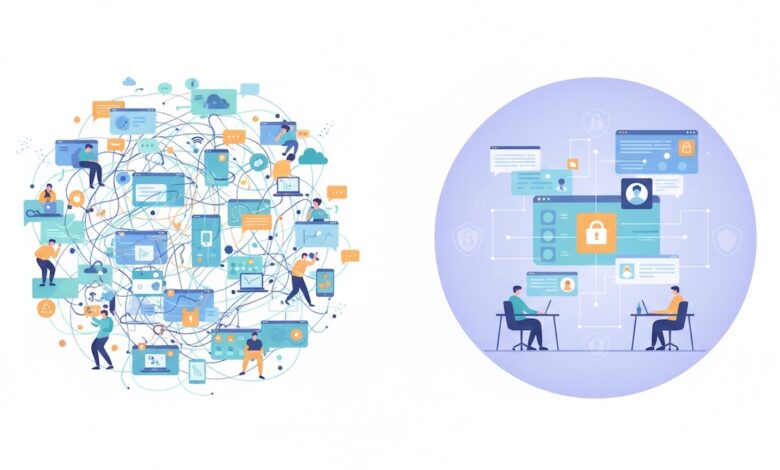
Many companies today appear highly digital: CRM in the cloud, projects in the browser, communication via messenger. But the more flexible the tool landscape becomes, the more difficult it becomes to really control data, communication and access rights. Centralized platforms like Bitrix24 show why less fragmentation often means more security and predictability.
Many companies have long since solved their “digitization problem”, but in return they have created a control problem. CRM, project management, messengers, file storage, accounting and specialized SaaS tools often emerge organically next to each other. Specialist departments decide for themselves what “works fastest”. The result is a digital working world without a clear perimeter.
What initially seems flexible and modern leads to very practical risks in everyday life: fragmented communication, distributed customer data, unclear access rights, shadow IT, complicated offboarding and IT that only tries to document afterwards who accesses what and where. It becomes particularly critical when sensitive business communication ends up on private devices and consumer messengers.
The number of digital tools is not the real problem today. But the loss of control over data, communication and processes.
Digital freedom without perimeters: When overview becomes the exception
A typical SME scenario: Sales works in a cloud CRM, the project team works in specialized project software, management uses a different messenger, HR manages applicants in a separate tool, and there are file storages in various cloud storage systems. In total, five to ten SaaS services are quickly in use. Plus undocumented solutions from individual teams.
Practical questions remain unanswered: Where is the current customer documentation located? Who else has access to sensitive contract documents? Which tools are actively used and which accounts only exist because no one has deactivated them properly? This is exactly where governance begins to become a daily challenge, especially when there is no central platform providing the framework.
Without a clearly defined, centrally controllable working environment, digital freedom quickly becomes a permanent construction site for governance, data protection and security.
Too many functions or finally a controllable infrastructure?
Platforms like Bitrix24, which combine CRM, tasks, projects, internal chats, telephony and document management, are often perceived from the outside as too extensive or too complex. However, first impressions are often misleading. In practice, modern all-in-one solutions have a modular structure.
Companies don’t have to introduce all features at the same time. Unnecessary modules can be hidden, interfaces can be customized per team, and access rights can be controlled based on roles. An HR team does not need CRM access, and sales does not need access to confidential HR data. In Bitrix24, exactly such role and rights concepts can be defined and maintained centrally, instead of distributing them across many isolated tools.
The real advantage lies less in the range of functions itself, but in the controllable infrastructure behind it: companies can gradually activate additional modules without creating new SaaS islands. This significantly reduces the need for additional integrations, accounts and data protection agreements.
What at first glance looks like too many functions is often exactly what makes digital infrastructure manageable, scalable and auditable in the long term.
Discover the GDPR-compliant platform here
Fragmented SaaS landscapes: Governance and GDPR flying blind
It is often said that specialized individual tools are easier to control and therefore safer. In practice, however, things often look different: many companies use numerous SaaS services in parallel. From collaboration and CRM to video conferencing to cloud storage and niche apps for individual teams.
From a governance and GDPR perspective, this creates additional layers of complexity: different user and role models, multiple AVV/DPA contracts, heterogeneous data flows, separate log files and authorizations. It often remains unclear which tool contains which personal data and how long it is stored there.
- Fragmented data landscapes make requests for information and deletion more difficult.
- Multiple systems with partially redundant data sets increase the risk of errors.
- Shadow IT and “fast” SaaS test accounts result in uncontrolled data flows.
- Manual exports between tools (e.g. CSV downloads) create unofficial copies of data.
A centralized work platform does not automatically solve these challenges, but it does make governance noticeably easier: roles and access rights can be assigned uniformly, data streams can be documented more consistently and audit trails can be evaluated centrally. Bitrix24, for example, bundles CRM, tasks, communication and document management in one system and, in the cloud version, offers hosting in German data centers with GDPR-compliant operations.
What matters is not how many SaaS tools are in use. But whether a company can still transparently understand where personal data is located and who is accessing what.
When WhatsApp becomes a company archive: Risks of external messengers
“Why do you need internal chats when everyone uses WhatsApp or Signal anyway?” This sentence is used in many companies. From a user perspective, this is understandable: familiar apps, fast communication, no training. From a communication, GDPR and security perspective, it is a risk. WhatsApp in the company poses clear risks.
As soon as business communication takes place in consumer messengers, company knowledge and customer data migrate to private devices and external infrastructures. Chat histories are outside the controllable system, contacts are stored locally, group chats cannot be administered centrally. At the latest during offboarding, the question arises: What happens to the customer conversations on an employee’s former work cell phone or private smartphone?
- Communication histories are lost or are no longer fully traceable.
- Customer contacts remain on individual employees’ personal devices.
- Phishing, CEO fraud and social engineering take place through uncontrolled channels.
- Companies lose control over sensitive content and metadata.
GDPR-compliant collaboration tools with integrated chat, for example in the form of an internal “work messenger” within a platform such as Bitrix24, offer a different approach here: communication takes place within a controlled framework, access rights can be managed centrally, chats remain in the company even if employees leave. This makes internal communication not only more convenient, but above all more secure and auditable.
As soon as business communication migrates to external or private channels, the company gradually loses control over knowledge, processes and data flows.
The new SaaS reality: predictability instead of low entry prices
Many modern SaaS tools seem attractive at first: low monthly fees, short contract periods, flexible user packages. However, as team size grows and the level of digitalization increases, a different reality emerges: license costs come from many directions, integrations have to be maintained on a permanent basis, and middleware and automation tools are necessary to orchestrate data flows between systems.
In addition, there are onboarding costs for new employees, training for different interfaces, additional administrative effort for user and authorization management as well as a constantly growing integration backlog in IT. Often the actual costs arise not from the individual tool, but from managing the connections between them.
Centralized platforms address exactly this point: Instead of constantly expanding the company with new special solutions, a common basis is created on which teams organize their work. Bitrix24, for example, combines CRM, task and project management, internal communication and document management in one system and also offers options including an on-premise version for maximum digital sovereignty.
Conclusion: Digital sovereignty means controlling your own work environment
The discussion about modern work platforms is often conducted on the surface: How many functions does a tool offer? How modern does the surface appear? How quickly can you try something new? The perspective behind it is more exciting: Which architecture will enable a company to still have communication, data and processes under control in five or ten years?
The real question is no longer how many digital tools a company uses, but whether it can actually control its own digital work environment. Digital freedom remains important, but without a clearly defined framework it quickly turns into confusion and increased risk.
Platforms like Bitrix24 exemplify a more centralized, GDPR-compliant business context: a common database, integrated communication, consistent access rights and the option to activate functions gradually instead of creating new islands. This is not a contradiction to flexibility, but rather the basis for true digital sovereignty in the company.
Check the central work platform now