Why do some summer pots look lush and harmonious, while others appear gappy and disheveled after a few weeks? Most of the time it is due to the composition, not the care. If you want to combine ice begonias, you should pay particular attention to one point: the neighbors must tolerate the same semi-shady place and the same, rather sparing watering as the begonia itself. A sun-hungry bed flower next to it suffers, even though it would be perfectly healthy on its own – and the whole arrangement falls apart.
In short
- Common location – Like the ice begonia, good partners like partial shade, no waterlogging and only a little fertilizer.
- Use foliage color – Silvery, bronze or yellow-green foliage highlights the flowers; white varieties contrast with blue, red with pink and white.
- Proven buckets – Coleus with purple bells, a rose stem planted underneath or fuchsia with fern work reliably.
- Shadow and grave – Ice begonias show their strengths under trees and on easy-care graves.
- hands off – Sun and dry artists such as succulents or Mediterranean herbs do not fit in the same pot.
These requirements determine who suits ice begonias
The ice begonia (Begonia semperflorens) can be recognized by its thick, almost fleshy leaves, which, depending on the variety, shine fresh green or dark bronze. Small flowers in white, pink or strong dark red sit tirelessly above it. As pretty as the plant looks on its own, its real value in the bed lies in how easily it fits in.
It’s best to remember your requirements: a shady to semi-shady place, permeable soil without waterlogging, moderate watering and only sparing fertilization. Any plant with a similar profile is a candidate, any with conflicting requirements is eliminated. This filter works regardless of the flower color, and the same rule of thumb helps with any bed planning – for example when deciding what suits geraniums.
The flowers of the ice begonia are edible and taste slightly sour and lemony – a decorative ingredient for summer salads or desserts.

Color partner: Combine ice begonias according to leaf and flower tone
Ice begonias look most beautiful when the neighbors’ foliage picks up on their flowers or consciously contradicts them. Garden centers roughly sort possible partners according to four foliage moods – a practical guide if you want to determine a color direction in the bed or pot.
| foliage effect | Suitable partners |
|---|---|
| Silvery & cool | Lady fern ‘Ghost’ (Athyrium), silver rain ‘Silver Falls’ (Dichondra), snake’s beard ‘Nigrescens’ (Ophiopogon) as a dark counterpart |
| Green-bronze | Taro ‘Black Magic’ (Colocasia), maidenhair grass (Isolepis cernua) |
| Warm yellowish | St. John’s wort ‘Brigadoon’ (Hypericum), sun gold ‘Persian Chocolate’ (Lysimachia congestiflora), sword fern ‘Rita’s Gold’ (Nephrolepis) |
| Emerald-yellow-green | Yellow larkspur (Corydalis lutea), pennywort ‘Aurea’ (Lysimachia nummularia), small periwinkle ‘Illumination’ (Vinca minor) |
When it comes to the flowers themselves, a simple idea of contrast helps: white ice begonias shine next to shades of blue and purple, for example next to male faithful (Lobelia erinus). Red and pink varieties look most elegant with white and delicate pink. If you like it airier, add magic snow (Euphorbia ‘Diamond Frost’); Sweet potato plants (Ipomoea batatas) or – in a slightly brighter spot – long-flowering verbena plants are suitable for hanging pots.

Three ready-made arrangements for beds and pots
If you don’t want to compose yourself, adopt one of the following combinations. All three share the same requirements for light and water, which is why they work all season long.
Lush pot with coleus and purple bells
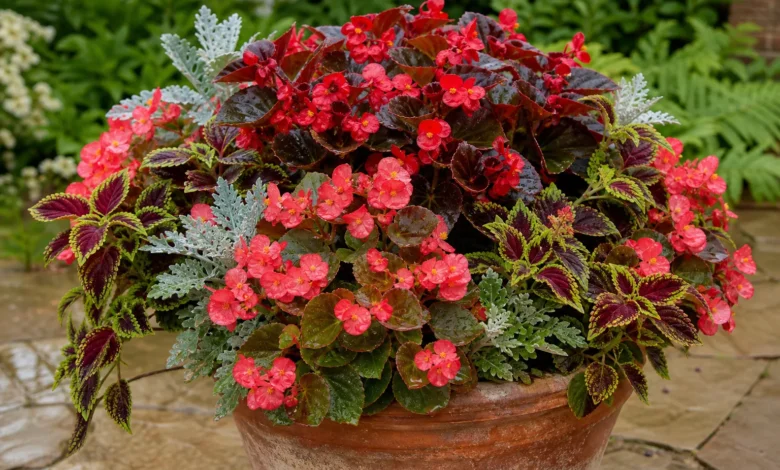
For a pot with structure, place a pink ice begonia (‘Bayou Pink’) at the front and stagger coleus ‘Christmas Candy’ (Coleus) and dark purple bells ‘Palace Purple’ (Heuchera) behind it. Silvery groundsel ‘Dusty Miller’ and climbing ivy ‘Eva’ frame the edge, an upright dragon tree (Dracaena marginata) provides the height. This creates fullness from the overhanging edge to the tip. For a bed with light shade, the same idea works with coleus, caladium and – in a sheltered, warm spot – a hibiscus as an eye-catcher.

Rose stems with ice begonias as living mulch
A rose stem in a pot quickly appears bare at the base. Plant low, bronze-leaved ice begonias (‘Prelude Pink’) underneath as a dense ground cover, complemented by periwinkle ‘Coconut Cooler’ (Catharanthus). The bronze-leaved varieties tolerate the brighter location of the roses well. The side effect is practical: the green cushion shades the soil, it dries out more slowly and you have to water less often. Low rows of lavender look good in a bed next to it – our overview of companion plants for lavender provides suggestions.

Shade pot with fuchsia and fern
In a shady, rather cool corner, ice begonia, fuchsia ‘Hidcote Beauty’ and worm fern (Dryopteris) form a harmonious trio. Just like begonias, fuchsia and fern love shade and consistent moisture, so all three will be happy with the same watering can. The hanging fuchsia flowers, the upright fern fronds and the compact begonia cushions create three heights without any planning effort.

What’s Hot

Terrace and balcony
Blue-purple balcony flowers appear elegant instead of overly colorful
Professional tips for the bucket
- Stagger heights: Hanging at the edge, compact at the front, an upright plant in the middle – this makes the pot appear full instead of flat.
- A substrate for everyone: Only put plants with the same water requirements in one pot, otherwise you will water one dead and the other dry.
- Not too tight: Two to three varieties per 30 cm pot are enough; If placed too close together, the begonias will rot and bloom less.
- Bronze in the sun: Bronze-leaved varieties tolerate more light than green-leaved ones – practical for brighter locations.
Plant ice begonias in the shade under trees
The area under trees and large bushes often remains bare because little light reaches them. This is exactly what the ice begonia benefits from: it continues to bloom reliably even in the shade and covers the ground with color where the lawn would have long since given up. Shade-resistant ferns such as lady fern and worm fern, which appreciate the same cool, partially shaded location, are suitable as partners.
An honest tip: The soil is drier under densely rooted trees because the trees and bushes pull away the water. The ice begonia can handle short dry periods better than many bed flowers, but you should still water during longer heat periods. Our list of ground cover plants for shady locations shows which other species are suitable for such locations.

Ice begonias for grave planting
What is most important in a cemetery is that the plants look good even between two visits. Ice begonias are ideal for this: they bloom from planting in early summer to autumn, require little water and remain low and tidy. Red and white varieties appear calm and well-kept in a simple grave field.
As a permanent border, combine the begonias with an evergreen frame made of small periwinkle (Vinca minor) or low ivy. This frame remains in place when the summer planting changes in the fall and keeps the grave green even during the cold season.

What’s Hot
Garden and plants
8 companion plants for lilacs – and 3 that don’t fit
These partners are not suitable for ice begonias
Just as important as the good neighbors are the ones you save. The most common mistake is a plant that has the same look but completely different requirements. This cannot be compensated for in the same pot or root zone – you can only water once and one of the two loses.
- Succulents and cacti – want it sunny and dry; If the begonias are watered properly, the roots will rot.
- Mediterranean herbs like lavender, rosemary and thyme – need full sun and lean, dry soil.
- Classic sunbathers such as purslane, pelargoniums (balcony “geraniums”) or zinnias – take care of things in the shade and rarely bloom.
If you are unsure, place your desired partner next to the ice begonia for a week as a test and water both of them at the same time. Anyone who becomes exhausted belongs in another bed.
Frequently asked questions
Are ice begonias hardy?
No. Begonia semperflorens is not hardy in our area and freezes to death at the first frost. It is kept as an annual summer plant and replanted every spring. Overwintering is usually not worth it because young plants are cheap and start stronger in early summer.
Do you have to clean out dead ice begonia flowers?
No. Ice begonias are largely self-cleaning: dead flowers fall off on their own, so there is no need to constantly pluck them out. This makes them particularly easy to care for in pots that you don’t keep an eye on every day and for planting graves.