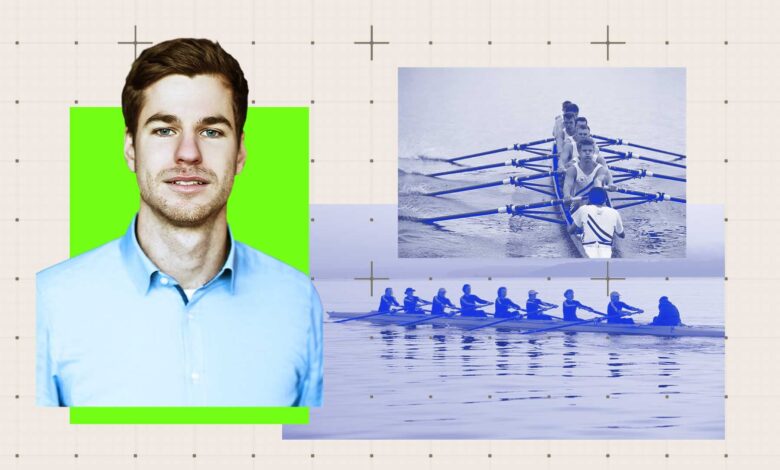
Flavio Holstein wanted to go to the U23 World Rowing Championships. Instead, he founded a startup – and only later realized that he was building for the wrong customers.

Flavio Holstein actually wanted to go to the U23 World Cup. Today, the 34-year-old sells rowing machines for several thousand euros to private customers all over Europe. In between lies an aborted competitive sports dream, a founding at the TU Berlin, weak sales figures and a pivot that saved his startup.
The Augletics company is now located in an industrial area in Königs Wusterhausen near Berlin. Gründerszene was there and looked at the production. In a large hall full of screw stations and mechanics, Holstein develops and sells intelligent rowing machines for training at home. The hall smells of metal and production; at the beginning, Holstein would have done everything here himself, he says to Gründerszene. And a second hall will soon follow; Augletics is growing. But no one would have thought that at first.
From competitive sports to founding a company
Rowing, studying, training. For years, Holstein’s everyday life revolved around competitive sports. His big goal was the U23 World Championship. At some point, however, he realized that although the path to the top was possible, it would not offer him any long-term career prospects.

So he concentrated on studying computer engineering at the TU Berlin. However, the new direction did not last long. With the support of the EXIST start-up grant, he founded his own company just a few months later.
The idea came directly from his time as an athlete: the rowing machines he trained on didn’t convince him. They were loud and provided too little training data. Holstein wanted to improve both: the hardware and the software.

Gründerszene tested the current rowing machine on site: A simple but chic design is coupled with a large monitor on which the various training programs can be used. There is no noise when you start the rowing movement, you glide like you are on water. What’s particularly noticeable is that rowing is almost pleasant and the effort is hardly noticeable.
The wrong target group
Initially, Augletics was aimed at rowing clubs. That seemed logical. After all, Holstein knew the market from his own experience. The problem: the market was too small. There were only a few clubs, and even fewer regularly bought new equipment.
Later, the team also tried to win gyms as customers. But sales remained disappointing. “We sold maybe three or four devices a month,” Holstein remembers. That wasn’t enough for a hardware startup.
Looking back, he says the team thought too strongly about the product. “We were very product-driven in the beginning,” he says. The focus was on the device, not the question of who would actually buy it.
The pivot came at a trade fair
There wasn’t much time left. According to Holstein’s assessment, Augletics would only have lasted a few months with the sales figures at that time. Then came the decisive moment. At a trade fair he noticed that people who had nothing to do with rowing were suddenly interested in the product. “There were people who were actually looking for a sauna for their own home and then got stuck with our rowing machine,” he says.
While only one or two devices were often sold at fitness fairs, eight or nine devices were sold in one day at home fairs. Almost at the same time, orders began piling up in the online shop from people who had never rowed. For Holstein it was clear: the actual target group was not rowing clubs, but private customers.
From sports equipment to design object
Augletics then fundamentally changed its strategy. Instead of building a device for insiders, the team developed a product for people who want to exercise at home. The rowing machine should no longer look like a training device from the club, but rather like a high-quality piece of furniture that fits into the living room. The change of course paid off.
Today, Augletics says it is active in Germany, France, Belgium and Italy. In recent years, sales have grown by around 40 to 50 percent. An important lesson from competitive sports has stayed with him to this day: “Competitive sports are a good school for sticking with it and persevering,” says Holstein. This mentality helped him, especially in the difficult phase before the pivot. Don’t give up, keep improving – until the product and the market finally fit together.