
Three quarters of Germans enjoy AI, but almost as many would prefer to live in a world without it. A new Bitkom study reveals a deep conflict in dealing with artificial intelligence. Why this ambivalence is not a contradiction, what it reveals about our society and why the existential question of AI has long since shifted. A commentary analysis.
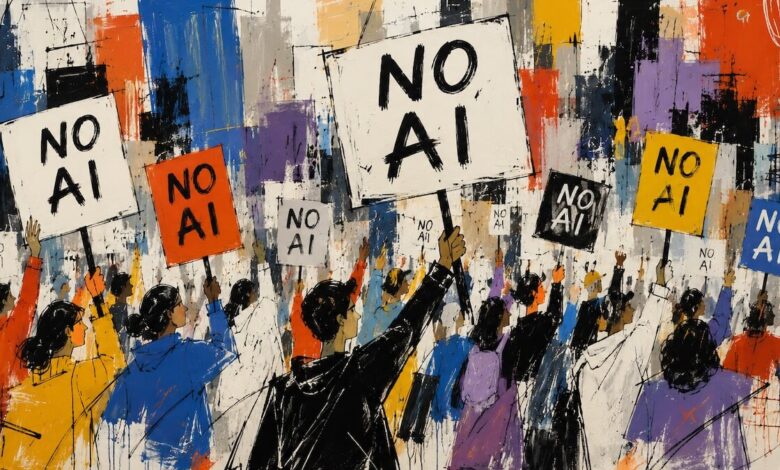
40 percent of Germans want a world without AI
- Around three quarters of users say that they Fun with artificial intelligence have. For 41 percent, AI models are the first point of contact for almost all questions – even before classic search engines. And yet: More than 40 percent of Germans would prefer to live in a world without AI. These are the central results of a current survey by the digital association Bitkom.
- According to the analysis, users usually integrate AI deeply into their everyday lives and expect the technology to have a predominantly positive outcome. At the same time, around 26 percent of those surveyed feel left behind. Almost as many are overwhelmed. The background: There is a mixture Skepticism, uncertainty and rejection towards the increasing spread of AI. The results primarily reflect concerns about control, job loss and social consequences.
- Due to numerous legitimate risks and dangers Many people demonize artificial intelligence and take a defensive stance. According to a study, most people are worried about losing their jobs due to AI. How justified these are is still unclear. What is clear, however, is that AI models will at least change the world of work. Other concerns include the enormous energy consumption of data centers and disinformation. Yes: AI models can also have positive effects – for example by relieving the burden on the healthcare system, in environmental protection or in promoting social behavior and education.
Why the longing for a world without AI falls short
The longing for a world without AI is initially entirely justified Desire for less data misuse, less machine logic and less flood of information. But this world is long gone. Because there will no longer be a world without AI.
It’s not just in chatbots, where God knows cause great damage but in medical software, traffic control, environmental protection, translations or weather models. In other words: in things from which the general public benefits.
Anyone who demonizes AI per se can hopefully only be referring to its disadvantages. These are undoubtedly large and present. But just like all other technologies, artificial intelligence has Advantages and disadvantages. Doomsday scenarios and promises of salvation are at least as naive as technophobia.
AI will neither solve all problems nor automatically eliminate all jobs. Above all, it will automate, accelerate and shift power – mostly in favor of the corporations that control computing power, data and infrastructure. The crucial question is no longer whether AI will come, but rather who controls it and what it will be used for.
It would make sense to use it where social benefit arises: in diagnostics, care, research or energy management. At the same time, there are limits to excessive leisure use with high power consumption or AI-generated disinformation. Because a society that no longer recognizes fakes will at some point no longer discuss truth and the good, but only about untruth and the bad.
What researchers and the Pope say
- Bitkom President Ralf Wintergerst in a statement: “Artificial intelligence has enormous disruptive potential and is changing our everyday lives and our working world at a pace that understandably unsettles many people. The best antidote to uncertainty is knowledge. We need comprehensive offers that give people of all ages easy access to AI, from primary school to vocational school and the workplace to adult education centers for senior citizens. A digital gap must not even arise between people with and without AI.”
- Futurologist Thomas Druyen in an article for Focus Online: “The rapid and historically unique developments in artificial intelligence present us with a central challenge: Anyone who does not keep up with this technology will be left behind in many areas. It is no longer enough to view AI as a technical ‘nice-to-have’. AI is an indispensable part of the future, and we must now ultimately begin to understand it, learn it and integrate it into our everyday lives. This is also the only chance to avoid the dangers and threats associated with AI “anticipate.”
- Relatively at the same time as the new Bitkom study the Pope spoke out. In “Magnifica Humanitas,” his first encyclical, Leo XIV writes about “the preservation of humanity in the age of artificial intelligence,” is the subtitle of the 122-page church circular. It says: We “must ask God for wisdom to correctly interpret the great developments of our time, especially those in the field of technology. (…) The use of AI is never a purely technical matter. From those who design and train the systems to those who use them”. During a presentation, he added: “AI must be disarmed. The word is strong, I know.”
Artificial intelligence as a democratic test
The coming years are likely be less influenced by the question of whether people use AIbut how naturally they do it. Search engines become answer machines, office jobs become control jobs and creativity becomes a collaboration with software. Anyone who still believes that AI is optional or will disappear again could soon look like someone who asked in 2007 whether the Internet would really become established.
But: In the future, the AI divide will not only run between rich and poor, but between people with AI competence and those without access or understanding. But political pressure is also growing. Governments will Need to regulate AI. Not out of anti-technology, but to stabilize the social order.
Questions about copyright, liability, energy consumption and workplace protection are becoming increasingly important. AI could, especially when it comes to disinformation become a democratic test. Because if every voice can be imitated and every image can be manipulated, trust becomes one of the scarcest resources of all.
This could further endanger the already ailing discourse and democracy. And of all things in an era in which information is actually available in unlimited quantities; but possibly sink. Despite it AI will not be able to be turned back. The fact that even the Pope has now commented on this shows how deeply technology has penetrated into fundamental social issues.
AI is therefore final not a toy of the tech elites more, but part of a question of power. The coming years will likely determine less whether AI will change our everyday lives, but rather whether democracies will learn quickly enough to keep up with this change.
Also interesting: