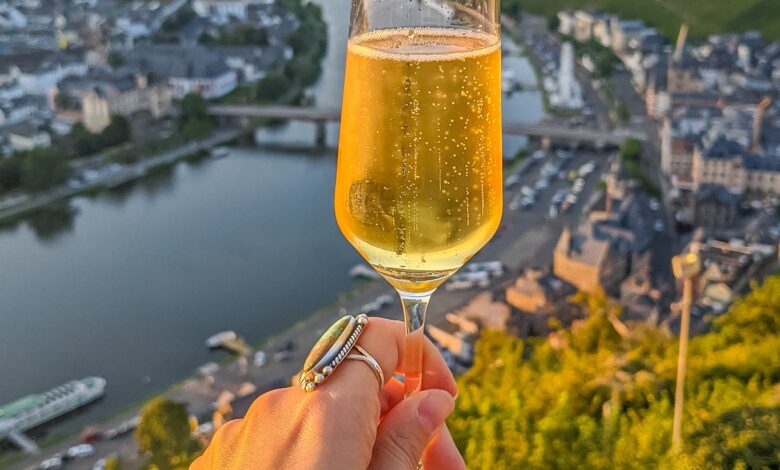
I have to admit something embarrassing… I didn’t know Germany had a famous wine culture (or even one at all) prior to moving to Cologne in 2019. German beer was what I always heard about. Not German wine. I had no idea that wine was such an important industry in Germany. That misconception was quickly dispelled after my first visit to the Mosel Valley!
Characterized by the snaking Mosel river, half-timbered towns, and hilltop castles, the Mosel Valley is a popular summer and fall destination famous for its steep vineyards and Riesling wine.
Spelled Moselle in English or Mosel in German, I will use these two spellings interchangeably throughout this article. The Moselle Valley is still relatively under-the-radar as a tourist destination, especially for North Americans. Hardly anyone I know from the US or Canada is familiar with the Moselle, but now I tell everyone I can. I love traveling in the Mosel! This is the perfect guide for first-time visitors, covering everything you need to know to plan the perfect trip to the Moselle Valley.


Flowing from France and Luxembourg, the Moselle river winds through the hilly German state of Rhineland-Palatinate like a snake, carving these steep massive curves in the hillside to form the Mosel Valley. This picturesque region is renowned for white wine, especially its Riesling.
The Moselle Valley is one of Germany’s most important wine producing regions. Wine production in the Moselle Valley originate from Roman times when they brought grapes to provide a local source of wine for their garrisons. You’ll find that Germans are quite proud of their white wine and Riesling is incredibly popular. In fact, Germany is responsible for approximately 50% of the world’s Riesling cultivation and production. Combined with the Upper Rhine River Valley, this part of Germany produces 70% of all German wine.

Best Time to Visit the Mosel
You can visit the Mosel Valley throughout the year, but you’ll find that tourism peaks from late August to early October during the wine harvest. I have visited the Mosel many times, and the fall is my favorite season here. It is obviously busy, but it doesn’t pose a major hurdle. We booked hotels about a month ahead, and dinner reservations were important. The middle of summer is a lovely time to go because everything will be green and lush with minimal crowds. The weather also permits you to hike and cycle the region more comfortably.

How to Get Around in the Mosel
There are three ways to explore the Mosel Valley on your long weekend itinerary.
Mosel Valley by Car
Both sides of the Moselle River are flanked with two lane roads, sometimes called the Roman Wine Road (Römische Weinstraße in German). Driving in this region is pretty easy. I find the navigation to be simple and the roads are well-marked. If you are short on time or want to cover a lot of distance, this is the easiest way to get around. As long as you are outside the old city centers, parking is fairly easy to come by with free street parking and paid lots.
Mosel Valley by Train
It is fairly easy to travel in the Mosel via train. Deutschebahn connects many of the small towns along the Moselle River. The most common trains are regional trains. They run from Koblenz to Trier with stops in the larger towns of the Mosel. You can book point-to-point train tickets ahead of time, or buy them on the train. If you plan to do a lot of train travel, you can also get multi-day rail passes with Deutschebahn.
Mosel Valley by Bike
Perhaps my favorite way to experience the Mosel is by bike–and I’m not the only one. You will see lots of people cycling in the Moselle Valley! If it is your first time traveling in the Mosel region by bicycle, I have a separate blog post covering everything that you need to know about biking in the Moselle Valley. The bicycle infrastructure is great with bike paths along either side of the river. The terrain is flat and appropriate for all skill or fitness levels.

Day 1: Koblenz to Cochem
Because of its advantageous location at the confluence of the Rhine and Mosel rivers, Koblenz is a perfect destination to start your long weekend in the Mosel Valley. Koblenz ranks among Germany’s oldest cities and bursts with sights from the past 2,000 years. You can see most of the major highlights within a few hours, so dedicate a morning and early afternoon to exploring this historic city. To avoid this post becoming too long, I have a separate Koblenz itinerary covering everything to see & do there.

From Koblenz main station, you can hop on a regional train heading to Cochem. If you prefer to drive, it takes about 45 minutes. The route runs directly along the Mosel River, so you’ll get your first lovely views . Cochem itself is a little touristy (in my opinion), so I recommend staying outside of the Old Town area.
Cochem is fairly well-known because of its beautiful and Instagrammable castle in the center of town. Known locally as Reichsburg, Cochem Castle is precariously perched 300 feet above town along the river banks. You are able to walk up to the castle walls for free without a ticket. The walk up is lined with shops and restaurants, as well as a few parks and nice viewpoints. If you want to go inside the castle, you’ll need to be on a ticketed tour.


Day 2: Burg Eltz + Wineries
One of the most iconic castles in Germany resides in the Mosel Valley — Burg Eltz. You have undoubtedly seen the cloud shrouded valley and stone bridge of this castle on your Instagram feed. It’s relatively remote location also protected it during the war periods, which means it remains largely in its original condition. Eltz Castle is a 30 minute drive from Cochem, or an hour bike ride. It isn’t super easy to access via public transportation, but there are plenty of local operators offering shuttles and local buses.
Because of its notoriety, you can expect crowds at Burg Eltz. For clean, unobstructed photos worthy of your Instagram feed, you should plan to arrive early before it even opens. That’s exactly why I included it as the start of your second day in the Mosel.
Construction of Burg Eltz dates back to the 9th century. This castle has been continuously privately owned by the Eltz family, whose 33rd generation of descendants still maintain the castle today. After paying for a ticket at the castle entrance, you will be whisked onto a 45 minute guided tour through the various Medieval styled rooms. Because one family has consistently owned the castle, you will find the rooms filled with original artifacts, like paintings, armor and furniture. Tours are offered in English and no photography is allowed inside during the tours.


Now that you’ve gotten your cultural activity for the day out of the way, it is time to drink some of that famed Mosel white wine! Wine is deeply rooted in the culture of the Mosel, so you will hear affectionate locals calling it “their” wine.
How to Do Wine Tastings in the Mosel
Unlike other wine regions in the world like Napa Valley, California or Rioja Spain, wine tastings aren’t a big part of the culture in Germany. Germans are more matter of fact kind of people. You come to the Mosel for drinking wine, not tasting wine.
- It is common to go into a wine tavern (Weinstube in German) and order a small pour of whichever wine seems interesting to you. You typically order in milliliters, opting for .1 or .2 liters. There are even special mini wine glasses to accommodate this.
- If you see wine cellars offering free wine tastings, that’s something they’ve set up for tourists. You’ll see wine flights every now and then, but the most common way to sample wines in the Mosel is simply to order off the menu.
- Most of the vineyards in the Mosel are quaint family-run operations that produce mostly for domestic consumption, with some European exports. You can expect to discover some new vintners on your long weekend in the Moselle Valley!
- Riesling wines can be either dry (trocken), semi-sweet (halbtrocken), sweet (lieblich) or sparkling (sekt), although inexperienced Riesling drinkers are likely to find all of them a bit sweet. The white wines of the Mosel are particularly cherished for their refreshing mineral notes and fruity aromas. This flavor profile comes from a characteristic microclimate that exists here, as well as the growing conditions on the steep silty slopes along the Mosel river.

Day 3: Cruise to Traben Trarbach
Now that you’ve explored some of the main attractions in Mosel Valley, why not get out on the river? There are plenty of companies that offer multi-day Mosel River cruises on large river boats, if you are interested in a longer river experience with included accommodation. But it is easy enough to simply take a day trip. It saves you money and gives you more flexibility on where you stop and for how long.
The main ferry boat company, Gebrüder Kolb, offers day trips along the Mosel river. With more than 20 passenger ships, Kolb is the largest provider of boat tours on the Moselle. There are three routes that the boats travel–from Koblenz to Cochem, from Cochem to Bernkastel-Kues and from Bernkastel-Kues to Trier.
You can board the ferry going either direction, and you can get off at any of the ports. I think the middle region from Cochem to Bernkastel-Kues is the most scenic. It has the best assortment of cute small towns, so this would be my recommendation for your ferry ride. The scenery along the winding river is lovely, full of wineries and deciduous forests. It is especially vibrant in the fall colors. The boat has a small cafe so you can order food or drinks while riding along the river. This is a flexible and laid-back way to explore the Moselle at your own pace!


Day 4: Cycling Trip
Prior to my visit to the Mosel, I really didn’t understand how ubiquitous cycling is in this region. Immaculately maintained bike paths line both sides of the river from Trier to Koblenz. Unless you decide to bike up into the wineries or to a viewpoint, the paths are almost entirely flat. Biking along the river is totally manageable for all skills and fitness levels – even if you are not an experienced bike rider! We biked about 80km during our long weekend in the Mosel, simply enjoying the scenery and stopping in whichever towns seemed interesting to us.
Cycling is a nice way to drink some wine at the various wineries you pass without worrying too much about driving in a car or working around the train or ferry schedule. You can also easily stop at any cute towns. It is also possible to bring bikes on the ferry boats (you’ll see LOTS of people doing this), so you could combine day 3 and day 4 of this itinerary.
My husband and I did exactly that. We took the ferry from Cochem to Traben-Trarbach and then biked back from there. We are regular bike riders, although not cyclists, and found this to be a manageable amount of biking for one afternoon.

If you are staying in Cochem, then Beilstein is a great biking destination. It is a 10km bike ride one way, so it can work as a test for your endurance and desire to bike in the Mosel. Maybe my favorite small town in all of Germany, Beilstein has a special place in my heart. This town is one of the best-preserved in the Mosel Valley with an original settlement dating back to 800 AD. You can even visit some ruins of an old castle.
Located on a picturesque bend in the Mosel River, Beilstein is a picture perfect town with coordinating building facades and minimal tourist crowds. It’s like local people purposely paint and decorate the exteriors of their home to match each other. It feels like a living museum, and clearly some tourists treat it that way because you’ll see signs that say things like “We Actually Live Here” or “Private Property, don’t just walk into our house”. The planter boxes and hanging flowers are the cherry on top of this picturesque place!


In my experience, good wine regions are typically accompanied with good food regions. It’s a match made in heaven! The Mosel is no exception. You can find all my top restaurant & food recommendations in the Mosel on a separate blog post. Hardly any other German region has a higher density of award-winning restaurants than the Mosel. Most of the cuisine in the Mosel is regional German fare, including a few noteworthy local specialties. My personal favorite is Flammkuchen, which is a German flatbread.

There are plenty of worthy accommodations at in the Mosel, so you’ll have an abundance of good choices depending on your budget. The key is deciding WHERE in the Mosel to stay, because it will determine how you to organize the schedule. Take for example the following scenarios:
- If you opt to stay in the middle of the Moselle Valley, you can go up the river one day and down the river another day.
- Selecting a hotel that is at one of the ends of the river (such as Cochem) means you will traverse the same stretch of river several times.
None of these are bad options. I have done both approaches, and both worked great! It just depends on your preference or budget. Choosing a unique hotel option, like a wine hotel or a spa hotel, is a way to add a little extra romance and personality to your getaway. A few hotels in the Moselle Valley that I recommend include:
- Hotel Kessler-Meyer: We had a lovely stay at this wellness hotel with a lovely full-service spa. Plus the in-house restaurant offers delicious dinners and a great breakfast buffet.
- Weingut Gehlen-Cornelius: a wine hotel located directly in the vineyards, so you can expect morning chats with the owners and lots of wine drinking. the
- Schloss Lieser: For a truly wonderful stay in the Mosel, this is an ideal luxury option. It is a magnificent and imposing castle built in the late 1800s which has been completely restored in its former glory.
- Das Marienhöh: Although not technically in the Moselle Valley, I loved my stay at this wellness hotel. It’s about a 30 minute drive from the Mosel in a sub-region called Hunsrück, a semi-mountainous region filled with pine forests. The spa is great, the rooms are SO comfortable and the hotel restaurant is delicious.