
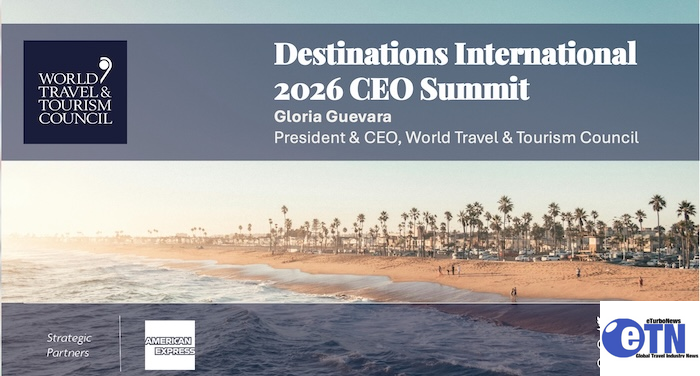
At the Destinations International 2026 CEO Summit in Newport Beach, WTTC CEO Gloria Guevara outlined a $16.5 trillion future for global travel while encouraging destination leaders to shift from growth to stewardship. Her message highlighted sustainability, workforce challenges, and the need for resilient, purpose-driven leadership across the tourism sector.
Newport Beach, California – Global travel is entering a historic growth phase—but without stronger leadership and stewardship, that growth could come at a cost.
That was the central message delivered by Gloria Guevara, President and CEO of the World Travel & Tourism Council (WTTC), during a keynote presentation at the Destinations International 2026 CEO Summit in Newport Beach, California.
Addressing an audience of destination CEOs and senior tourism leaders, Guevara framed the next decade as both an unprecedented opportunity and a defining test for the industry.

Destinations International Home
Destinations International strives to make our members and their destinations successful. As the world’s largest and most reliable resource for destination organizations, we inform, connect, inspire and educate ourselves […]
A $16.5 Trillion Future—and Rising Expectations
According to WTTC data presented at the summit, travel and tourism is on track to contribute $16.5 trillion to global GDP by 2035supporting 462 million jobs worldwide.
The sector has already reached record levels, with $11.7 trillion in GDP contribution in 2025 and 371 million jobs supported globallyunderscoring its role as one of the world’s most powerful economic engines.
But Guevara emphasizes that scale alone is not the goal.
The industry is no longer just recovering—it is redefining its future.
Four Structural Shifts Reshaping Travel
World Travel & Tourism Council
The World Travel & Tourism Council (WTTC) represents the Travel & Tourism sector globally.
At the heart of Guevara’s presentation was a clear framework outlining four forces fundamentally transforming travel demand:
- Emerging markets—particularly across Asia-Pacific, the Middle East, and Africa—are driving new growth, expanding the geographic footprint of tourism
- Domestic travelnow nearly three times larger than international, has become both a stabilizer and long-term growth foundation
- Premium and luxury experiences are reshaping value creation, with travelers prioritizing quality, authenticity, and sustainability over volume
- A generational shiftled by digitally native and values-driven consumers, is redefining expectations across the travel journey
For destination leaders, these shifts signal a move away from traditional volume-driven strategies toward more targeted, experience-led approaches.
From Expansion to Stewardship
Guevara’s most pointed message focused on what she described as a critical transition: from growth to stewardship.
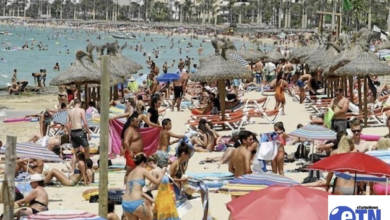
As travel scales, destinations are facing mounting pressures—from overtourism and infrastructure strain to environmental impact and workforce shortages.
WTTC’s priority agenda reflects this shift, highlighting the need to:
- Manage overcrowding and destination impact
- Accelerate climate action and sustainability initiatives
- Leverage AI, robotics, and digital innovation
- Expand connectivity and new travel corridors
- Address talent gaps and workforce development
- Enable safe, seamless travel through digital standards and biometrics
For the destination leaders in the room, the message was clear: success will increasingly be measured not just by visitor numbers, but by how well destinations are managed.
Global Growth Is Shifting East and South
Guevara also highlighted a significant rebalancing of global tourism growth.
WTTC projections show Asia-Pacific leading the next decadewith travel GDP expected to rise from $3.5 trillion in 2025 to $6 trillion by 2035far outpacing other regions.
At the same time, the Middle East and Africa are emerging as high-growth markets, reflecting a broader diversification of global demand.
For destination organizations, this means intensifying competition—and new opportunities—in a more distributed global marketplace.
Resilience Tested by Geopolitics
Guevara also addressed the impact of geopolitical disruption, pointing to the ongoing Middle East conflict as a case study in both vulnerability and resilience.
WTTC estimates the situation is costing the sector $600 million per day in international visitor spendingwhile affecting a region that accounts for 14% of global transit traffic.
Despite this, she noted that travel and tourism has consistently demonstrated an ability to rebound quickly—often within months—provided the right conditions are in place.
A Call to Lead Differently
For attendees at the Destinations International CEO Summit—an event designed to explore the evolving demands of leadership—the WTTC presentation reinforced a central theme: the role of destination leaders is fundamentally changing.
As the sector moves towards supporting one in three new jobs globally by 2035 leaders are being asked to balance:
- Economic growth
- Community well-being
- Environmental responsibility
- Technological transformation
Guevara’s conclusion was clear: the future of travel will be defined not just by how fast it grows, but by how well it is led.
The Bottom Line for Destinations
In Newport Beach, the message from WTTC resonated strongly:
The next phase of global tourism will demand smarter, more responsible leadership.
For destination CEOs navigating an increasingly complex landscape, the challenge is no longer simply to attract visitors—but to ensure that growth delivers lasting value for places, people, and the planet.