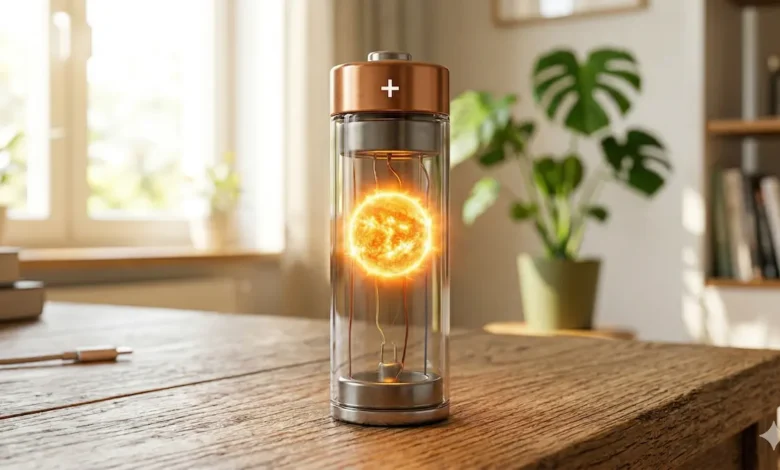
The solar heat goes down with the sunset. But that could soon change. A new solar battery promises to store heat efficiently and even provide twice as much energy as lithium-ion batteries.
Solar heat has a crucial weakness: it disappears as the sun sets. Reliably storing this energy for later use remains one of the biggest obstacles to the expansion of renewable energy. A research team from the University of California, led by doctoral student Han Nguyen, has now presented an interim solution.
At the center is a tiny organic molecule called pyrimidone, which captures sunlight and traps the energy within its structure. Technically, the researchers refer to the system as “Dewar pyrimidone”. The structure is based on the structure of human DNA. To illustrate the principle, the team points to self-tinting sunglasses, which automatically darken in sunlight and become clear again in shadow.
However, instead of changing color, this molecule changes its energy state to store heat and release it when needed. Professor Ken Houk from UCLA supported the project with computer models. Simulations have shown that the captured energy can be stored stably in the molecule for years. The team specifically looked for a configuration that would prevent unwanted energy losses when idle.
Solar battery: how it works and chemical storage
The developed molecule acts like a tensioned spring. Once exposed to sunlight, it switches to a high-energy arrangement. A targeted trigger such as heat or a catalyst acts as a trigger to retrieve the stored energy in a controlled manner. During this process, the material releases the stored energy as heat.
The mechanical tension inside the molecule enables a capacity that exceeds common storage solutions. The energy density achieved is said to be over 1.6 megajoules per kilogram. This value would be around twice as high as the capacity of ordinary lithium-ion batteries, which is around 0.9 megajoules per kilogram. Han Nguyen emphasizes that for this project, the team cut out everything unnecessary to keep the molecule as compact as possible.
From camping stoves to home heaters
In laboratory experiments, the researchers demonstrated that the heat released is enough to bring water to a boil. According to Han Nguyen, this performance enables future applications such as mobile heating solutions for camping meals. The technology is not yet a finished product, but rather a glimpse into the future. However, it opens doors for completely new, off-grid heat sources.
Because the material is water-soluble, researchers could in the future pump it through solar thermal collectors mounted on roofs. There the liquid would charge during the day and then flow into insulated storage tanks. During the night, the system could then use the stored heat to heat living spaces.
The Moore Inventor Fellowship provided financial support for the research project to advance the development of the solar battery. This technology completely decouples the use of solar energy from daylight for the first time. Han Nguyen and his team are providing a new approach to overcoming the biggest bottleneck in the energy transition.
Also interesting: