More than a century after its invention, a battery designed by Thomas Edison is making a surprising comeback. Researchers at the University of California have reinterpreted the nickel and iron-based idea with modern nanotechnology. The result is an energy storage device that can be charged in seconds and could withstand up to 30,000 charging cycles.
The idea of storing electrical energy is significantly older than current discussions about renewable energies and large-scale storage suggest. Inventors and scientists have been developing the first practical batteries and energy storage devices since the 19th century.
This was also the case with Thomas Edison, who introduced a robust and long-lasting nickel-iron battery at the beginning of the 20th century. Since then, the battery market has developed significantly, but the basic principle of electrochemical energy storage has essentially remained the same.
This is exactly why researchers at the University of California (UCLA) have revisited the principle of the Edison battery and modernized it. With the help of nanotechnology, they were able to develop a nickel-iron battery that could withstand tens of thousands of charging cycles.
New nickel-iron battery uses old principle from Thomas Edison
Electromobility, which is much discussed today, often seems like an achievement of the 21st century. But their roots actually go back much further. Around 1900, electric cars were even more widespread in the USA than vehicles with gasoline engines.
Back then, Thomas Edison was already working on improving battery technology for electric mobility. He wanted to make a range of 160 kilometers possible with his nickel-iron battery. The battery charging time should be seven hours.
But the rapidly advancing developments in the internal combustion engine pushed the idea of electromobility out of the picture. However, it has now become the focus of attention again, as powerful batteries are considered a key technology for more climate-friendly mobility.
In an international research project led by UCLA, researchers have now revisited Edison’s approach and developed a nickel-iron battery technology that could be ideal for storing energy generated in solar farms. The work was published in the specialist journal Small published.
The researchers were able to charge their prototype in a matter of seconds. It withstood more than 12,000 charging and discharging cycles, which in reality would correspond to daily charging processes of more than 30 years.
Nickel-iron battery utilizes by-product from beef production
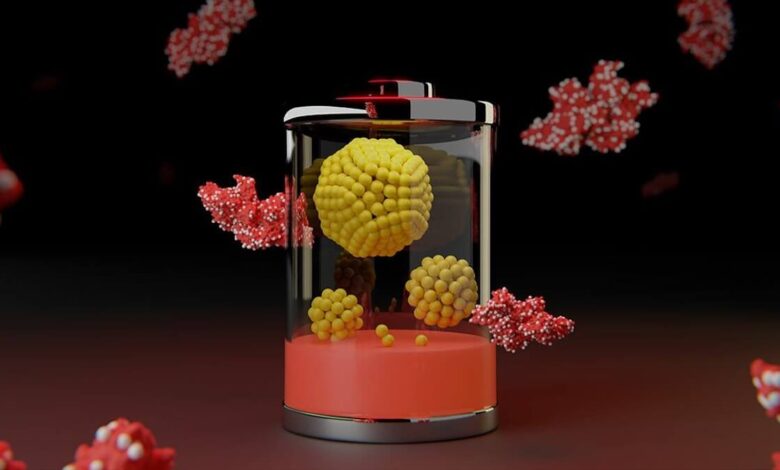
For their development, the researchers developed tiny metal clusters. These are structured with the help of proteins. According to UCLA, the process used is “astonishingly simple and inexpensive.”
“People often think that modern nanotechnology is complicated and high-tech, but our approach is surprisingly simple and straightforward,” explains co-author Maher El-Kady from the Department of Chemistry and Biochemistry at UCLA. “We simply mix common ingredients, apply gentle heating steps and use widely available raw materials.”
During development, the researchers used, among other things, proteins that are produced as by-products of beef production. They were based on the process by which animals form bones and shellfish form their hard outer shells.
The researchers tried to mimic this mechanism to create their tiny nickel or iron clusters. “We were inspired by the way nature deposits these types of materials,” said co-author Ric Kaner, a professor of chemistry and biochemistry at UCLA. “The targeted deposition of minerals results in bones that are strong yet flexible enough not to break. The process is almost as important as the material used, and proteins control the arrangement of the minerals.”
With the help of proteins from beef production, molecules were created that served as templates for the growth of nickel clusters for positive electrodes and iron clusters for negative electrodes. The size of the metal clusters was ultimately less than five nanometers. For comparison: To achieve the thickness of a human hair, around 10,000 to 20,000 clusters would be necessary.
“With these extremely small nanoclusters, the surface area increases dramatically,” explains El-Kady. “This is a huge advantage for batteries. When the particles are so tiny, almost every single atom can take part in the reaction. This means that charging and discharging processes occur much faster, more charge can be stored, and the entire battery simply works more efficiently.”
Are nickel-iron batteries the new lithium-ion batteries?
Despite their fast charging capability and service life, the new nickel-iron batteries cannot yet keep up with the storage capacities of today’s common lithium-ion batteries. But the properties of the development could be used in solar parks as large-scale storage in the future.
“Because this technology could extend the lifespan of batteries to decades, it would be ideal for storing renewable energy or quickly taking over power during power outages,” explains El-Kady. “This would eliminate concerns about rising infrastructure costs.”
The scientists are now continuing to research how their development affects the use of other metals. They are also looking for alternatives to beef proteins. Natural polymers could potentially be used for this, as they are more common and therefore cheaper and easier to scale up for future production.
Also interesting: