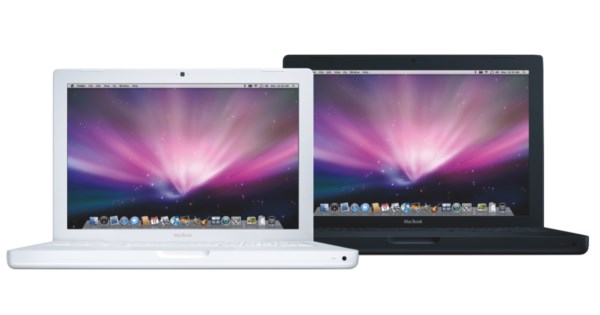
 In May 2006, twenty years ago, Apple introduced the first MacBook. While Apple’s notebooks were called “iBook” and “PowerBook” in the era before the switch to Intel processors, the MacBook Pro came onto the market at the beginning of 2006, followed by the MacBook a few months later. Apple thus completed the Intel transition in the notebook segment, because the MacBook Air did not yet exist at that time and Apple only had to maintain two series. Compared to the iBook G4, the MacBook represented a huge step forward.
 Intel MacBook vs. G4 iBook
Instead of the aging and rather weak G4 chip, an Intel processor with two cores now worked – either 1.83 or 2.0 GHz. Depending on the benchmark, the computing power increased enormously. Compared to the iBook, the MacBook completed demanding tasks like rendering in Cinema 4D or video compression in half to a quarter of the time. Even though Apple switched from dedicated graphics to Intel’s chipset graphics, the new MacBook also performed better in games than its G4 predecessor. When it came to the housing, customers had the choice between white and black plastic – but the latter cost a whopping surcharge of 200 euros. The entry-level model was 100 euros more expensive than in the G4 era, but it also had a slightly larger display (13.3″ instead of 12″) and a hard drive with more capacity (60 instead of 40 GB). Incidentally, the reflective display caused the most discussion; there was no matte option for the MacBook.

Quality problems were varied
A few weeks after the launch, however, it became clear that Apple was struggling with quality problems everywhere. This started with the casing: if it didn’t turn yellow and soon show very unsightly stains, then it was breaking at the edges. Apple had to start a replacement program for both problems. As if that wasn’t enough, the logic board was extremely vulnerable and had to be replaced by many customers. On the software side, the “Sudden Shutdown” bug caused trouble – the MacBook often suddenly switched off completely. In addition, a high-frequency, clearly audible beeping sound occurred in many models. Apple was also only able to fix this error by replacing the logic board.
We also heard several times about heat problems, which Apple fixed with a fan update. This was accompanied by an inconvenience in production – the engineers obviously first had to learn how to use thermal paste – previously Apple had always used pads instead of paste. Numerous images remain in the memory of the MacBook Pro and MacBook processors virtually drowning in thermal paste. Thermal paste that was not applied professionally resulted in the overheating problem becoming even worse.
Still a sales success
Regardless of all the quality problems, the MacBook was still a great sales success for Apple; the notebook performed excellently in test reports. In the same year, Apple presented the second generation and switched from Core Duo to Core 2 Duo – which also marked the transition from 32 to 64 bit for Apple’s entry-level notebook. Almost all of the problems of the first generation were eliminated with generation 2 – except for the case, which broke very easily and continued to show the first cracks at the edges after a few months.