


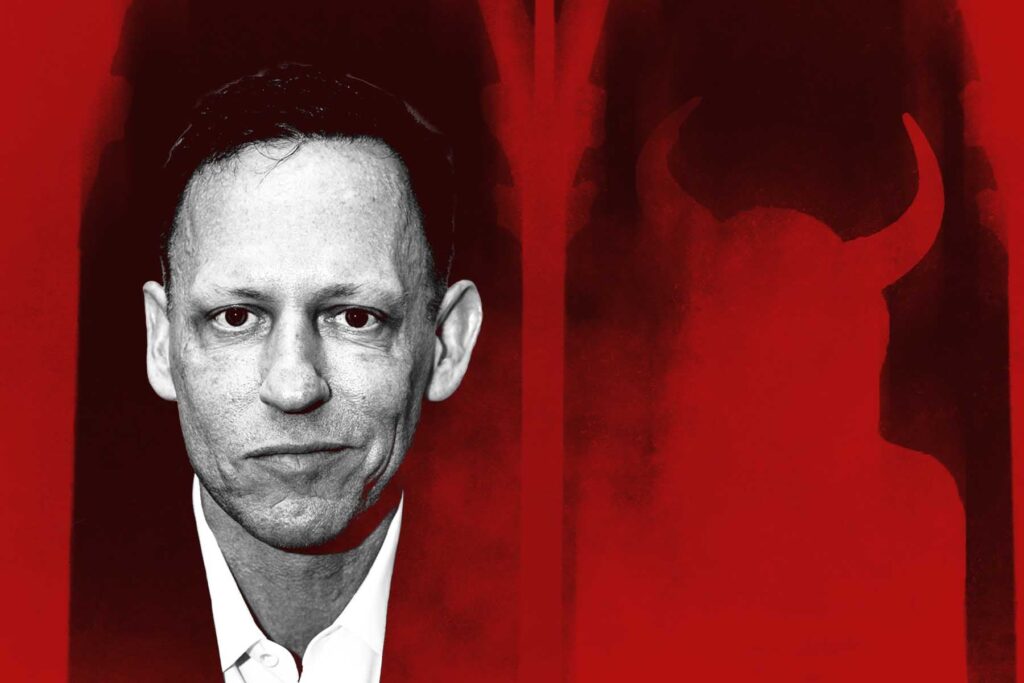

Tech investor Peter Thiel has just given lectures about the Antichrist in Rome. Why is the controversial billionaire so fascinated by the end of the world? We spoke about this with the Catholic theologian and personal Thiel confidante Wolfgang Palaver.
Professor Palaver, does Thiel’s image of the Antichrist coincide with Catholic dogmatics and tradition?
Wolfgang Palaver: You have to look at what you mean by the term. The Catholic philosopher Josef Pieper writes about the Antichrist in “On the End of Time” and builds on traditions according to which he could be a tyrannical world government – this corresponds to Thiel’s position.
Pieper’s thesis is: With every step towards a political world order, the danger of a global state that controls everything grows. The difference from Thiel, however, is that despite this danger, Pieper advocates working towards global political unity where it is necessary – albeit with awareness of this danger.
In addition, there is Catholic social teaching: at the latest with John XXIII. and his social encyclical “Pacem in Terris” calls for a world authority with efficient means. However, this should not be a global state, but should be structured on a subsidiary basis. This serves as a hedge against a tyrannical world state that Thiel fears.
Did Thiel adopt Catholic social teaching?
palaver: Thiel is not a Catholic, but actually a Lutheran; today he represents his own style that deviates from the usual evangelical faith. He read Pieper, but he did not adopt Catholic social teaching. He calls Nick Bostrom and especially Greta Thunberg legionaries of the Antichrist. If he were consistent, he would have to replace the popes since John XXIII at the latest. denote the same. Then conservative Catholics like JD Vance would have to ask themselves: Am I on Thiel’s side or on that of the papal magisterium? He doesn’t, although it is known from leaked tapes of his lectures that he said that JD Vance should pray for the Pope but not listen to him.


Mark Siaulys Pfeiffer/SZ Photo/picture alliance
Is Thiel close to the sedevacantists who believe that there is currently no legitimate pope?
Palaver: I don’t think so. You have to look at the libertarian background. Thiel is influenced by Ayn Rand, for example, and there is an important book that he enthusiastically read in 1997: “The Sovereign Individual” by William Rees-Mogg and James Dale Davidson. This libertarian manifesto predicts that the digital revolution will dissolve the state, politics and democracy. There is also a chapter about the parallel between the decline of the “senile, holy mother church” and the “nanny state”: Just as the Reformation freed believers from the burdensome Catholic Church, the digital revolution will undermine the welfare state. Thiel points to his Lutheran denomination and says the Lutheran Church has never been a centralized, global organization like the Catholic Church. A Christianity compatible with libertarianism is therefore relatively far removed from the Catholic Church.
Is Thiel a Christian for libertarian reasons – or a libertarian for Christian reasons?
Palaver: Of course I don’t have a look into his heart. But I would say: He is already a Christian. And then there are points of contact between Christianity and libertarianism that cannot be overlooked. Libertarianism is an extreme emphasis on individual freedom. Without the Judeo-Christian tradition this would not have been possible. Ayn Rand is also interesting: she is extremely anti-victim. For them, the collective, whether state or church, are all sacrificial machines that sacrifice the individual for the interests of the collective. Thiel was clearly against the Iraq war in 2003. He still says today that we should leave the Islamic countries alone; they have to find their own way. You can feel the libertarian element there. The difference between Ayn Rand and Thiel is that Thiel always saw himself as a religious person.
How did you experience the change in Thiel’s thinking – from libertarian to Trump supporter and acquaintance of the controversial political thinker from the tech scene, Curtis Yarvin?
Palaver: When he supported Ron Paul, it seemed to me to be in the direction of peace advocacy. Then comes this pivot to Trump and JD Vance. My explanation is that he saw a change in the population, a vibe shift. Regarding Curtis Yarvin, I would be cautious about identifying Thiel with him. Thiel says he does not represent Yarvin’s position. If the Catholic neo-integralists succeeded in building an American state based on their model, Thiel would not fit in: as a homosexual with same-sex marriage and adopted children. In this respect, he supports these developments as long as they do not really establish an authoritative state. Katechon light.
Does Thiel really believe in the Antichrist? Or is he just using that as a mental model?
Palaver: You have to see it in context: This antichrist discussion has been going on in the USA for decades: the UN is antichrist, Gorbachev is antichrist. Thiel differs from the millenarians who truly believe that the Antichrist is coming, then the Battle of Armageddon, and then Jesus returns. Thiel says the biblical ideas are not a historical sequence, but a warning. He even differs from Pieper, who gives the impression that he is saying: The biblical writings predict a final catastrophe that Christians must expect.
Does Thiel share René Girard’s idea that we live in apocalyptic times?
Palaver: I think he shares that. I would agree with both Girard and Thiel that we are in an apocalyptic phase of the world. The Doomsday Clock was set to seven minutes to midnight in 1947 and to 85 seconds in 2026 – that’s not what theologians say, but people who simply look at the world situation. Then there are the biohazards, the climate crisis and the dangers of AI. Thiel is betting on a miracle somewhere and believes that technological breakthroughs can be had. He has an interesting essay about Goethe’s Faust, where he shows why technical progress and belief in science go together. And how the Faustian idea of putting one’s soul at risk can be reconciled with belief in God. The bad thing is that he says nothing about the murder of Philemon and Baucis, who oppose the project. Faust risks collateral damage – and that would be my point: if you promote technological advances, please don’t do it like Faust. AI requires “ethics by design”.
But Thiel sees those who talk about the end of the world – like Greta Thunberg – as anti-Christian.
Palaver: His position is: The more we focus on these dangers, the greater the danger of the totalitarian world state. He finds that even worse than the apocalyptic dangers. It’s a bet: It’s better to rush ahead – maybe a miracle will happen – than to create the apocalypse in the sense of a totalitarian world state out of fear.
Is Thiel being too careless with theological categories – or is he questioning himself?
Palaver: You watch him struggle there. If you build the tyrannical world state today, the apocalypse will already be here, he thinks. That’s why it’s better to take a path where it isn’t there yet and take advantage of the ten percent hope that things will go well. But it is not a belief that this will happen. There were interpretations that Girard and Thiel wanted to accelerate the apocalypse – such nonsense.
So Thiel and Girard don’t want the apocalypse?
Palaver: Yes, just. Girard says we need to talk about the issue and take the apocalypse out of the hands of the fundamentalists. In the USA, it is often only fundamentalists who talk about apocalyptic texts. There are reasons to deal with it quite rationally.
The interview first appeared in World.