 Let’s be honest, I didn’t plan on writing about peanuts in Bali. I hadn’t even thought about peanuts. It happened like that. There are several reasons why this article was written. For the first time I see how peanuts are harvested, try a fresh, unroasted peanut and then discover a great peanut snack in a small supermarket. I want to know more about it. Question about the traditional family business Kacang Laksmi Devi Oleh-oleh whether I can visit her. And learn a lot about the snack culture in Bali.
Why peanuts are important for rice fields
Peanuts are legumes. This means that they enrich the soil with nitrogen because their nodule bacteria bind nitrogen from the air. Therefore, they are often grown alternately with rice or corn and function as natural fertilizer. They also use less water than rice, making them an ideal dry season crop.
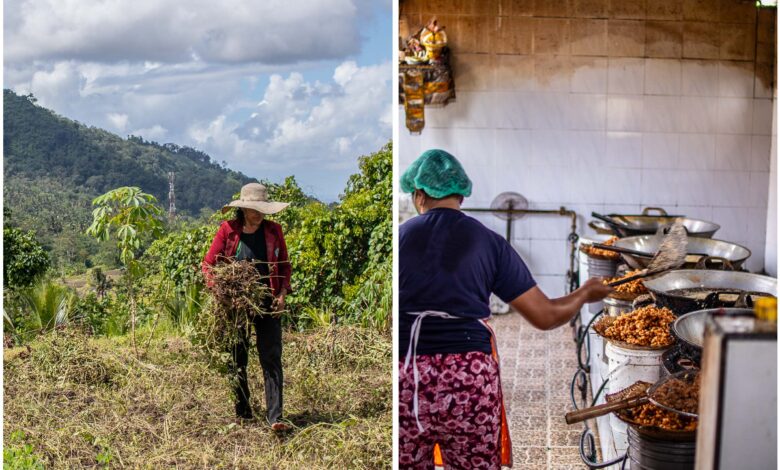
I found out about this when, while walking through the rice fields, I observed a woman pulling supposedly grasses out of the ground and collecting them in large piles. “These are peanuts,” explains my guide. He wants to know if I’ve ever tried a fresh one. I deny. He plucks a nut from the end of a root and gives it to me. A fresh peanut is almost white, tastes slightly grassy but definitely like peanuts.
Botanically speaking, the peanut is not a nut, but a legume – and one of the few plants in the world whose fruits ripen underground after flowering. After fertilization, the fruit carrier grows downwards and presses the young fruit into the soil. The process is called Geocarpy (geo = earth, karpos = fruit) and is unique.
However, compared to Java, West and East Nusa Tenggara and Sulawesi, Bali is rather insignificant when considering the total cultivation of peanuts in Indonesia. Of the 400,000 tons produced annually in Indonesia, only around 2,000 – 4,000 tons are produced in Bali.


Peanuts are everywhere
The first thing you notice in a Balinese supermarket is the huge selection Snacks. Chips and the like dominate here too, but where they appear, peanuts are usually not far away. In a tiny supermarket in Sidemen I discover a peanut mixture that makes me curious. With Garlic, chili and Kaffir lime leaves. This is so delicious that I go looking for it again the next day, but they were sold out. I only discovered it again after I continued my journey to Ubud. Of course, peanuts are not only roasted for snacks, they are also a central part of Indonesian and Balinese cuisine. Gado-gado and satay skewers, for example, would be unthinkable without them Peanut sauce.

Gado-gado with peanut sauce
Oleh-Oleh
“Mana oleh-olehnya?” Where is my souvenir? In Indonesia, culinary souvenirs (Oleh-Oleh) are more than just a gift or a gift. Oleh-Oleh create social bonds and in most cases these snacks are made from local produce. Bringing something with you is basically one cultural duty. Which could be an explanation for why the supermarkets here are so lavishly stocked with snacks. And for me too, peanuts are the perfect travel souvenir. A whopping 3 kilos of peanuts go into the suitcase.

that’s just part of it
A visit to the Laksmi Devi peanut snack factory
It may sound a bit unusual, but business appointments here are preferably arranged via WhatsApp. In our part of the world it is rather exotic to make an interview request via this service, but here it works great. After a week in Bali, I am firmly convinced that this messenger service is absolutely indispensable. So I’m asking Kacang Laksmi Devi Oleh‑oleh Bali whether I can visit her. And the answer comes promptly. In this case, I have to trust the ability of the translation services because all communication is in Balinese. So the next day I’m going there Klungkung. I organize a driver who speaks Balinese and some English. You never know.
From the outside, the building is inconspicuous and cannot be identified as a production facility. This is not unusual for smaller family businesses in Bali. There is also no company sign anywhere to be seen. Again, registration is done via the messenger service (if you want to be polite in Bali, come a quarter of an hour early). The gate is opened and the owner Ketut Raka welcomes me.

top right the owner of Laksmi Devi: Ketut Raka
My journey into the world of peanuts begins behind this gate. Here they are fried, seasoned, packaged and labeled. Everything is handcrafted. The three women packing the peanuts greet me with a smile. I recognize that, despite the face mask. Her eyes are smiling.
Already 1991 The company was founded and has been family-owned ever since. Around 180 tons of peanuts are processed here every year. Some of the peanuts are imported because the demand cannot be met from local cultivation. In addition to the peanuts, the factory also offers roasted beans. Also superbly seasoned and wonderfully crispy.
It quickly becomes clear that I have to rely more on visual impressions because communication is difficult due to my lack of language skills. My interpreting driver is reaching his limits. But it is all the more impressive to observe the deep-frying process. The floor is slippery, but the women at the large woks move with skill. Only women work in the factory. Such divisions of labor are not uncommon in smaller food companies in Indonesia – especially where careful manual work and consistent quality control are required.
A delicious scent permeates the entire area and in front of me lies a whole mountain of my favorite mixture. They also make the spice mixture themselves from lime leaves, garlic and chili and a little flour for that special “crunch”. No artificial ingredients.
For this reason, the nuts only have a shelf life of around 6 months. What is certain, however, is that these wonderful nuts will not see the end of their shelf life for me.
Unfortunately, the family business does not yet export abroad.


What is behind Kacang Koro
Not everything called kacang here contains peanuts. Like the peanut, the Koro bean (Jack Bean / Canavalia spp.) is not a real nut, but a tropical bean. Somewhere between broad beans, chickpeas and lupine. It contains less fat than peanuts and is higher in protein. And it’s cheaper, which is why they like it “Everyday snack” appears.
Roasted, it is incredibly crunchy and more filling than peanuts. I will be very grateful for this on my long drive from the far northwest to the airport.

In general, I am grateful for the opportunity to take a look behind the scenes.
Why snacks in particular often show the most honest cuisine in a country
Many national dishes will eventually be simplified, internationalized and “explained”. Hardly any snacks. They are there and always will be. A bag of Kacang Bali is not altered for visitors to understand.
It exists for locals — tourists just come by chance.