


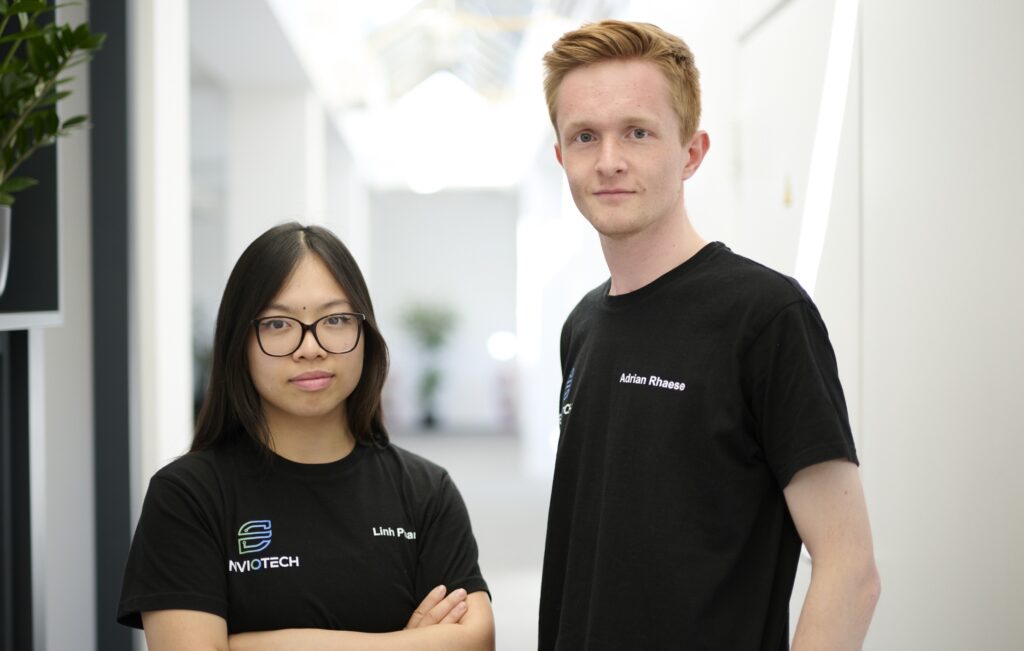
Enviotech from Frankfurt am Main, founded in 2022 by Adrian Rhaese and Linh Pham, develops “intelligent retrofit solutions for street lighting”. Specifically, it is about “intelligently retrofitting existing street lighting instead of having to completely replace it at great cost.”
Business angels such as Jürgen Fitschen, Joachim Drees, Alexander Eyhorn and Danilo Jovicic-Albrecht are investing around 1 million euros in the young company. “Our investors understood that Enviotech is not just a single hardware product, but can become an infrastructure platform in the long term. What was particularly valuable for us was that we were able to attract supporters who not only provide capital, but also bring experience, network and strategic perspective,” says founder Pham.
In an interview with deutsche-startups.de, the Enviotech creator speaks in detail about the state of affairs in her company.
How would you tell your grandmother Enviotech explain?
I would say: Imagine a city has to light its streets at night, but the lamps are often on at full power even though no one is out and about. This costs a lot of money and energy and also disrupts the sleep of many citizens. At Enviotech, we make existing street lights smart. Our technology ensures that light only gets brighter when it is really needed, for example when a person, a bicycle or a car passes by. At the same time, cities can monitor and control their lighting digitally without having to replace the entire infrastructure. In short: We make street lights smarter, more economical and more future-proof.
Was this your concept from the beginning?
The core was the same from the start: we wanted to make existing public infrastructure smarter. We started with the problem of street lighting because it is very tangible: cities are under enormous cost pressure, have to save energy and ensure safety at the same time. What has evolved greatly since then is our understanding of how big the opportunity really is. In the beginning it was all about smart lighting and energy saving. Today we see Enviotech much more broadly: street lights are present everywhere in the city, have power, height and a perfect position in public space. This means they can become the basis for many smart city applications. That’s why we’re not just developing hardware, but also an open dashboard that cities can use to monitor and control their infrastructure and, in the future, integrate additional applications. So it wasn’t a classic pivot, but rather a strong expansion of the vision: from smart street lighting to a digital infrastructure platform for cities.
How has Enviotech developed since its founding?
We developed Enviotech from an initial idea into a real hardware and software product. Today we work at the interface between green tech, smart city and public infrastructure. It all started very classically in Adrian’s garage. The first sketches, prototypes and tests were created there, initially with a lot of improvisation, personal initiative and the aim of solving a concrete problem in everyday life in cities: street lighting should not run rigidly all night long, but should be controlled intelligently, according to needs and efficiently. These first attempts gradually became a technological approach, an idea became a product concept and finally a company with a clear structure, partners and growing market interest. Since then, we have significantly professionalized Enviotech. Our team currently consists of a small, very focused core team with skills in product development, software, hardware, operations and business development. Currently we are 6 people. We also work with technical partners, sensor technology partners and investors who provide us with strategic support. The team is expected to grow to up to 10 people by the end of the year. In doing so, we are consciously shifting from the classic start-up phase to a professional development phase: with clearer responsibilities, stronger product development, initial pilot projects and a structured market entry. We were also recently able to complete a pre-seed financing round of around 1 million euros. This was an important step for us because it allows us to further accelerate product development, initial pilot projects and the establishment of our market presence. The first garage idea has become a growing startup that is now tackling the next phase: from prototypes to scalable applications in municipalities and smart city infrastructures.
How did you get in touch with your investors?
A lot was about networking, trust and persuasion. Especially in the hardware and B2G sectors, it is not enough to simply have a nice pitch presentation. You have to show that you have understood a real problem, that the solution is technically feasible and that there is a realistic path to market. For us, it was crucial that we not only talked about Smart City, but also solved a very specific entry-level problem: Street lighting is expensive, energy-intensive and in many cities has hardly been digitized yet. At the same time, there is a clear economic benefit because municipalities can save costs through adaptive lighting and monitoring. Our investors have understood that Enviotech is not just a single hardware product, but can become an infrastructure platform in the long term. What was particularly valuable for us was that we were able to attract supporters who not only provided capital, but also brought experience, a network and a strategic perspective.
Please take a look back: What has really gone wrong since the company was founded?
Some things, especially with a hardware startup, you quickly learn that a lot of things look easier on paper than they actually are in implementation. We underestimated how complex public infrastructure is. A street lamp sounds simple at first, but behind it there are standards, interfaces, safety requirements, tenders, responsibilities and very long decision-making processes. In addition, hardware development often takes longer than planned. You test, improve, test again and then realize that a detail that seems small is extremely important in real life. We also had to learn in the team and in the organization. In the beginning you do a lot of things at the same time: product, fundraising, sales, partnerships, strategy. It’s easy to get lost there. We had to learn to focus more and prioritize more clearly. But it was precisely these mistakes that were important. They have forced us to move much closer to the reality of cities, operators and infrastructure partners.
And where have you done everything right so far?
I think we chose a real problem from the start. Energy waste in public infrastructure is not a nice-to-have issue, but something that really affects cities financially, environmentally and operationally. It was also true that we did not try to completely replace existing infrastructure. Cities don’t need another vision that can only be implemented in ten years. You need solutions that build on existing systems and quickly add value. Our retrofit approach was therefore a very conscious decision. We also understood early on that Smart City doesn’t start with the technology, but with the benefits. What matters for municipalities is not whether something sounds futuristic, but rather whether it reduces costs, improves processes, increases security and can be realistically implemented. And we have built a strong network of investors, partners and supporters. This helps enormously, especially when you are in a market that needs trust and long-term relationships.
What general tip would you give other founders?
Don’t stay in the perfect theory for too long. You can do a lot of planning, research and modeling, but in the end you learn the most when you talk to real customers, understand real problems and get real feedback. At the same time, I would say: Don’t underestimate how important endurance is. Starting a business often looks glamorous from the outside, but in reality it involves a lot of uncertainty, setbacks and decisions where you never have all the information. My tip would be: Find a problem that is big enough to motivate you even on difficult days. And don’t build for applause, but for real benefit.
Where will Enviotech be in a year?
In one year we want to have brought Enviotech significantly further from the pilot phase towards rollout. Our goal is to implement concrete reference projects with the first cities and infrastructure operators and to show that our solution saves energy in real operation, reduces costs and makes cities smarter to control. At the same time, we want to continue to expand our dashboard and our partner ecosystem. For us, street lighting is the starting point, but in the long term it is about making existing infrastructure usable as a platform for smart city applications. If everything goes well, Enviotech will represent a new generation of municipal infrastructure in a year’s time: not completely rebuilt, but intelligently retrofitted, digitally controllable and significantly more efficient. That is exactly our claim.
Startup jobs: Looking for a new challenge? In ours Job exchange You will find job advertisements from startups and companies.