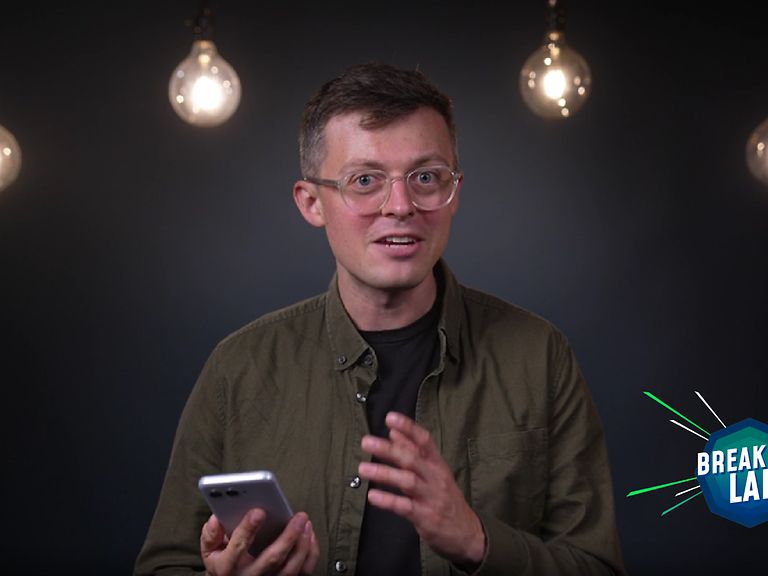
That’s what the current episode of “Breaking Lab” is about – a popular knowledge format on YouTube with over 700,000 followers. Moderator and science journalist Jacob Beautemps takes viewers behind the scenes of the AI revolution.
Artificial intelligence (AI) specializes in recognizing patterns and characteristics. With images, this can quickly require billions of calculation operations. Conventional computer chips reach their limits. So-called AI accelerators, which are new superchips in data centers, enable continuous development – at a rapid pace. How do they work? How does this affect our everyday lives, for example through AI applications such as AI phones or AI agents?
AI is sprinting – hardware has to keep up
AI algorithms are becoming more and more powerful. At the same time, they consume exponentially more computing power and energy. How can they still become faster and faster? This is where hardware with high-performance computer chips comes into play: hundreds to thousands of times more efficient than traditional computer processors, the so-called AI accelerators use less energy and make it possible to process enormous amounts of data in record time. Behind this is innovative technology that is already used in many AI data centers.
Science influencer Jacob Beautemps – known for his clear explanations – explains how these chips work. Its superpower essentially lies in three pillars: Firstly, in improved data flow: The data circulates in the chip like a bloodstream in the body, saving time and energy. Secondly, in mathematical optimization: A “rough look” is often enough: the AI tolerates irrelevant inaccuracies and therefore becomes faster and more efficient. Thirdly, in an innovative architecture: One chip can solve several AI tasks in parallel.
Turbo booster for AI phones and AI agents
AI accelerators are a driving force behind AI becoming faster and better. Their computing power enables many of the innovations that we experience in everyday life today. For example this AI phone from Telekom with AI assistant from Perplexity. The virtual butler provides support with everyday questions. He books a table in a restaurant using voice command and enters the appointment in the calendar. He can digitize photos of texts, summarize them and translate them into other languages. The video shows various practical examples: A photo is enough to make the Breaking Lab studio more attractive. A handwritten note can be digitized in no time. Suggestions for a suitable YouTube video are also provided at lightning speed via voice command.
AI agents work in the background of the AI phone. These are software programs that independently solve tasks for a specific goal – autonomously. You make decisions and learn. And all without constant human accompaniment. They use Natural Language Understanding to understand language. Personalization comes via generative AI, i.e. large language models (LLMs). So-called reasoning skills enable them to draw conclusions. AI agents work with other AI agents as well as with humans.
The video gives insights into technology that you don’t normally see because it’s in data centers. It also shows how practical AI assistants – such as those on the AI phone – are revolutionizing our everyday lives. It’s worth taking a look.
About the moderatorJacob Beautemps is a well-known science journalist and influencer in German-speaking countries. With his YouTube channel “Breaking Lab” he inspires a wide audience with technology and science topics, which he explains in a clear, well-founded and entertaining way. His goal: to make complex connections understandable.