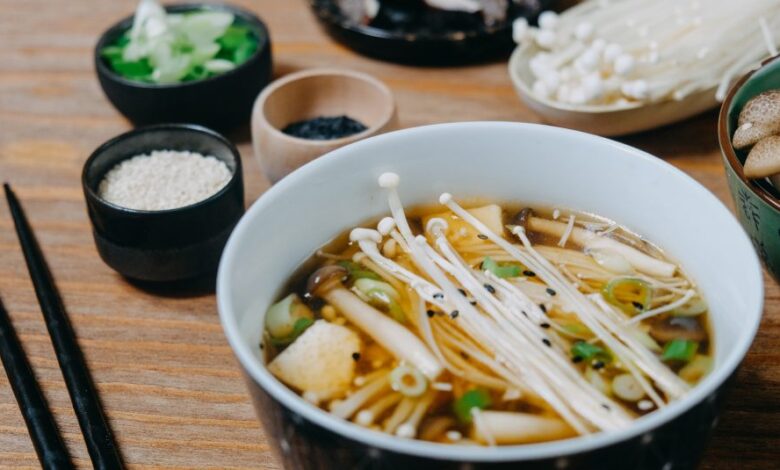
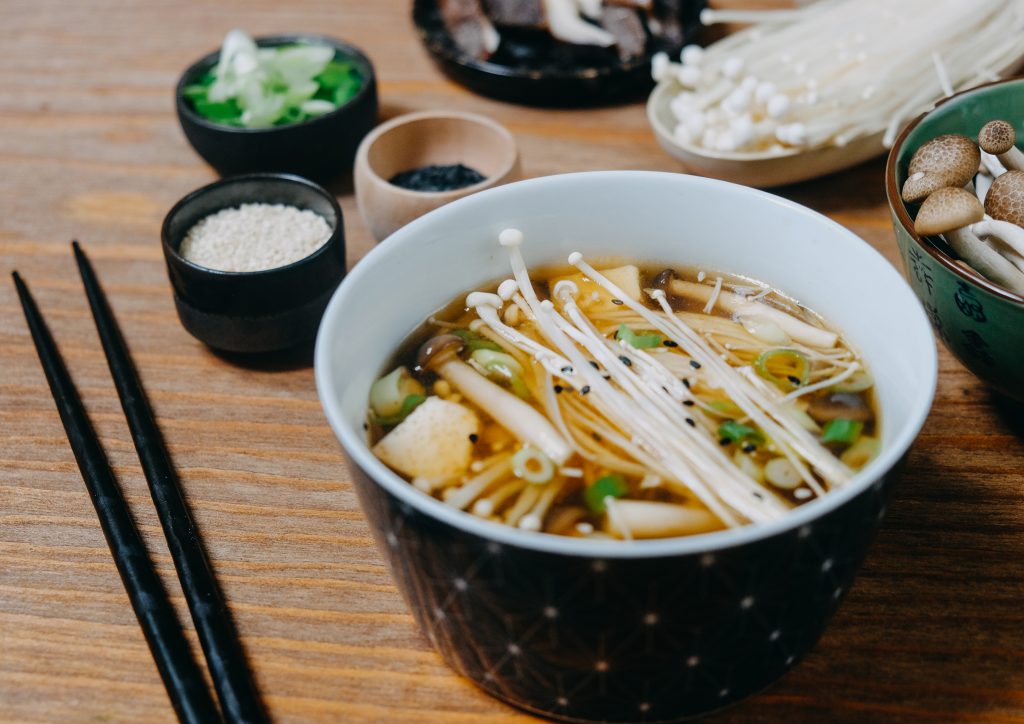
Of course, a recipe for miso soup cannot be missing from our Japan month. But what is probably the most famous Japanese dish next to sushi doesn’t just have a recipe. In fact, there are probably as many variants as there are people in Japan. What they all have in common are the components.
Dashi as the most important ingredient for miso soup
A miso soup always consists of Dashi and Miso. And it starts with the dashi. Dashi is our classic broth. It is traditionally made from seaweed (Kombu) and tuna flakes (Katsuobushi), which are briefly heated in water. Because unlike German vegetable or even meat broths, dashi is ready in a very short time. But since it contains tuna flakes, a classic dashi is not vegan.
Vegan versions are often made only with kombu or with dried ones Shiitake. For our miso soup we chose a vegan version with kombu and shiitake and thus also got a strong aromatic dashi. Dashi is full of umami and is used in a variety of ways in Japanese cuisine.
Since the Japanese often eat miso soup for breakfast, it’s a good idea to soak kombu (and shiitake mushrooms) the night before. So the next morning you only have to heat the kombu briefly before you can use the dashi for the soup. Dashi should always be made fresh. But since it’s so simple (see recipe), that shouldn’t be a problem.
Jump to recipe

By the way, we used real Japanese shiitake for our dashi. We were given these as a gift during Berlin Food Week by Kazu, who is basically Mister Shiitake. His mushrooms from the island of Kyushu are currently only available on Amazon (no affiliate link). Most of the shiitake sold in Asian supermarkets come from China. Although it is the same mushroom, they have a very different aroma. In general, you should always use dried shiitake for more flavor.
Miso paste determines the aroma of the miso soup
The first component is ready. And now? At the Miso it continues. The Japanese seasoning paste usually consists of fermented soybeans, but can also contain rice and other grains. We could probably write an entire chapter about miso. But let’s say this: there is very mild and very strong miso. For our soup we chose a Genmai miso. This is an aromatic miso with brown rice. Here you can simply play with different variants.

The addition of a miso soup
Mixing both ingredients together actually creates a miso soup. But insoles are very popular. The most common ones you probably see Silken tofu, Spring onions and Wakame-Algae. But depending on the season, mushrooms are also included and in the Japanese cookbook there are recipes that also contain eggs, carrots or onions. Here you can give free rein to your appetite. We opted for a more filling layer of silken tofu, spring onions, Enoki-Mushrooms and brewing Shimeij-Mushrooms decided. These are classics in Japanese cuisine and can be found in any Asian shop.
So get to the pots and bring a little Japanese feeling home if you haven’t already tried our teriyaki salmon, okonomiyaki or onigiri. By the way, you eat miso soup with chopsticks and then slurp the soup from the bowl.

Vegan miso soup with mushrooms and silken tofu
for the dashi
- approx. 20 G Kombu from the Asian supermarket
- 4 dried shiitake mushrooms best from Japan
other ingredients
- 3-4 EL Miso paste e.g. Genmai miso
- 40 G Silken tofu
- 80 G brown shimeji mushrooms from the Asian supermarket
- 80 G Enoki mushrooms from the Asian supermarket
- 2 Spring onions
- 1 TL sesame oil
- Sesame seeds if desired
-
Soak shiitake in 250 ml of cold water overnight or for several hours. Cut the kombu into squares and soak in a pot with 1 liter of cold water. (Do not wash the kombu first.) Remove the shiitake from the water and reserve the mushroom water. Cut off the stem and cut the shiitake into strips.
-
Heat the pot of kombu over low heat. Heat until small bubbles form on the bottom. Be careful not to let the water boil under any circumstances as the kombu can become bitter and ruin the dashi. Remove the kombu from the pot. Add shiitake and mushroom water and heat over medium heat for about 8 minutes. Then drain the dashi through a fine wire sieve into a smaller pot.
-
Clean the spring onions and cut them into fine rings. Cut silken tofu into cubes. Clean mushrooms.
-
Put the dashi back on the stove and heat it up.
-
In a small bowl, mix the miso well with a ladle of dashi. Add the dissolved miso to the remaining dashi and heat everything up. Then add mushrooms and spring onions as well as sesame oil and let it steep for 3-4 minutes. The soup doesn’t have to boil.
-
Distribute the silken tofu evenly in bowls and pour in the miso soup. Add some sesame seeds if desired and serve immediately.