


MADRID — More than half a century after the world’s governments chose Madrid as the home of the global tourism body, UN Tourism marked another milestone Monday with the inauguration of its long-awaited new headquarters. The ceremony celebrated continuity and Spain’s enduring support for multilateralism, yet its subdued atmosphere also reflected the challenges facing an organization that has struggled to regain the dynamism many associated with earlier decades.
The nearly 10,000-square-meter headquarters, integrated into the renovated Palacio de Congresos on Madrid’s Paseo de la Castellana, concludes a relocation project first announced in 2019 and repeatedly delayed by political changes, the COVID-19 pandemic, and administrative hurdles. Spain invested approximately €25 million in renovating the building, which was designed according to modern sustainability standards and incorporates the iconic Joan Miró ceramic façade that has long defined the Congress Palace.
A 50-Year Relationship with Madrid
The World Tourism Organization traces its roots to the former International Union of Official Travel Organizations. Following the entry into force of its statutes in January 1975, the organization’s first General Assembly met in Madrid in May of that year and decided to establish its headquarters in the Spanish capital. The Secretariat formally began operating from Madrid on January 1, 1976, launching what has become a five-decade partnership between Spain and the United Nations tourism agency.
For almost fifty years, the organization occupied its modest headquarters on Calle Poeta Joan Maragall, opposite Spain’s Secretariat of State for Tourism. As membership expanded and the agency’s activities grew, the building increasingly proved inadequate for its needs.
Spain first announced plans to relocate UN Tourism to the historic Palacio de Congresos in January 2019, presenting the move as a reaffirmation of the country’s commitment to hosting the United Nations specialized agency. The project, however, became emblematic of bureaucratic delays. Only after a formal agreement was signed in 2022 and construction began in late 2023 did the long-promised headquarters begin to take shape.
A Ceremony Without Celebration
Despite the historical significance of the occasion, Monday’s inauguration unfolded with little of the pageantry often associated with major United Nations milestones.
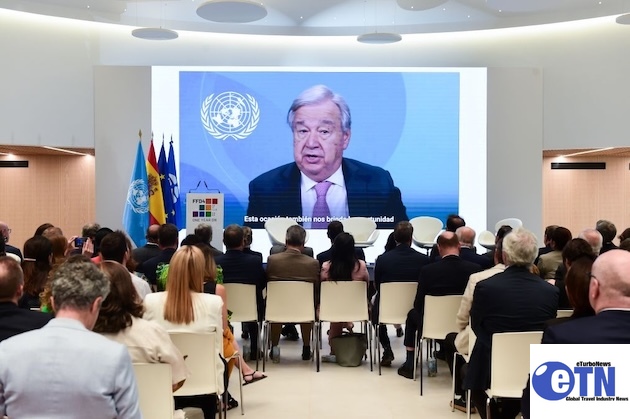
The event was held in a relatively small room, attended largely by Madrid-based diplomats, Spanish officials, and invited guests. There were no major international media events, no keynote addresses by visiting world leaders, and only limited opportunities for press interaction, with Chinese press dominating.
Addressing the ceremony was Spanish Prime Minister Pedro Sánchez, whose wife, Begoña Gómez, remains under judicial investigation in Spain, used the occasion to emphasize Spain’s commitment to international cooperation. Spanish media have previously reported that investigators examined contacts between Gómez and former UN Tourism Secretary-General Zurab Pololikashvili as part of broader inquiries, although no wrongdoing by Pololikashvili has been established and he has not been charged in connection with the investigation.
“We inaugurated the new headquarters of UN Tourism with Miró’s imprint on its facade and, soon, with a work by Canogar. Past and future in the same building: a bridge between eras,” Sánchez said.
“Like Spain, a refuge for multilateralism. A space for encounter, dialogue, and cooperation among nations.”
Rather than attending in person, UN Secretary General António Guterres appeared via a prerecorded video message recorded on June 29.
Your Excellency Pedro Sánchez Pérez-Castejón, President of the Government of Spain, Excellencies, dear colleagues, ladies and gentlemen,
I am pleased to send my warmest wishes as you inaugurate the new headquarters of UN Tourism.
Today is a celebration of the power of travel:
To drive economic growth. Empower local communities. Protect nature and heritage. And build bridges of peace and understanding among cultures and people. For fifty years, Spain – and the beautiful city of Madrid – have been steadfast partners in that mission.
Thank you for hosting the United Nations as we embark on the next stage of this voyage.
This occasion also provides an opportunity to mark another milestone: the election of Secretary-General Shaikha Al Nuwais, the first woman to lead UN Tourism.
Together, these moments signal the beginning of a new era – defined by inclusion, equity, and sustainability.
Through travel, we can learn to love what makes us different and to recognize our shared humanity. At a time of division and mistrust, these connections matter more than ever. May these new headquarters bring our world closer together – and serve as the starting point for many great journeys to come.
Thank you.
A New Era Under New Leadership
The inauguration also marked one of the first major public appearances associated with Secretary-General Shaikha Al Nuwais since assuming office in January.
During her election as the first woman to lead the organization represents a historic milestone, she has maintained a significantly low public profile during her first months in office, with limited media engagement and no opportunities for journalists to ask questions.
Supporters argue she inherited an institution requiring rebuild carefuling. Critics say the organization faces a broader challenge of restoring its visibility and influence within global tourism governance.
From Vibrant Partnership to Isolation
For many long-time observers, the opening inevitably invited comparisons with an earlier period when UN Tourism was widely regarded as a more energetic platform for international tourism leadership.
Former Secretary-General Taleb Rifai frequently described the relationship between UN Tourism and the World Travel & Tourism Council (WTTC) as being “like Siamese twins,” emphasizing close cooperation between governments and the private sector.
That collaborative spirit has, in the view of many industry veterans, largely faded in recent years as the organization has become increasingly isolated from parts of the global tourism community. Critics argue that over the past eight years, institutional divisions and governance controversies have weakened its standing and reduced engagement with many traditional partners.
Today, while UN Tourism remains the only United Nations specialized agency dedicated exclusively to tourism, its most visible global contribution is often seen as producing international tourism statistics and policy reports rather than serving as the central convening force it once aspires to be.
It was no surprise that WTTC CEO Gloria Guevara and members of her team were in the audience, invited by the Spanish Government, but were neither recognized nor invited to address it by UN-Tourism.
UN Tourism Opening event had little connection to tourism
Unfortunately, the event had little to do with tourism and was all about a UN System coming to Spain and a dialogue panel with the WHO, IFAD, and IFC discussing multilateralism, but not related to tourism.
A Symbol of Hope—or Simply Another Building?
Architecturally, the new headquarters is widely regarded as a success. The modern, sustainable building provides facilities that the organization had lacked for decades, including a new auditorium, exhibition areas, meeting rooms, and environmentally efficient systems.
Whether the building becomes the foundation for a renewed organization remains an open question.
For supporters, it represents a fresh beginning and a visible investment in international cooperation.
For skeptics, Monday’s quiet inauguration—without major speeches, broad media attention or visible international enthusiasm—felt less like the start of a new chapter than the completion of a long-delayed construction project.
The building may be new. Whether it can help restore the relevance and influence of UN Tourism in an increasingly fragmented international landscape is a question that only the years ahead will answer.
