


Uganda possesses some of Africa’s greatest natural treasures and warmest people, yet repeated government crackdowns on media freedom, LGBTQ rights and civil liberties continue to overshadow its tourism ambitions, international partnerships and growing aviation investments, raising serious questions about the country’s global reputation and future economic potential.
Uganda should be one of the easiest countries in Africa to celebrate.
It is a land of mountain gorillas, crater lakes, thunderous waterfalls, vast savannahs, the source of the Nile, and some of the warmest people a traveler can meet anywhere in the world. From Bwindi to Kidepo, from Kampala’s restless energy to the quiet dignity of rural communities, Uganda has a natural and human richness that few countries can rival.
Its people are resilient, entrepreneurial, and hospitable. Its tourism industry has fought hard to sell a hopeful story: that Uganda is not merely a destination, but an experience — wild, beautiful, generous, and unforgettable.
But again and again, that story is being damaged by the country’s own rulers.
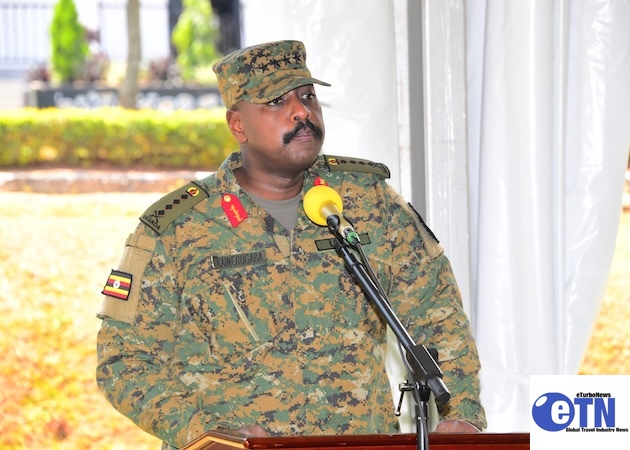
The latest blow came when Uganda’s military chief, Gen. Muhoozi Kainerugabason of Uganda’s president Yoweri Museveni, who has been ruling the country since 1986, ordered the shutdown of major independent media outlets, including Daily Monitor and NTV Uganda. In public comments, he declared that he did not believe in a free press. Soldiers were deployed to media premises in Kampala, preventing staff from entering or leaving.
For any country, this would be alarming. For Uganda, it is another wound in an already battered international reputation.
A nation cannot market itself as open to the world while closing the spaces where its own citizens speak. It cannot invite tourists, investors, and airlines with one hand while using the other to intimidate journalists, opposition voices, civil society, and vulnerable minorities.
Uganda’s government wants global confidence. Its actions repeatedly destroy it.
The contradiction is especially strong because Uganda is pursuing an ambitious aviation and tourism future. Construction has begun on Kidepo International Airport, a project promoted as a gateway to Kidepo Valley National Park and the wider Karamoja region. The vision is bold: connect remote tourism jewels directly to international markets, attract investment, expand air links and position Uganda as a stronger East African hub.
In a world where instability in parts of the Gulf and Middle East can disrupt air corridors and travel planning, Uganda clearly sees opportunity. A better-connected Uganda could offer alternative regional routing, new safari circuits, and stronger links between Africa, Europe, Asia, and the wider world.
That ambition deserves attention.
Home – Uganda Tourism Board
But airports do not build a national brand by themselves. Trust does.
A runway can bring an aircraft to the ground. It cannot persuade visitors that a country is safe, free or predictable. It cannot reassure investors that institutions are independent. It cannot erase headlines about media repression, anti-LGBTQ persecution, political intimidation controversial or migration deals.
Uganda is also trying to protect its tourism sector while dealing with Ebola concerns. Public-health officials, conservation workers, and tourism operators have every reason to want calm, factual reporting rather than panic. Travel and tourism bodies have stressed that Ebola risks must be handled with facts, coordination, and targeted health measures.
Yet this is precisely why a free press matters.
When governments suppress independent media during a public health challenge, they do not inspire confidence. They create suspicion. Tourists need reliable information. Airlines need reliable information. Communities need reliable information. Investors need reliable information.
Censorship does not protect a tourism industry. It poisons the trust on which that industry depends.
The same is true of Uganda’s treatment of LGBTQ+ people. The country’s harsh anti-LGBTQ laws and rhetoric have drawn international condemnation and damaged Uganda’s image among many travelers, governments, donors, and global companies. Whatever the government’s domestic political calculations, the message sent abroad is unmistakable: Uganda’s beauty is open to visitors, but its freedoms are not open to all.
US-Uganda underground dealing
Now, another issue complicates the picture.
Uganda has agreed to receive some third-country deportees removed from the United States — people sent not necessarily to their own countries, but to a country with which they may have no meaningful connection. Human-rights advocates have warned that such arrangements can leave people exposed, disoriented, and legally vulnerable.
For Uganda, already one of the world’s major refugee-hosting countries, the optics are serious. The country risks being seen not only as a tourist destination, but as a place where powerful nations can export difficult political problems.
That perception may be unfair to ordinary Ugandans. But an international reputation is not built only on what citizens are. It is also built on what governments agree to, tolerate, and enforce.
And this is the tragedy.
- Uganda’s people are not the problem.
- Uganda’s landscapes are not the problem.
- Uganda’s tourism workers, guides, conservationists, hoteliers, artists, farmers and entrepreneurs are not the problem.
The problem is a political culture that seems increasingly comfortable with sacrificing the country’s image to preserve control.
- Every time journalists are silenced, Uganda loses credibility.
- Every time minorities are targeted, Uganda loses goodwill.
- Every time political power behaves as though criticism is treason, Uganda loses the confidence it needs to grow.
The country’s leaders may believe they are projecting strength. To the outside world, they are projecting fear.
And fear is bad for business.
Tourism is emotional. Visitors choose destinations that make them feel welcome, safe and inspired. Investors choose countries where the rules are predictable. Airlines choose routes where demand, reputation, and stability align. No government can bully its way into becoming a trusted global hub.
Uganda could be one of Africa’s great success stories.
- It has the wildlife.
- It has the landscapes.
- It has the people.
- It has the location.
- It has the ambition.
But ambition without freedom is fragile. Infrastructure without trust is hollow. Tourism promotion without human dignity is hypocrisy.
The Pearl of Africa still shines. Anyone who has seen its mountains, rivers, wildlife and people knows that.
But the shine is being dulled by a government that repeatedly turns global admiration into global concern.
Uganda does not need to be rescued from its people.