



Fixed-line customers are now also benefiting from Telekom’s mobile communications expansion. Modern hybrid routers combine the network capacities of LTE and 5G with the existing fixed network speeds. Hybrid technology can be a real data boost, especially in regions with limited internet speeds. Telekom developed this technical innovation on its own. You can find out here why hybrid technology is an important step into the new world of fiber optics.
5G for the home network
Even without a fiber optic connection, up to 500 Mbit/s download and 50 Mbit/s upload are possible with hybrid technology. An example: With Internet connections with download speeds of 16 MBit/s, customers can receive up to 100 MBit/s in their home WLAN network by using Hybrid. With download speeds of 50 Mbit/s it can even go up to 250 Mbit/s. This brings a lot of speed to the home network.
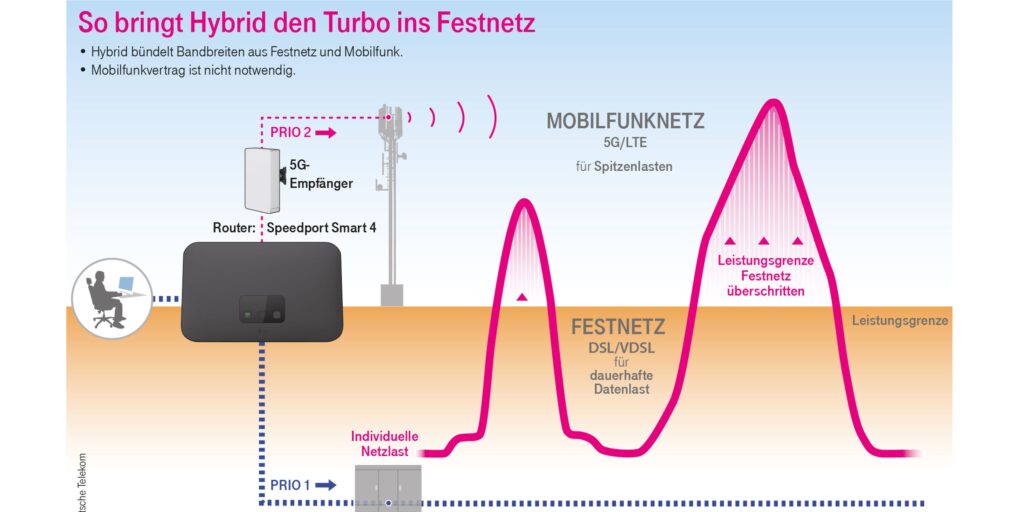
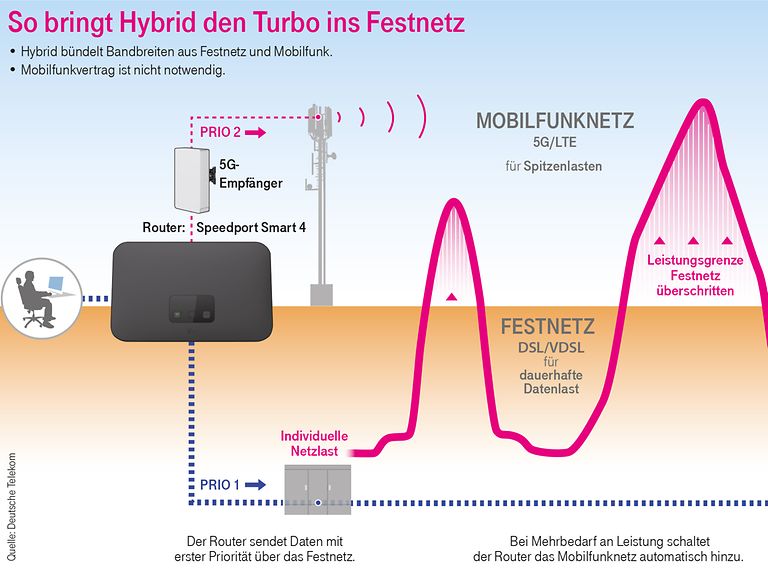
In order to achieve these high speeds, a lot of high-tech is used: firstly, a suitable router, such as the Speedport Smart 4, and secondly, a weatherproof mobile radio receiver. This processes the LTE and 5G signals and is connected via a network cable and attached, for example, to the outside facade or a window sill. The special thing about hybrid technology is how this hardware duo combines the bandwidths of landline and mobile communications. The interaction only begins when the fixed network reaches its performance limits but the data requirement is higher.
Mobile communications kick in during load peaks
If, for example, the whole family surfs the Internet and a lot of data is transferred while streaming or gaming, additional performance requirements may arise in these phases. The router recognizes if the landline line is no longer sufficient in such a situation. In other words: The landline line always has the highest priority and is fully utilized first. If the mobile network is then used as a supplement, so-called “bonding” takes place. This “bonding” is the actual hybrid functionality and at the same time describes a technical masterpiece.
If you look at the technical descriptions, it sounds like this: The home gateway (i.e. the hybrid-capable router at home) works together with the hybrid access aggregation point (HAAP) during “bonding”. The HAAP is a special hybrid server in Telekom’s mobile network. The two components, i.e. the Home Gateway and the HAAP, share and bundle the data streams using software. Two separate tunnel connections are set up: one via DSL/VDSL and one via mobile communications (5G / LTE). These tunnels are then merged in the router to provide a seamless connection.
At the same time, a mechanism is used that is technically called “coloring”. “Coloring” ensures the prioritization of data packets. Green packets are sent via the classic landline network (DSL/VDSL), while yellow packets are transmitted via mobile communications (5G / LTE) when the DSL/VDSL connection is busy. This means that the available bandwidth is always used optimally. In addition, there is so-called “bypass” traffic. This includes all IP packets that are not tunneled within the hybrid session. Such packets are always sent directly via DSL/VDSL.
Does it all sound quite complex? In any case, the Speedport 4 router is the router that can handle all of these tricky tasks and has integrated this hybrid functionality. If you want to know more about the interfaces and If you want to find out more about the functionality, you can take a look here.
Hybrid is a clever transitional solution on the way to fiber optics
Telekom is continually expanding and modernizing its mobile network. The majority of their cell phone towers are connected with fiber optic lines. Hybrid fixed-line customers therefore benefit from Telekom’s high-performance mobile network.
Reading tipTelekom’s ultra-capacity network
At the same time, the company is constantly expanding its fiber optic network and already offers fiber optic connections to 12 million households and companies. However, as long as customers cannot yet access Telekom’s fiber optic offerings, hybrid solutions are an option as a transition. These include, for example, hybrid-capable routers such as the Speedport 4, which combine the bandwidths of landline and mobile communications. Other solutions are Vectoring– and supervectoring offers. Here, Telekom’s fiber optics already extend to the gray distribution box in front of the front door. Special software is used to make the copper lines faster over the last mile during vectoring, so that 100 Mbit/s or up to 250 Mbit/s are available for download at home. If you also use a hybrid-capable router, you can even bring up to 500 Mbit/s into your home network.