


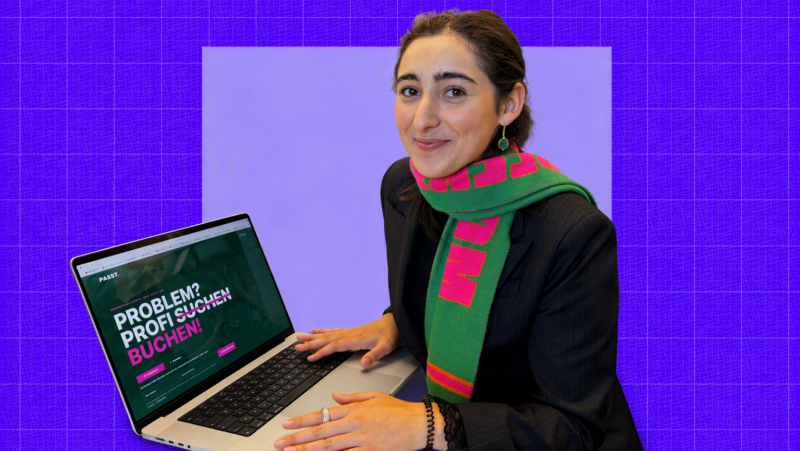
The important AI chatbot in your service app no longer works. Our super founder Suna Marie Tamboga solves the problem with a new concept.


Suddenly the chat is down. It is the key feature of the app. And Suna Marie Tamboga is at a loss. “We threw in some prompt and after that he just stopped answering,” she says. The 20-year-old looks for the error. She checks the code and programs the chatbot. Then the AI responds again. But just repeats Suna Marie’s input “and always asked: ‘Do you mean that?'”
The bot remains broken. So Suna Marie rebuilds her service after three weeks of work. She now wants to realize her vision of a “Doctolib for craftsmen” in a different way at the “Start-up scene is looking for super founders” summer camp. As one of eight fellows, she is developing her own consumer app. Tech and business professionals help you as personal coaches.
Read too


After errors in the test phase: This is how the craftsman app should work
Suna Marie calls her platform “Fit.” It is intended to bring households together with craftsmen. She describes the need as follows: “Customers are calling around, writing emails and getting no response.” At the same time, “companies receive a lot of emails and calls that don’t suit them at all. Most people simply don’t know whether they need an electrician, a plumber or another tradesman.” Your app should query customers directly for all information and automatically arrange appointments with the right tradesmen.
Suna Marie is still in the test phase and is looking for craftsmen to “fit”. She created a Minimum Viable Product (MVP) to collect feedback and further develop the product. After the chatbot fails, Suna Marie and her coach Till Kolter develop a new workflow that collects details about damage. To do this, they use Codex, OpenAI’s vibecoding model. This allows you to write code per prompt.
She looks to competitors for inspiration. She clicks through competing products and analyzes their user experience. “I mainly looked at what I didn’t like and how I could make it better,” she says. From these observations, she designs a new concept for her app step by step.
Read too

Users will soon be able to upload a photo of their damage to “Passt” and enter a short voice memo. The app transcribes the information and then asks specific questions in a questionnaire: How long has the problem existed? How urgent is it? When would an appointment be possible? Do you live in a rented or condominium? The idea is that the app uses this to find a match.
Suna Marie builds a click demo that shows what the process in her app should look like later. She writes a long prompt for this. “I recorded my vision in Codex. Then I gave the order: Keep asking questions until we have a very detailed text,” she says. The AI queries various scenarios: What happens if a customer has been matched? What email does he receive? How does onboarding work for plumbing companies? And how does the platform handle requests that are still incomplete? Suna Marie walks through the entire process from the customer’s perspective. It defines every decision, every status and every notification.
The answers create a comprehensive prompt that determines the principles according to which “fit” should work. It serves as the basis for the new prototype.
Advertising professionals give tips for marketing
Suna Marie also has another topic on her mind in week three: marketing her app. Two advertising professionals visit the founders: Kai Lentering and Simon Knittel from the Jung von Matt Start advertising agency. They specialize in logos, design and names for startups. They now further develop the fellows’ brand identities in individual coaching sessions.


They like the name “Fit”. But the problem they see is that it doesn’t tell new users what the platform stands for. That’s why they recommend consistently combining the brand name with a message: “Find the right craftsman”. The slogan explains the usefulness of the app.
The experts also give Suna Marie tips for an advertising campaign she is planning. For this purpose, she created eye-catching meme-style posters. Here too, she should focus on the slogan. However, a “loud” approach could help to reach so-called early adopters. These are people who are open to new ideas and could become Suna Marie’s first customers.
“The fact that professionals said they liked my ideas and posters strengthened my vision. That gave me security,” she says.
Read too

Suna Marie’s top learning after three weeks
Suna Marie’s most important learning: “I had already focused a lot on sales because I’m better at it. Now I had to take a step back and accept that I first have to implement the product properly.”
Conclusion of the week: “I always define goals for myself and then the timelines shift again. I often can’t estimate how long the product will actually take and I’ve never really narrowed down the goal before.”
Suna Marie’s goal for week four: “Get the product ready as quickly as possible,” she says. She also made appointments with other first craftsmen. “And then I try to do everything at the same time – product, sales and marketing. Those are my three pillars.”
Do you have questions or want to talk to the fellows about their product? Write to them here.
“Start-up scene is looking for super founders” powered by Dash0, DHL, OpenAI & Vercel.