


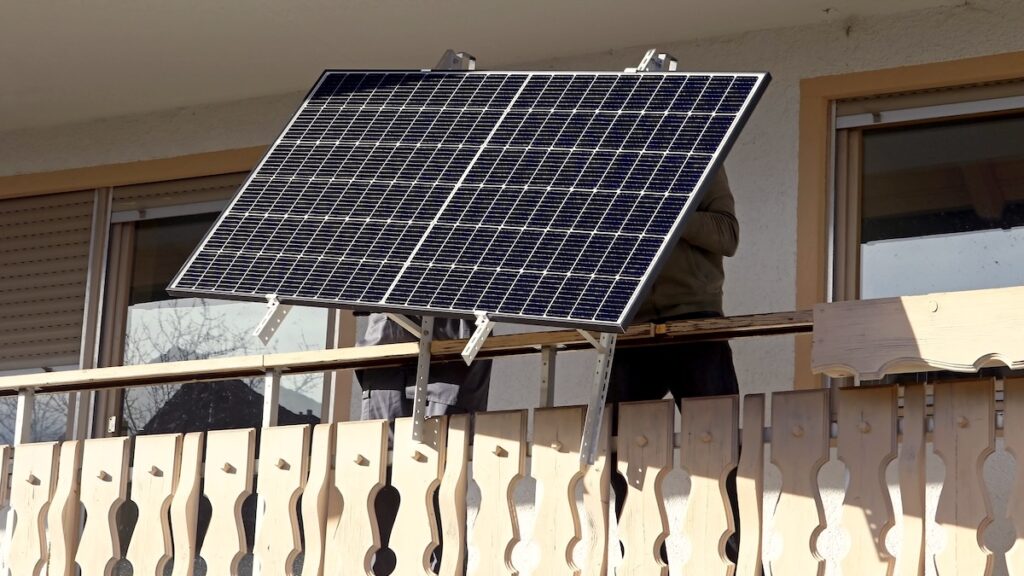
Self-produced electricity, directly from the balcony: Balcony power plants make this possible for as little as 200 euros. But since December 2025, with the new VDE product standard, stricter rules have applied to the devices and prices could rise. At the same time, households save up to 280 euros per year with an electricity price of 35 cents.
Balcony power plants turn tenants and apartment owners into electricity producers. The compact systems feed the energy generated directly into the home power grid. In this way, households can reduce their dependence on energy suppliers and make a personal contribution to climate protection.
Plug-in solar devices offer a practical advantage, especially for tenants: when moving, they can be dismantled and taken to the new apartment without much effort. Technically speaking, a balcony power plant is not a system, but an electrical household appliance. Thanks to a new product standard, operation is now officially possible via a normal household socket.
What does the new VDE standard require?
Since December 2025, the product standard VDE 0126-95 has bindingly regulated the technical structure of the devices. Since then, manufacturers have had to provide a connecting cable that is at least five meters long. Under no circumstances should users connect the devices via a multiple socket. The standard also prescribes binding specifications for the mechanical safety and statics of the devices.
The feed-in power via the inverter may not exceed 800 watts. When using a conventional Schuko plug, the solar modules produce a maximum of 960 watts. Systems with outputs of up to 2,000 watts absolutely require a Wieland plug as an energy connector. In most cases, households will likely need to hire an electrician to install these larger three- or four-panel systems.
Are balcony power plants now more expensive?
According to the consumer advice center, complex certification procedures are likely to make future purchase prices more expensive. Small providers may disappear from the market if they cannot bear the high costs of these procedures. The new product standard offers consumers more clarity, but also limits the diversity of providers.
In addition, the new standard effectively forces used solar modules out of operation. According to consumer advice centers, these will probably no longer be used in balcony power plants in the future. Manufacturers now have to ensure that each module meets strict security requirements, which makes it difficult to use legacy hardware. Matthias Döring, from the Hamburg consumer advice center, said:
With the new rules, consumers finally have security when it comes to balcony power plants. Anyone who now builds in accordance with standards can rely on a stable legal framework and enrich their home with solar power. Unfortunately, the standard also has some downsides.
This is how quickly a balcony power plant pays off
Retailers are currently offering simple 400-watt devices for around 200 euros, while 800-watt sets cost between 400 and 500 euros. When purchasing these photovoltaic systems, customers do not have to pay VAT. An 800-watt device generates between 600 and 800 kilowatt hours of electricity annually, depending on its orientation. The plug-in solar simulator from the Berlin University of Applied Sciences provides a precise assessment for the respective location.
With an electricity price of 35 cents, households save between 210 and 280 euros annually. Since plug-in solar devices often last 20 years or longer, they are almost always worth purchasing. Depending on the location and usage behavior, the investment pays off after just a few years. In order to optimize the yield, a south orientation at an angle of around 30 degrees is recommended.
Storage usage and self-consumption
Battery storage makes it possible to use the solar power produced efficiently even in the evening hours. For a system with 800 watts of power, the ideal storage capacity is between one and two kilowatt hours. With dimensions of around 35 × 30 centimeters, such storage takes up about as much space as a classic desktop PC. Complete sets including suitable storage are available from 850 euros.
A storage system significantly increases the proportion of electricity used in the household. While a standard balcony power plant covers around ten to 20 percent of the requirement, a battery supplies a good third more. However, the actual energy yield depends heavily on the annual hours of sunshine in the respective region.
Register in just a few minutes: Here’s how it works
The responsible authorities have now significantly reduced the bureaucratic effort. Operators can register their devices in the Federal Network Agency’s market master data register with just a few pieces of data. Unlike before, a separate report to the network operator is no longer necessary. This automatically finds out about the system through the register.
After registration, the network operator independently takes care of installing a modern electricity meter. For a transitional period, running electricity meters will be officially tolerated. Users are allowed to put the balcony power plant into operation immediately after installation, even if an old meter is still installed.
What funding will still be available in 2026?
Solar devices have been considered privileged structural changes since 2024, which is why landlords must generally allow their installation. Homeowners’ associations also usually have to agree to the installation. The operators just have to ensure that they mount the modules in a storm-proof manner. However, additional design requirements may exist for listed buildings.
In Hamburg, the city provides subsidies of up to 90 percent of the costs for low-income households. Tenants in Mecklenburg-Western Pomerania receive funding of up to 500 euros. For owners in this federal state, however, the corresponding funds have already been used up. In Lower Saxony, cities like Lüneburg and Braunschweig support the devices with up to 350 euros.
In other cities such as Göttingen, Jever or Oldenburg, however, the funding pots are currently exhausted. A corresponding program in Schleswig-Holstein ended in 2024. It is therefore best for those interested to find out in advance about currently available regional subsidies. Despite regional differences, the low entry-level prices make the technology attractive to a broad audience.
Also interesting: