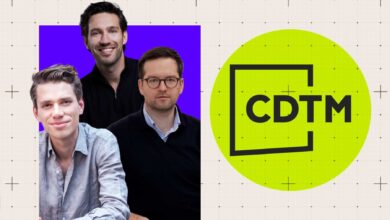
What are sensible goals for a company? How do you reach them? When do you perhaps overshoot the mark? Nikita Fahrenholz and Martin Eyerer discuss this in the Royal GS podcast.

Many people make new resolutions at the turn of the year. True to the motto: New Year, New Me – both privately and professionally. However not Nikita Fahrenholz (Founder of Delivery Hero & Fahrengold) and Martin Eyerer (Ex-CEO Factory Berlin, entrepreneur, techno DJ). The two of them don’t believe in classic resolutions that are discarded after a few weeks anyway. In ours Podcast Royal GS (new episode every Thursday) they talk about how they really implement annual goals.
Listen on Spotify and Apple Podcasts
What makes a meaningful goal?
According to Fahrenholz and Eyerer, the goals for the company and the runway that comes from it show whether someone understands their own business. Because there are short-term vs. long-term goals, overarching vs. small-scale goals, goals that are too high vs. too low.
For Fahrenholz, the following three things make a good goal: It must be “attainable, measurable and clearly defined.” To do this, he sits down with his team during budget planning and asks the following three questions:
- What is achievable?
- What is our focus?
- Can we exceed the target?
According to Fahrenholz, the latter in particular is not insignificant. If founders can even exceed their goals, they would have a good story that they can communicate to the outside world. According to Fahrenholz, anyone who underperforms also runs the risk of giving investors the impression that they are not able to plan well.
Read too

That’s why Fahrenholz’s biggest career learning so far is: “Don’t build plans that you can’t achieve anyway,” he says in the podcast. When he took over the CEO role at his company Fahrengold last year, he initially adjusted the goals to a realistic level. The previous CEO planned very ambitiously. “If you set a plan too high and miss it by five percent, it is perceived to be much worse than if you exceed a plan by 20 percent.”
But how do you get realistic numbers? According to Fahrenholz, the basis for good goal setting is the company’s data situation and the financial plan, which must include all important KPIs.
Fahrenholz also advises founders to stick to the set budgets. “I see a lot of teams starting to change budgets all the time,” he says. Budget is budget. That has to stand for the whole year.
How do you measure goals?
Once the goals have been set, you should stick to them – of course. But how do you ensure that the whole team stays on the ball? Eyerer and Fahrenholz have different opinions here.
Eyerer recommends this OKR method – OKR stands for Objectives and Key Results. The method involves setting goals in phases within the company and how the success of these goals is measured. There is an overarching, ambitious goal, which is then broken down into measurable results. Martin Eyerer uses his own example: With Green City Development, he wants to build Europe’s leading startup ecosystem for innovation and industry in Berlin-Neukölln. Bigger than Station F in Paris.
In order to achieve this in the future, several intermediate goals are necessary. However, these should not be formulated in too detailed a manner. If this is the case, the OKR method quickly becomes too bureaucratic and time-consuming, according to Eyerer.
Read too

He therefore had good experiences with a “light version” of the OKR method. What then? “Management by Objectives” method come close. Eyerer gives another example: “I would like 500 companies to approach me a year asking whether they can rent from us.” This is a concrete number that Eyerer can use to measure the reach of Green City Development.
Fahrenholz sees it differently: He hasn’t had any good experiences with the OKR method so far. He thinks the method is rather unsuitable for startups. He therefore advises founders who manage fewer than 100 employees to focus on product development and to have an increase in sales as their only annual goal. Because goals have to be measured by someone and reported to someone. That costs a lot of time.
Read too

He also used to set up reports with goals. At Fahrengold, Fahrenholz did things differently. First, he collected all the data about the company. Based on this, he derives goals that he can track automatically. “For me it’s important to find something that the employees are excited about.” And for him that doesn’t mean a statement like “We want to become the Google of XYZ”.
For his company Fahrengold this means: “I would like to buy a mass product from Fahrengold in a media market in Berlin by December 2026 at the latest.” He wants to work towards that now.