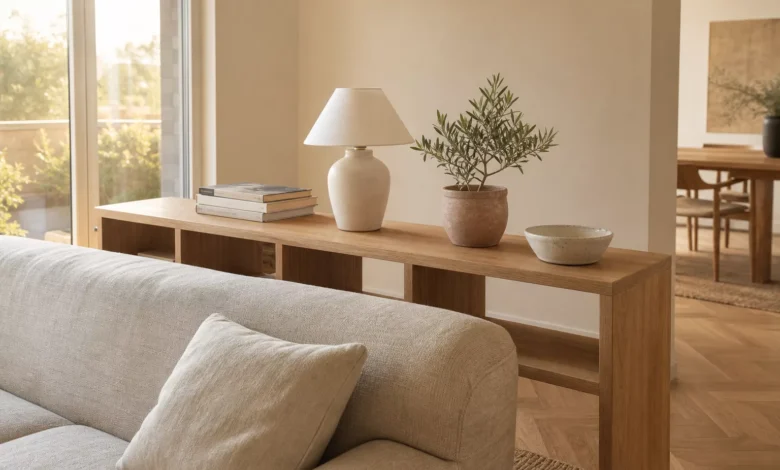

The strip behind the backrest is dead land in many living rooms: too narrow for furniture, too wide to ignore. A Shelf behind the sofa turns it into one of the most practical surfaces in the apartment – storage space, decorative stage and visual room edge all in one. The difference to pure storage: A real shelf has compartments, carries books and can even be used as a room divider. In this guide you won’t get a loose picture gallery, but rather a clear type decision, the correct distances and the safety rules that many forget.
In short
- Five guys – Bookcase, open shelf, industrial, hanging shelf and room divider shelf cover almost every style and floor plan.
- Distance – 20 to 30 cm between the sofa and the shelf is normal; a floor-to-ceiling model with a ladder needs 80 to 90 cm.
- Anti-tip protection is mandatory – Always secure free-standing shelves with wall anchors or L-brackets, with heavy things at the bottom.
- Rule of thirds – a third books, a third decoration, a third intentionally empty seems the calmest.
- Just looking for a narrow solution? Then a flat console is a better choice than a full shelf.
Sofa position first: wall in the back or room divider?
Before you think about shelf types, answer the question below: How does the sofa actually stand? Most people feel most comfortable with their backs against the wall. This is no coincidence, but the basic rule that Feng Shui also emphasizes – a solid wall at the back provides support, and the door and window remain in view. In this arrangement, the shelf becomes the second level on the wall and visually merges with the sofa to form an ensemble.
It becomes more exciting when the sofa stands freely in the room. Then the shelf takes on a real task: it closes the open back, gives the seating area a border and, for example, separates the living area from the dining area. If you are furnishing a small apartment, you should think through this layout early on and plan the appropriate living room floor plan before the furniture is delivered.
Shelf, shelf or room divider – which type is right for you?
There is no one right shelf, but rather five sensible ways. Here are the types at a glance:
- Classic bookshelf: closed sides, solid bottoms, lots of volume. Ideal if you really want to store books or showcase a sloping ceiling.
- Open shelf: the all-rounder without doors and drawers. It appears light, shows decorations and plants from both sides and fits into almost any room.
- Industrial shelf: Metal frame plus dark wood, freestanding or wall mounted. Brings loft character without becoming bulky.
- Hanging shelf: floats on the wall, often reaching almost to the ceiling. Asymmetrically arranged boards look airy and modern.
- Room divider shelf: Can be used from both sides, usually low to medium high. The perfect solution for open living areas.
An important note on differentiation: If you are not looking for storage furniture at all, but just a flat surface for a lamp, remote control and a glass of wine, then a narrow shelf behind the sofa is a better and cheaper choice. It’s about depth, sockets and lighting in detail – this article stays with the full-fledged shelf with compartments.

Safety first: Secure the shelf against tipping over
The point that brochures tend to leave out: A shelf behind the sofa is often in the middle of the movement space, is climbed by children and discovered by cats as a lookout tower. A free-standing model should therefore always be screwed to the wall – with wall anchors or L-angles and dowels that match the type of wall. Normal dowels don’t hold much in a plasterboard wall; Here you need special cavity dowels or a screw connection into the stand behind.
If the shelf is free in the room as a room divider, the wall is not enough. Then anchor it to the ground so that it cannot tip over. A second trick doesn’t cost anything: consistently put the heavy objects – thick illustrated books, stone vases, stacks of books – into the lower compartments. This lowers the center of gravity and makes the shelf inherently more stable.
Plan distances and heights correctly
You need air between the back of the sofa and the shelf. 20 to 30 cm is the minimum so that you can easily reach the compartments and don’t have to move the sofa when dusting. If you are planning a floor-to-ceiling bookcase with a library ladder, the value increases to 80 to 90 cm because the ladder needs space to lean on. As a room divider in an open floor plan, there is a rule of thumb for the passage: around 80 cm of free width, otherwise the path around the sofa becomes a narrow space.
The height also determines the effect. A low shelf at the height of the backrest extends the line of the sofa and makes the room appear calm. A high shelf, on the other hand, emphasizes the vertical – strong with high ceilings or in a sloping roof, where it takes up the triangular shape. You should definitely avoid a height: exactly at the head height of the person sitting. Edges or boards right there seem cramped and it’s easy to bump into yourself when you get up.

How to decorate the shelf harmoniously
A fully stuffed shelf appears restless, an empty one appears bare. The rule of thirds brings balance: about a third books, a third decorations, a third consciously released. These gaps are not wasted space, but rather allow the individual pieces to breathe. The following also applies per shelf: it is better to have two to three larger objects than ten small accessories that quickly look like odds and ends.
Mix up the heights – a standing vase, a lying stack of books, a framed picture behind it. This creates the curated look that you know from magazines. Color is provided by one or two tones that you pick up from the sofa or the cushions; this ties the shelf and seating area together. Plants make the area come alive: ivy and arched hemp tolerate little light, a monstera makes a green statement. If you like things harmonious, choose Feng Shui plants for the living room, which also symbolize calm.

Which type of shelf suits which style of living?
To make the decision easier, here are the five types with their favorite environment and a concrete idea:
- Bookshelf: solid and classic. Strong under a sloping roof or in a household with a lot of volume that loves reading.
- Open shelf: the most versatile model. A cheap DIY trick: paint a simple black metal shelf frame from the furniture store gold – standard goods become a unique piece.
- Industrial shelf: Metal and dark wood for loft and modern spaces. Goes well with concrete, leather and strong wall colors such as petrol.
- Hanging shelf: minimalist and floating. Ideal for small rooms because the floor remains free and the room appears larger.
- Room divider shelf: for open floor plans in which living and dining flow together. You can find further approaches in our room divider ideas for open living areas.

What’s Hot

Living room
Set up a 20 sqm living room: the right floor plan counts
Professional tips for buying and building
- Think double-sided: If you want to set it up free-standing, choose a shelf that is open from both sides and can be decorated – this way the dining area side also gets its look.
- Set color anchor: Pick up a tone from the sofa (cushion, plaid) and repeat it in a vase or the spine of a book on the shelf – connects both pieces of furniture.
- Plan for light: A warm table lamp or a battery spotlight in the compartment turns the shelf into a second source of light in the evening instead of a dark wall.
- Match material to floor: With light oak floors, light types of wood, with dark parquet, walnut or black metal – the ensemble looks as planned, not thrown together.
In the end, the right shelf behind the sofa is a question of two things: How is your sofa positioned and how much do you want to store? First, clarify the position and distance, secure the furniture against tipping, and then choose the type that suits the style and layout. The dead strip behind the backrest becomes the surface that holds the entire room together.
Frequently asked questions
How much space does a shelf need behind the sofa?
For a normal shelf, 20 to 30 cm is enough to reach the compartments. A floor-to-ceiling model with a library ladder needs 80 to 90 cm, a room divider shelf needs around 80 cm of free passage width.
Should the shelf be higher or lower than the back of the sofa?
Both work. A low shelf at backrest height extends the sofa line and has a calm effect; a high shelf emphasizes the vertical and suits high ceilings or sloping ceilings. Just make sure that one edge ends exactly at head height of the person sitting.
How do I secure a free-standing shelf from tipping over?
Screw it to the wall using a wall anchor or L-bracket and suitable dowels. As a room divider without a wall, you can also anchor it to the floor. Heavy objects belong in the lower compartments, which lowers the center of gravity.
Is a shelf also suitable as a room divider in an open living room?
Yes, a low to medium-high shelf that can be used from both sides is the classic room divider solution. Plan around 80 cm of clearance and anchor it to the ground, as there is no wall security.