


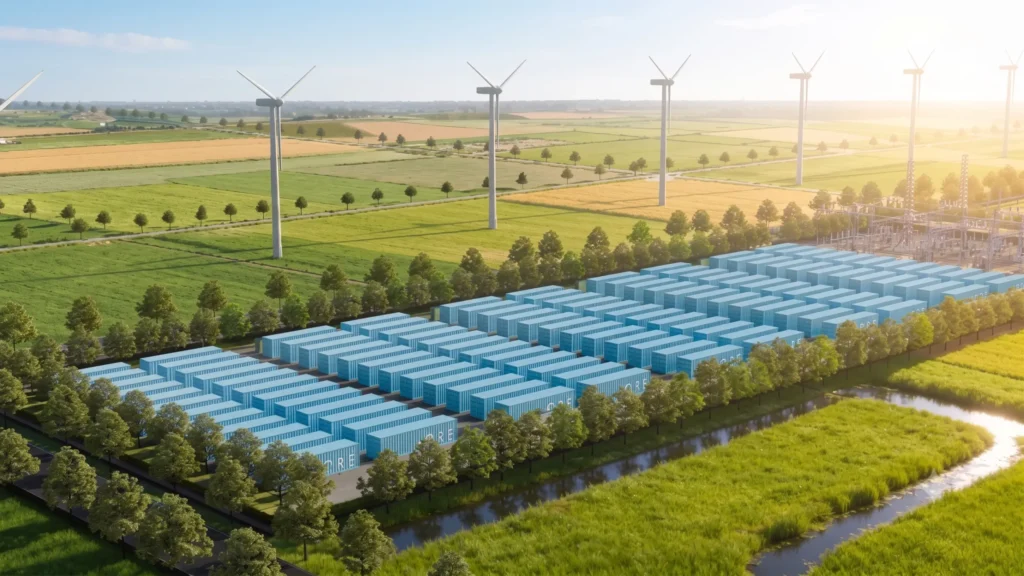
The Dutch energy supplier Budget Thuis plans to build an iron-air energy storage system with a capacity of one gigawatt hour. The technology uses iron, water and air to store electricity for up to 100 hours. This could reduce costs for consumers and make networks more stable.
The Dutch company Ore Energy has reached a far-reaching agreement with the energy supplier Budget Thuis. Together, as partners, they want to implement the largest purchase contract to date for a gigantic iron-air energy storage system on mainland Europe.
In a first phase, the project partners want to provide a capacity of around 400 megawatt hours by 2028. The entire system is based on a special architecture in containers, each twelve meters long.
The largest iron-air energy storage in Europe
The technology promises a solution to a central problem in modern energy supply. Because: When the wind doesn’t blow or the sun doesn’t shine, there are often gaps of several days in the generation of clean electricity in the European power grids.
Conventional short-term batteries cannot bridge these phases cost-effectively because they usually only shift energy for a few hours. The new iron-air batteries are intended to store excess wind power over several days and release it again when necessary.
For consumers in the Netherlands, the development could bring tangible benefits in everyday life. The system is intended to feed in clean electricity exactly when energy is most scarce and most expensive. This planned shift could reduce the risk of volatile wholesale markets for electricity and gas. This also reduces the dependence on gas-fired reserve power plants in the network. Annemarie Buitelaar, Managing Director of Budget Thuis, said:
Providing our customers with affordable, reliable energy is at the heart of everything we do, and multi-day storage gives us the ability to store clean power when it is plentiful and release it when it is most valuable.
No lithium and no cobalt: Why iron is the better storage raw material
The company, which is part of the Nuts Groep, supplies more than one million customers in the country with energy and other services. Multi-day storage offers the opportunity to give customers long-term access to clean and more predictable electricity. It is also about reducing the risk from fluctuating prices for fossil fuels.
A key advantage of the new storage technology lies in the materials used. Since the systems only require iron, water and air, there is no need for critical raw materials such as lithium or cobalt. The systems are naturally incombustible and should be manufactured via a purely European supply chain. This strengthens European energy sovereignty and reduces dependence on imported critical raw materials.
The functionality of the technology has already been proven under real conditions in initial projects. The completion of a grid-connected pilot project in France was announced in February 2026. From August to November 2025, a test system already showed that it could store energy for four days. A similar system in the Dutch city of Delft had previously been successfully integrated into the existing network.
Also interesting: