 The Mac Pro 2023 was the last representative of a long line, as Apple announced this week that the tower would be discontinued without replacement. With the Mac Pro, not just one model is disappearing, but an entire Mac family that has been Apple’s most professional desktop computers for decades. Of course, it is always a question of definition as to what is meant by “professional”, but this usually refers to devices at the upper end of the performance spectrum that also offer expansion options. In this article, we take a look at the history of Pro Macs, which began at the end of the 80s, and introduce some of the important representatives as examples – of course without claiming to be complete.
 Macintosh II – expandable, color
Steve Jobs was neither a fan of easy expandability nor of color displays on the Mac – at least in the 80s, when this meant poorer display quality. In 1985, a project began that would bear fruit two years after he left Apple: The Macintosh II in 1987 marked the actual beginning of Apple’s professional Macs. While the first Macintosh models were primarily compact all-in-one computers, Apple took a completely different path with the Macintosh II.
The system was modular, offered expansion slots, supported color graphics for the first time (with different resolutions and color depths!) – and was clearly aimed at professional users. A Motorola 68020 was initially used as the processor, and the hard drive could store 20 MB. With an external display and 8-bit graphics card you had to pay at least $7,145; for the basic version it was $5,500.
The IIfx, launched in 1990 and promoted by Apple with the slogan “Wicked Fast”, was another important step. A 68030 processor with 40 MHz ensured high performance, the maximum RAM capacity of 128 MB was astonishing, but the starting price of $9,000 (adjusted for inflation, this would be almost $23,000 today) was a considerable financial burden.

The Macintosh II with external Apple display (source)
The Quadra series – high performance and even video
With the Quadra series, Apple consistently expanded the concept of the professional Mac in the early 1990s. The Quadra finally made the Mac a staple in agencies, publishers, graphics studios and other professional environments. The devices stood for high computing power due to comparatively modern processors.
The Quadras were also clearly intended to be upper class when it came to graphics. Depending on the model, they offered integrated video output or could be expanded with more powerful graphics cards. In terms of expandability, the devices were in the tradition of the Macintosh II. Desktop and tower models offered NuBus slots. The fastest Mac model with a 68k processor from Motorola comes unsurprisingly from the Quadra series, namely the “840 AV”. With the 68040 processor clocked at a then-groundbreaking 40 MHz and the ability to record and output video via S-Video, this Mac was remembered by many Apple fans.

Macintosh Quadra 840 AV (source)
Power Macintosh
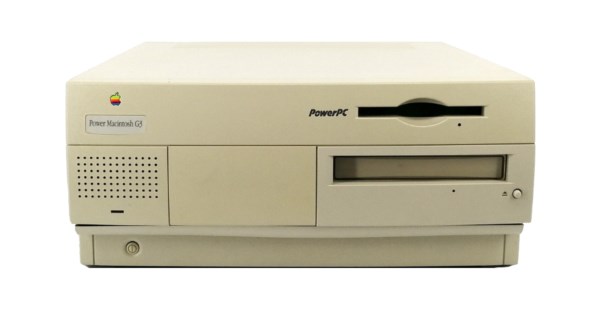
The name of the series clearly showed that there was a new processor architecture inside: a new era began for Apple’s professional computers in 1994. The crucial technical step was the switch from 68k chips to PowerPC processors, which Apple had developed together with IBM and Motorola. The first models were called Power Macintosh 6100, 7100 and 8100 and relied on a PowerPC 601 with clock frequencies starting at 60 MHz.
The new processor offered a significant increase in speed, but came with a catch: older software could no longer be run, which is why Apple had to develop an emulator, which was accompanied by significant performance losses.
The system, then version 7.1.2, was not fully adapted to PowerPC, so even the system software often ran slowly. At this point, Apple was still using the long form of the name, i.e. “Power Macintosh” and not “Power Mac”.