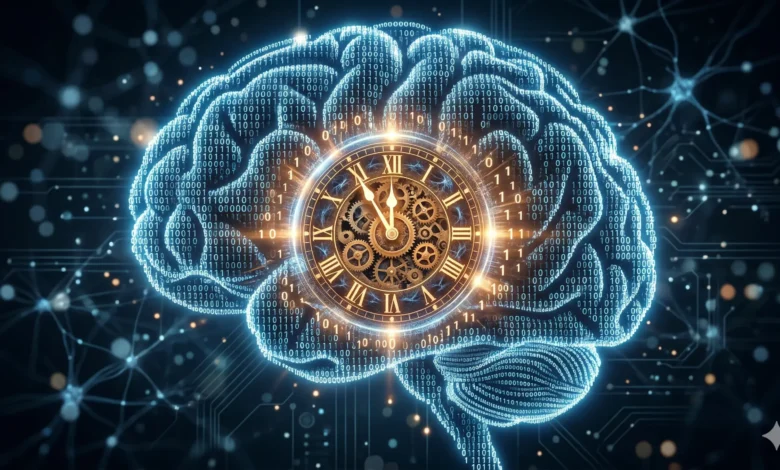
Researchers have developed an AI that analyzes fine signals in the sleeping brain and shows how quickly our thinking organ ages. The aim is to identify a possible risk of dementia years in advance.
Scientists have identified a subtle signal in the sleeping brain that reveals the true rate of brain aging. The discovery makes it possible to assess the risk of dementia long before the first visible symptoms. The research team used machine learning to find tiny differences between the biological state and the actual age of the test subjects.
The University of California, San Francisco led the study under senior author Yue Leng. Together with Haoqi Sun from Beth Israel Deaconess Medical Center, the team evaluated data from around 7,000 participants from five different examinations. The experts observed the test subjects over a period of 3.5 to 17 years. During this time, around 1,000 people were diagnosed with dementia.
Dementia prevention with AI
The central point of the analysis is the brain age index. This value works like a biological speedometer and expresses the wear and tear of the thinking organ in years. If the index shows an older age than the actual year of life, the probability of cognitive failures increases significantly.
The journal JAMA Network Open published the detailed results on March 19, 2026. Each additional ten-year gap between brain age and chronological age increased the risk of dementia by almost 40 percent. The result remained stable even after the researchers statistically took factors such as smoking, education and genetic risks into account.
Why conventional sleep measurements often fail
Senior author Yue Leng emphasizes that simple sleep metrics do not adequately capture the complex physiology of the brain. Classic metrics such as pure sleep duration or efficiency provide no information about the future risk of illness. According to Leng, only the AI analysis of the fine electrical discharges provides a reliable window into the aging process.
The AI model developed by Haoqi Sun looks deep into 13 different features of brain activity. In addition to delta waves for deep sleep and sleep spindles for memory, the so-called kurtosis plays a crucial role. These signals appear as sharp, high-amplitude voltage spikes and are associated with a reduced risk of dementia.
Early detection through wearables in the bedroom at home
Doctors now record EEG signals completely painlessly and without surgical intervention. This uncomplicated method will allow researchers to use the technology outside of special sleep laboratories in the future. Wearable devices could soon determine the brain age index directly in the bedroom at home.
Healthy weight management and regular exercise protect the brain from premature aging. Such measures specifically reduce the likelihood of apnea, which in turn has a positive effect on brain waves. There is no magic pill for brain health, but targeted prevention slows down cognitive decline.
Also interesting: