The Berlin casual gaming startup founded in 2020 JustPlay recently moved under the NCSoft umbrella. The Korean video game developer took over the majority (70%) of the hidden champion from the capital. The purchase price: $202 million.
JustPlay, founded by former AppLovin employees Carl Livie, Gil Mincberg and Mirko Aquaro, currently reaches more than 25 million players with around 40 games. JustPlay is a big number, especially in the USA.
The bootstrapped games champion, who runs a loyalty gaming app, generated around $172.8 million in sales and $19.1 million in profit in 2025. The team is targeting $300 million in sales for the current year. Around 110 employees currently work for JustPlay.
In an interview with deutsche-startups.de, founder Carl Livie speaks in detail about the history of JustPlay.
How would you explain JustPlay to your grandmother?
I would probably say to my grandma: Imagine playing a game on your phone and instead of just passing time, you get something in return at the end. Then she would probably ask, “So you people pay to play dad?” And I would say: In principle yes, but the technology behind it would rather bore you over coffee. But to help her put this into perspective, I always say: Mobile gaming is the largest entertainment category in the world. Every day a billion people play games on their mobile phones. We simply give players something for what they would do anyway and make the whole thing fairer and more fun. The simple idea is: When people spend time in digital products, others earn money from them, for example through advertising. We build JustPlay so that the players also get something back from it. Simple and without complicated rules. In the end, users need to understand how something works and what they get. No matter what product it is. This is exactly why trust is so important to our model. Most importantly, it’s fun too. Nobody gets rich off the rewards, but the rewards add another exciting entertainment dimension to the whole gaming experience.
Was this your concept from the beginning?
To be fair, I first have to point out that my co-founders and I built around 20 apps that didn’t come to fruition, but JustPlay came out of that. From this process, however, a fundamental belief emerged: We wanted to build a product in which players would be more involved in the value that they create through their involvement. At the beginning you mainly see the visible product: users play and receive rewards. However, the important thing happens in the background. In order for rewards to work in the long term and for users to come back, many parts have to work very closely together: the app, the games, monetization, growth, adtech, fraud prevention, data, payouts and of course the user experience. We have learned that we are not just building a rewards feature, but rather a fully integrated ecosystem in which the value flow must function sustainably.
How exactly did the idea for JustPlay come about?
The idea came from an observation we’ve seen over and over again in the mobile gaming and adtech world: There’s a lot of value in this market, but it’s not particularly fairly distributed. Billions of people play mobile games. Advertisers pay to reach these users. At the same time, games publishers are under a lot of pressure because user acquisition is becoming increasingly expensive. And the users themselves often get very little in return, even though you engagement is the basis of the entire system. We asked ourselves: What if we built this model differently? What if rewards weren’t just an add-on, but a central part of the user experience? Combined with many adtech learnings at AppLovin, JustPlay was created.
How has JustPlay developed since it was founded?
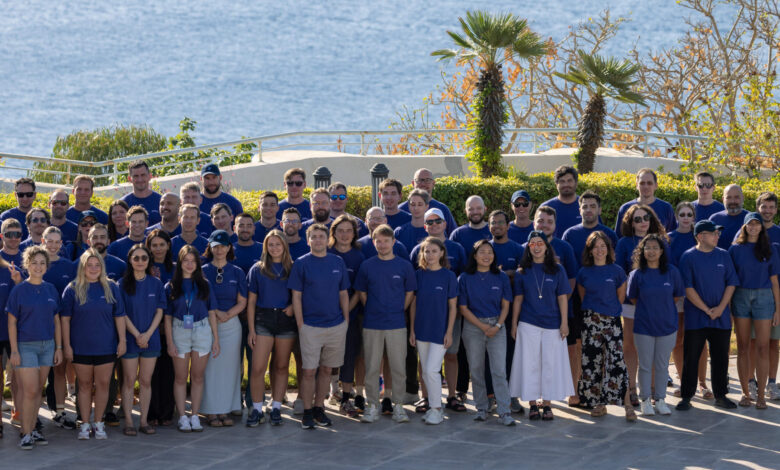
We founded JustPlay in 2020 and have since grown the company from an idea into one of the most scaled rewarded gaming platforms. Today we operate in more than 25 countries, have reached over 25 million downloads and paid out more than $200 million to users. At the same time, we have built a portfolio of over 40 casual mobile games. A little more concrete: In 2026 we will generate sales of well over 300 million US dollars, grow over 80% year over year and have a very sustainable EBIT margin. Our team is around 110 people globally, with around 50 in our HQ in Berlin. We are also very proud of our sales and EBIT per capita, which only works in a very flat and impact-oriented team structure. We founders are very close to the product, engineering and marketing, which is a lot of fun, but also has the advantage that the team always works on the topics that we believe have the most business impact. For me, it’s not just the size that matters, but the quality of the system behind it. We deliberately built JustPlay as an integrated model with teams from Product, Engineering, Adtech, Data, Growth, Gaming and Payments working together to ensure the value for users remains clear and reliable. And despite all the technology, one thing shouldn’t be forgotten: it has to be fun for the players too. If the product doesn’t entertain, even the best reward model won’t work in the long term.
You have just sold the majority to NCSoft. What happens next?
For us, this is not an end point, but the next step. With NCSoft we have a partner at our side who brings in-depth gaming know-how, global experience and a long-term product perspective. For JustPlay this means: We now have a technologically leading and legendary gaming company at our side and can think faster and bigger about our mission. Our focus remains the same: We want to continue to expand the rewards engine for mobile gaming and show what rewarded commitment can go beyond gaming.
You built JustPlay without external financing or investors. Was this a conscious decision from the start?
Yes, it was consciously against venture capital, but not out of principle. For our model, it was important to build in an economically disciplined manner right from the start. Rewards only work if the business model behind them is sustainable. You can grow very quickly in this area, but if the value flow doesn’t support you, you lose trust. And trust is central to our model. Bootstrapping forced us to pay attention to true unit economics, product functionality and sustainable growth early on. That was certainly uncomfortable at times, but it also shaped JustPlay’s culture. We had to prioritize very clearly, test, react quickly and couldn’t just buy growth without understanding whether the system really worked. But I wouldn’t say that bootstrapping is always better. It has to fit the business model, the market and the founding team.
What advice do you have for other founders who decide to bootstrap?
First: Bootstrapping often sounds more independent from the outside than it feels in everyday life. You don’t have investors, but you still have very real constraints: cash flow, profitability, timing, etc. Second: understand very early on where value really arises. Every decision must be close to the product and the business model. We asked ourselves every day: Does it make us more money tomorrow? Third: Build a team that can deal with ambiguity while remaining pragmatic. You can’t do everything at the same time, so you have to be very conscious about what to do and what not to do. What is important is that the entire team is forced to be deep into the data and the product in order to push new innovations every day. And lastly: What matters is not whether you start with or without external capital, but whether you build a model that works in the long term.
Where will JustPlay be in a year?
In more markets with better products, a stronger games portfolio and a further improved reward experience for users. At the same time, we want to continue working on what rewarded engagement can mean beyond gaming. Rewarded gaming is booming and growing as a category much faster than the rest of the gaming industry. We see a huge opportunity here to emerge as a clear leader with our unique integrated platform. We are an ambitious team: 500 million annual run rate by the end of 2027 is achievable! I think that would make us one of the most successful young companies in Berlin. I think the bigger trend is that users want to understand more and more precisely what value they create for digital platforms and what they get in return. JustPlay is exactly at this interface. In a year’s time, we want to show even more clearly that rewards are not just a growth mechanism, but can become a sustainable part of digital user experiences.
Startup jobs: Looking for a new challenge? In ours Job exchange You will find job advertisements from startups and companies.