


Thailand’s tourism industry is experiencing an unusually prolonged green season, with lower-than-expected visitor numbers affecting destinations from Pattaya to Phuket. Veteran tourism professional Andrew Wood explores why official statistics tell only part of the story—and why Thailand’s remarkable resilience suggests recovery is already on the horizon.
Having lived and worked in Thailand’s hospitality and tourism industry for more than 35 years, I have learned one simple truth: tourism rarely moves in a straight line.
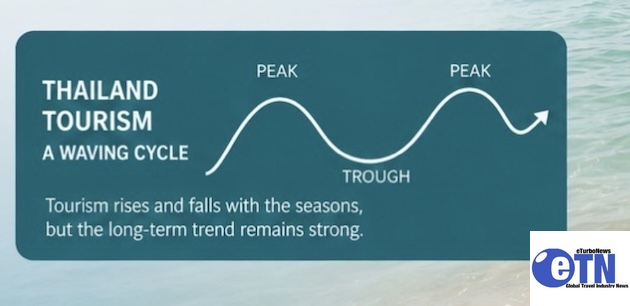
If you were to plot Thailand’s hotel occupancy throughout a typical year, the graph would resemble a series of rolling waves—rising to predictable peaks before settling into seasonal troughs.
Today, Thailand finds itself in one of those troughs.
What feels different this year, however, is that the traditional green season has become an unusually extended one. The slowdown has lingered longer, dipped deeper and tested the patience of tourism operators who would normally be preparing for the first signs of recovery.
Yet before headlines focus solely on declining arrival figures, it is worth remembering that statistics tell only part of the story.
A Perfect Storm for Tourism


The official website of Tourism Authority of Thailand
The official site of Tourism Authority of Thailand. Amazing Thailand, Travel information, Travel guide, maps, hotels, accommodation, attractions, events & festivals, food, culture, shopping information to help you plan your Thailand vacations.
Unlike previous seasonal slowdowns, this year’s softer market reflects an unfortunate convergence of global events.
Continuing disruption to air routes serving Europe and the Middle East has complicated long-haul travel, increased airline operating costs and reduced scheduling flexibility. At the same time, exceptional heatwaves across Europe have altered traditional summer holiday patterns, while economic uncertainty in several key source markets has encouraged travelers to postpone—or shorten—overseas vacations.
The consequences have been felt across Thailand.
During the recent Middle East airspace closures, more than 30 flights serving Phuket were canceled or disrupted, leaving over 5,000 visitors temporarily stranded. Koh Samui and Koh Phangan also experienced significant disruption, while major Gulf carriers including Emirates, Qatar Airways, Etihad Airways and Air Arabia were forced to reroute or suspend services.
Airports of Thailand, local authorities, hotels and tourism operators responded quickly, helping stranded visitors while flight schedules gradually returned to normal.
Even after the airspace reopened, uncertainty continued to influence booking behavior. Travelers naturally become more cautious when international air travel becomes unpredictable, particularly on complex long-haul itineraries.
Quiet Adjustments Across the Kingdom
The softer market is becoming visible throughout Thailand.
Airlines are quietly reducing capacity on selected domestic routes, particularly to secondary and tertiary destinations. Earlier departures have in some cases been consolidated into later flights—a sensitive commercial response that helps maintain healthy load factors.
Such adjustments are entirely normal.
But they also reflect the reality of an extended green season.
Statistics vs. What You Hear on the Ground
Over the decades, I’ve discovered that conversations with hotel general managers, restaurant owners, airline executives, tour operators, taxi drivers and shopkeepers often reveal tourism trends long before official statistics do.
In recent weeks, those conversations have been remarkably consistent.
As a property owner in Pattaya, I visit the resort regularly and have witnessed the quieter atmosphere firsthand. The beaches remain beautiful, restaurants continue to offer warm Thai hospitality, and the city remains every bit as welcoming as ever.
Yet visitor numbers are clearly below expectations.
Following a recent ten-day stay in Pattaya and Hua Hin, here’s what tourism operators repeatedly told me:
- Hotel occupancies remain below normal expectations for this point in the green season.
- Several businesses estimate visitor numbers are around 20 percent lower than during a typical low season.
- Some nightlife venues report fewer than 15 customers on certain evenings.
- Restaurant owners describe noticeably fewer walk-in diners.
- Many long-established operators believe this is one of the quietest green seasons they have experienced in years.
Individually, these observations remain anecdotal.
Collectively, however, they paint a compelling picture.
Phuket Reflects a Similar Trend
Thailand’s largest resort island tells a similar—but not identical—story.
Senior hotel executives report that several large international resorts are operating with occupancies 20 to 30 percent below normal seasonal expectations.
Interestingly, smaller boutique hotels appear to be performing considerably better, with occupancy generally ranging between 50 and 60 percent.
Their smaller inventories and greater pricing flexibility allow them to respond more quickly to changing market conditions.
The contrast is important.
Thailand is not experiencing a collapse in tourism.
Demand has simply softened unevenly across destinations, accommodation types and visitor markets.
Properties that depend heavily on long-haul international travelers feeling are considerably more pressure than those serving domestic guests or regional Asian markets.
Elsewhere around the Kingdom, the picture remains mixed.
Chiang Mai and Chiang Rai continue benefiting from domestic tourism and neighboring countries, Koh Samui’s luxury market has helped cushion the downturn, while Bangkok remains comparatively resilient—even though many hotels report increasingly short booking windows.
Looking Beyond the Numbers
One lesson Thailand has taught me is that no two tourism downturns are ever identical.
Every slowdown has its own causes.
Every recovery follows its own path.
And history offers plenty of reassurance.
Over the past four decades Thailand has successfully navigated financial crises, natural disasters, political uncertainty, tsunamis, pandemics and countless global shocks.
Each downturn felt significant at the time.