


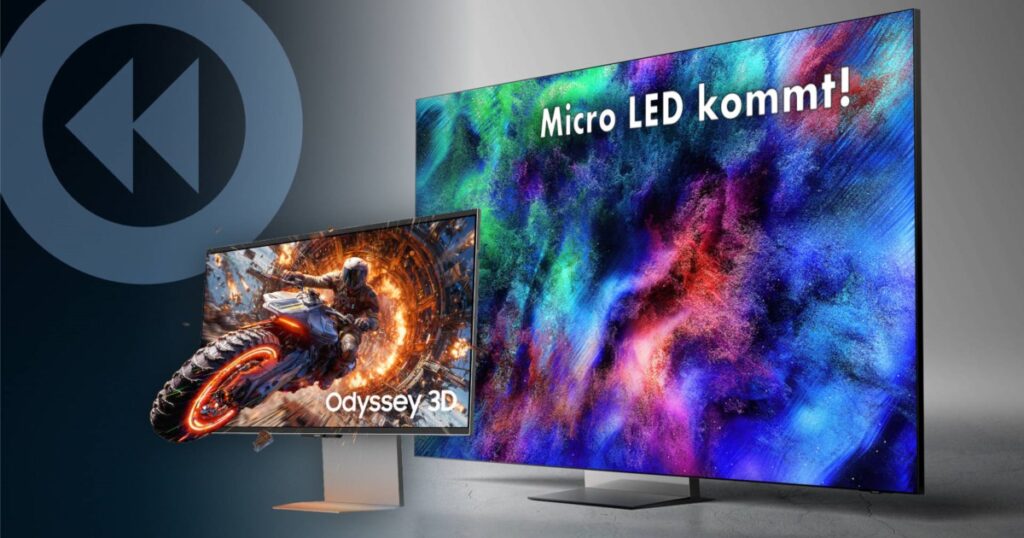


Samsung calls it “Micro RGB”, but it’s about displays based on tiny, Micro-LEDs. What is the difference to mini LEDs? While televisions (and displays) use mini-LEDs as backlighting that illuminate a conventional LCD screen, micro-LED screens work more like OLED: each pixel is self-illuminating. Each pixel is an LED. Or more precisely, three LEDs in the colors red, green and blue. There is no longer any backlighting, which means the black level reaches the level of OLEDs. If you want to have this explained in a little more detail: the colleagues at HiFi.de have broken down the different technologies in this article.
So far, technical development has not yet reached the point where micro-LED screens can be offered in reasonable sizes and at affordable prices. Samsung and others had already shown and sold screens with this technology in recent years, but they were all huge (usually over 100 inches) because the individual LEDs were so large, and cost five to six-figure sums.


In the new year, Samsung wants to present micro-LED TVs with reasonable dimensions for average living rooms for the first time at CES (January 6th to 9th in Las Vegas). That means six different sizes from 55 to 115 inches. In between, screens will be offered in sizes 55, 65, 75, 85 and 100 inches. This would be synonymous with a significant breakthrough in the development of smaller RGB LEDs that really deserve the name “Micro”, because this is the only way to create screens with today’s usual resolutions of at least 4K in sizes of 55 inches. – Okay, it could be that the 55-inch device mentioned only has HD resolution. Samsung hasn’t revealed that much yet, but I’m optimistic for now.
What Samsung has also kept quiet about so far are the prices. Should the smallest announced model at 55 inches actually be affordable and perhaps even be able to compete with at least previous high-end OLED models? Let us surprise you.
As mentioned, Samsung’s micro RGB technology for the 2026 models is based on red, green and blue light-emitting diodes. The LEDs are smaller than 100 micrometers and can light up independently of each other. This enables precise light control and improved color accuracy. The hardware is supported by software solutions for image processing, including 4K AI Upscaling Pro and AI Motion Enhancer Pro.2 They optimize brightness, smooth movements and ensure precise image display in real time, according to the manufacturer.
The main advantages of micro-LEDs compared to OLED are (potentially) much larger brightness reserves, even across the surface, and no burn-in effects in longer still images. This should also advance computer monitors in the medium to long term. However, it will certainly be a while before the “LED pixels” become small enough to be able to accommodate 5, 6 or even 8K in an area of around 32 inches or less.
Commenting on its CES announcement, Samsung writes: “Using Samsung’s latest technology, our Micro RGB portfolio delivers vivid colors and image clarity that make movies, sports and TV shows even more expressive and immersive,” said Hun Lee, executive vice president of the Visual Display (VD) business unit at Samsung Electronics. “By expanding the range for 2026, we are establishing a new premium category with sizes that cover the full spectrum of modern living spaces while meeting our highest imaging standards.”
+ + + + + + + + + +
SAMSUNG: NEW DISPLAY GENERATION ALSO FOR MONITORS
The Korean electronics giant also has a lot in the pipeline for computer displays for 2026. With the Odyssey gaming monitor series, the company is introducing five new models that are intended to set standards in terms of resolution, refresh rate and immersive image quality. The highlight is the first 6K 3D monitor without glasses: the Odyssey G90XH. The series is supplemented by the new Odyssey G6 and three models from the Odyssey G8 series. Samsung is also planning to launch these models in Germany – although some of them will only be available in the second half of 2026.
Apart from the 3D monitor, which is intended to display a spatial effect even without special glasses, the main thing that is possible with these displays is extremely high refresh rates. We’re talking about up to 1,040 Hz – as long as the existing graphics hardware can handle it. However, this only interests one target group, namely demanding hardcore gamers. The benefits for other applications are limited. The new monitors in detail:


Odyssey 3D: World’s first 6K 3D gaming monitor without glasses
The 32-inch Odyssey 3D (G90XH) offers a 6K display with glasses-free 3D. Thanks to real-time eye tracking, the depth effect dynamically adapts to the position of the viewer – for smooth gameplay without a headset. With 6K resolution, 165 Hz refresh rate (can be increased to 330 Hz via dual mode) and 1ms GtG response time, the action remains razor-sharp. Gamers can look forward to an expanded selection of supported titles with optimized 3D effects developed in collaboration with gaming studios. Supported games such as “The First Berserker: Khazan”, “Lies of P: Overture” and “Stellar Blade” gain depth and detail separation, while the 6K resolution enables a razor-sharp 3D experience.
Odyssey G6: World’s first 1,040 Hz for high-speed gaming
The 27-inch Odyssey G6 (G60H) is set to set new standards in e-sports: with dual mode it reaches up to 1,040 Hz4 (in HD), while native QHD is supported up to 600 Hz. AMD FreeSync Premium and NVIDIA G-Sync Compatible ensure smooth, responsive images – ideal for competitive gaming.
Odyssey G8: High-end options in 6K, 5K and OLED
The G8 series grows with three models:
Odyssey G8 (G80HS): 32 inches, 6K, 165 Hz (dual mode up to 330 Hz)
Odyssey G8 (G80HF): 27 inches, 5K, 180 Hz (dual mode up to 360 Hz)
Odyssey OLED G8 (G80SH): 32 inches, 4K QD-OLED, 240 Hz, Glare Free, VESA DisplayHDR™ True Black 5006
All models support AMD FreeSync Premium Pro and NVIDIA G-Sync Compatible for smooth gaming.
Samsung’s 2026 Odyssey gaming monitor line-up will also be presented at CES 2026 in Las Vegas from January 6th to 9th.
+ + + + + + + + + +
SIDE NOTE: LG WITH NEW MONITORS AT CES
While Samsung is trumpeting the announcement of Micro LED screens, LG has so far only announced new gaming monitors for CES. The UltraGear evo models are the first in the world to use 5K AI upscaling technology to improve image sharpness, even if the graphics hardware cannot support this resolution. The portfolio includes OLED and MiniLED models as well as UltraWide formats up to 52 inches. The flagship models offer dual-mode functionality with refresh rates of up to 330 Hz.


A highlight of the new series is the 27-inch 27GM950B. This has a MiniLED backlight with 2,304 dimming zones at 5K resolution. The monitor, which is up to 1,250 nits bright and certified according to VESA DisplayHDR 1000, also features 5K AI upscaling and dual mode (165 Hz at 5K / 330 Hz at QHD) with a response time of 1 ms.